Showing posts with label NASA. Show all posts

Wednesday, May 27, 2026

Second Tranche of UAP, UFO Files and Videos Released by Dept. of War

Second Tranche of UAP, UFO Files and Videos Released by Dept. of War - www.theufochronicles.com - © All Rights Reserved
"... the tranche expands the public archive with videos, audio files, PDFs, and historical records that stretch the story of unexplained aerial phenomena deeper into the government’s own memory...."
     The second release of UAP records from the so-called War Department lands with less fanfare than the first, but arguably with more substance. Published May 22, 2026 through the PURSUE portal, the tranche expands the public archive with
By
The UFO Chronicles
5-27-26
videos, audio files, PDFs, and historical records that stretch the story of unexplained aerial phenomena deeper into the government’s own memory. If the first release established that the files were real, the second makes clear that the record is broader, messier, and more persistent than many expected.

This time, the emphasis is not on novelty so much as accumulation. CBS News reported that the second contains 51 videos — while Reuters described the material as a fresh set of declassified UFO/UAP records that includes references ranging from green orbs and discs to fireballs and a 116-page historical file tied to Sandia, New Mexico. That mix matters because it shows the government is not simply releasing a few isolated clips for public consumption; it is building a record that blends modern sensor footage with older institutional paperwork.©The UFO Chronicles. All rights reserved.

Thursday, May 14, 2026

UAP, UFO Files: What the Department of War’s Release Reveals

UAP UFO Files - What the Department of War's Release Reveals


     When a government opens a long-closed file drawer, the public expects either revelation or vindication — rarely both at once. The so-called Department of War’s (legally still the Dept. of Defense) initial tranche of declassified records, published to the Presidential Unsealing and Reporting System for UAP
By
The UFO Chronicles
© All Rights Reserved
5-14-2026
Encounters (PURSUE) portal, offers context, clutter, and a few persistent mysteries that resist tidy explanation. The documents released on May 8, 2026, span decades of memos, eyewitness reports, photos and videos; they are raw, often grainy, and were placed in the public domain as part of what officials called an “unprecedented transparency” effort.

What’s in the files — and what isn’t — matters. First, the DOW's claim that these files have never previously been released is false — a characterization that reflects either ineptitude or sensationalism. For seasoned researchers and or archival documentarians, much of the older files are familiar. Conversely, the vast majority are unredacted, pristine and in color. The significance of this can’t be overstated. (Curiously, the PDF files are password-locked, which is a stumbling block for research.) The initial collection includes items from across federal agencies, including the Department of Defense, FBI, NASA and the Office of the Director of National Intelligence, with the stated aim of centralizing decades of previously siloed material for public scrutiny. Many entries take familiar forms: witness statements, radar and maintenance logs that require technical background to parse, and footage whose low resolution complicates interpretation. The Pentagon’s public affairs notes and the DOW press release stress that the tranche is the beginning of a rolling release, not a final accounting.©The UFO Chronicles. All rights reserved.

Wednesday, January 07, 2026

CIA's Silent Treatment on 3I/ATLAS Raises More Questions Than NASA's Answers

31-Atlas www.theufochronicles.com


     When Harvard astrophysicist Avi Loeb learned that the Central Intelligence Agency had invoked its standard "neither confirm nor deny" response to a Freedom of Information Act request about 3I/ATLAS—an interstellar object currently hurtling through our solar system—he posed a question that has reverberated through UFO
By
The UFO Chronicles
1-7-2026
© All Rights Reserved
research circles: Why would America's premier intelligence agency classify the very existence of records about a cosmic object that NASA insists is merely a natural comet?© The UFO Chronicles. All rights reserved.
The contradiction sits at the heart of an emerging debate that challenges the comfortable consensus the scientific establishment offered the public just weeks ago. In November 2025, NASA held a press conference declaring definitively that 3I/ATLAS—only the third interstellar object ever discovered entering our solar system—was unambiguously a comet of natural origin, nothing more. Administrator Nicky Fox stated investigators had found nothing "that would lead us to believe it was anything other than a comet." Case closed. Or so we were told.

Wednesday, October 18, 2023

The Study of UFOs Goes Mainstream (Video)

The Study of UFOs Goes Mainstream
     For decades, much of the discourse around UFOs has been confined to science fiction movies and novels. In the absence of government commentary on the topic, conspiracy theories
By CNBC
10-18-23
around the U.S. hiding alien life and technology in secret compounds like Area 51 have run rampant. In an attempt to address potential national security questions, Washington, D.C. has taken up the charge to publicize and legitimize the study of unidentified anomalous phenomena, or UAPs, as the military is calling UFOs.

Sunday, September 24, 2023

NASA Shares Unidentified Anomalous Phenomena Independent Study Report

NASA Shares Unidentified Anomalous Phenomena Independent Study Report

At NASA, we use data and the tools of science to explore the unknown in the atmosphere and space. In June 2022, NASA established an external independent study team to find a way we can use our open-source data and resources to help shed light on the nature of future UAP.

     In response to a recommendation by an independent study team for NASA to play a more prominent role in understanding Unidentified Anomalous Phenomena (UAP), the agency announced Thursday it is appointing a director of UAP research.

The study team’s full report, which includes a foreword from NASA noting the new role, is available here on the agency’s website.

NASA commissioned the independent study to better understand how the agency can contribute to ongoing government efforts to further the study observations of events in the sky that cannot be identified as balloons, aircraft, or as known natural phenomena from a scientific perspective.

“At NASA, it's in our DNA to explore – and to ask why things are the way they are. I want to thank the Independent Study Team for providing insight on how NASA can better study and analyze UAP in the future,” said NASA Administrator Bill Nelson. “NASA’s new Director of UAP Research will develop and oversee the implementation of NASA’s scientific vision for UAP research, including using NASA’s expertise to work with other agencies to analyze UAP and applying artificial intelligence and machine learning to search the skies for anomalies. NASA will do this work transparently for the benefit of humanity.”

The report contains the external study team’s findings and recommendations which aim to inform NASA on what possible data is available to be collected and how the agency can help shed light on the origin and nature of future UAP. The report is not a review or assessment of previous UAP incidents.

While NASA is still evaluating the report and assessing the independent study team’s findings and recommendations, the agency is committed to contributing to the federal government’s unified UAP effort by appointing a director of UAP research.

A NASA liaison to the Department of Defense previously covered limited UAP activities for the agency, and the director role will centralize communications, resources, and data analytical capabilities to establish a robust database for the evaluation of future UAP. The director also will leverage NASA’s expertise in artificial intelligence, machine learning, and space-based observation tools to support and enhance the broader government initiative on UAP.

The independent study team’s overall recommendation for NASA from its report is that the agency can play a prominent role in the government’s effort to understand UAP by furthering the study and data collection of UAP. The external study recommends that NASA use its open-source resources, extensive technological expertise, data analysis techniques, federal and commercial partnerships, and Earth-observing assets to curate a better and robust dataset for understanding future UAP.

NASA also will advance citizen reporting by engaging with the public and commercial pilots to build a broader, more reliable UAP dataset to use to identify future UAP incidents as well as destigmatize the study of UAP.

“Data is the critical lifeblood needed to advance scientific exploration, and we thank the independent study team members for lending NASA their expertise towards identifying what available data is possible to understand the nature and origin of future UAP,” said Nicola Fox, associate administrator, Science Mission Directorate at NASA Headquarters in Washington. “The director of UAP Research is a pivotal addition to NASA’s team and will provide leadership, guidance and operational coordination for the agency and the federal government to use as a pipeline to help identify the seemingly unidentifiable.”

The independent study team, set up outside of NASA, used unclassified data from civilian government entities, commercial data, and data from other sources to inform their findings and recommendations in the report. There are currently a limited number of high-quality observations of UAP, which currently make it impossible to draw firm scientific conclusions about their nature.

“Using unclassified data was essential for our team’s fact-finding, open-communication collaboration, and for upholding scientific rigor to produce this report for NASA,” said David Spergel, president of the Simons Foundation and chair of the UAP independent study team. “The team wrote the report in conjunction with NASA’s pillars of transparency, openness and scientific integrity to help the agency shed light on the nature of future UAP incidents. We found that NASA can help the whole-of-government UAP effort through systematic data calibration, multiple measurements and ensuring thorough sensor metadata to create a data set that is both reliable and extensive for future UAP study.”

The UAP independent study team is a counsel of 16 community experts across diverse areas on matters relevant to potential methods of study for unidentified anomalous phenomena. NASA commissioned the study to examine UAP from a scientific perspective and create a roadmap for how to use data and the tools of science to move our understanding of UAP forward.

Monday, June 05, 2023

NASA Responds in How To 'Destigmatize' Their UFO Research

Illustration of NASA and UFOs by www.theufochronicles.com

"... by holding public meetings such as this one, and having open conversations about findings, then we’re helping to normalize discussions again. And that really goes arm-in-arm with our commitment to openness and transparency with the public. And then finally, in terms of collaborating across the government, we’re working very closely with other government agencies, not least Sean’s office, AARO, to broaden the scope and the depth of our study. And I honestly believe that this collective inter-agency approach will lend credibility to the study of UAPs, and it’s going to demonstrate the seriousness with which we’re approaching this issue."

     In October of last year (2022), following in the footsteps of the Pentagon, NASA announced plans for their own independent study/investigation of UAP/UFOs and listed the names of 16 “… of the world's leading scientists, data and artificial intelligence practitioners [and] aerospace safety experts” that would be the independent study team. Their specific charge “… is to tell us how to apply the full focus of science and data to UAP.” They further stated:

The independent study will begin on Monday, Oct. 24. Over the course of nine months, the independent study team will lay the groundwork for future study on the nature of UAPs for NASA and other organizations. To do this, the team will identify how data gathered by civilian government entities, commercial data, and data from other sources can potentially be analyzed to shed light on UAPs. It will then recommend a roadmap for potential UAP data analysis by the agency going forward. The study will focus solely on unclassified data. A full report containing the team’s findings will be released to the public in mid-2023. “Exploring the unknown in space and the atmosphere is at the heart of who we are at NASA,” said Thomas Zurbuchen, associate administrator of the Science.

On May 31st (2023) NASA held its first, lengthy public, live-streamed meeting chaired by David Spergel Ph.D., and all the panel members in tow. After various presentations, towards the end of conference it was time for the Q & A session. Questions were submitted to NASA from the public leading up to the meeting. One question posited was:

What are you doing to solve the stigmatization surrounding the study of UAP?

The dialogue went as follows:

Karlin Toner (03:29:53): I can take that one

Karen Fox (03:29:55): And state your name if you wouldn’t mind. First.

Karlin Toner (03:29:57): Karlin Toner, FAA.

Karlin Toner (03:30:01): I think the fact that NASA has called us together here as a panel to look into this, that NASA is hosting a public meeting, that we’ve heard it clearly stated, we’re here to be transparent. I think that’s the first step in trying to really normalize the study of UAPs.

(03:30:20) And we talked a little bit earlier about the reporting, about how to make it credible. And we talked also about UAP in one of the earlier talks this morning, of the definition of the A, whether it was a aerial or anomalous, as the legislation now is. And really the distinction beyond UFOs, right? When we’re looking at UAPs here, we’re beyond just airplanes, we’re looking at all types of anomalous phenomena. And so that’s just a more inclusive term there.

Mike Gold (03:30:57):Yeah, still Michael. Just wanted to emphasize what Karlin said, which is so accurate. I really consider it quite amazing that we’re here having this discussion as the leadership. It serves great kudos for this. And beyond, I think a recommendation that I’d like to make is that NASA participate in symposia, in panels, sponsor research. When you have the NASA logo, on that sponsored research, on the discussion, it really helps normalize and push back against the stigma.

(03:31:27) I think NASA can leverage its excellent reputation, both domestically and abroad, to help push back on that stigma. And I think it’s important to do so, not just for science and discovery, but for national security, that we’ve all seen what’s occurred with balloons from rival nations. We don’t want this stigma to be a vulnerability that rival nations can take advantage of.

Karen Fox (03:31:48):Yes, Dan?

Dan Evans (03:31:49): Thanks, Karen. Just a few additional points from the agency perspective, we are of course taking a set of actions to effectively normalize the study of UAP. So that involves collaborating across the government, encouraging an open dialogue, and promoting rigorous scientific inquiry. Let me turn to each of those in turn.

(03:32:11) So in terms of promoting a rigorous scientific inquiry, the primary way we’re doing this is by being truly rigorous and employing an evidence-based methodology in everything that we do. That is characteristic of scientific research. It’s no accident that the people up on this stage are true experts in their respective fields. So that is, in turn, going to help us to legitimize UAP studies.

(03:32:42) Encouraging open dialogue. So by holding public meetings such as this one, and having open conversations about findings, then we’re helping to normalize discussions again. And that really goes arm-in-arm with our commitment to openness and transparency with the public. And then finally, in terms of collaborating across the government, we’re working very closely with other government agencies, not least Sean’s office, AARO, to broaden the scope and the depth of our study. And I honestly believe that this collective inter-agency approach will lend credibility to the study of UAPs, and it’s going to demonstrate the seriousness with which we’re approaching this issue. Thanks.

Friday, June 02, 2023

NASA Holds First Ever UFO, UAP Public Hearing

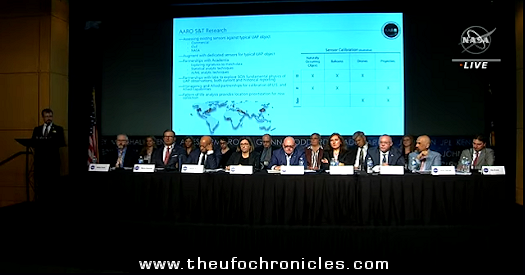
Photo of NASA's live meeting on UAP / UFOs presented by www.theufochronicles.com

NASA held its first ever, live-streamed public meeting yesterday, May 31, 2023, discussing its independent study of unidentified aerial phenomena (UAP / UFOs). The four hour meeting was the first time that NASA has publicly discussed its UAP research in detail.


     The meeting was chaired by David Spergel Ph.D., theoretical astrophysicist and current President of the Simons Foundation. The other 15 members of the UAP / UFO study team, "some of the world's leading scientists, data and artificial intelligence practitioners and aerospace safety experts" were present.

Spergel, initially stated that their mission was "not to resolve the nature of these events," but rather to provide NASA a "roadmap" to guide future analysis. At the same time, before getting into the weeds, not surprisingly—he shared that panel members have been subjected to online abuse.

Dr. Sean M. Kirkpatrick, head of the Pentagon’s, All-domain Anomaly Resolution Office (AARO) was first up and detailed AARO's latest findings.

[...]

Wednesday, May 31, 2023

NASA To Provide Coverage of UFO, UAP Meeting

Illustration by www.theufochronicles.com demonstrating NASA's involvement with UFO research

NASA is holding a public meeting at 10:30 a.m. EDT Wednesday, May 31, of its independent study team on categorizing and evaluating data of unidentified anomalous phenomena (UAP). The agency also will host a media teleconference at the conclusion of the meeting.


      The full meeting [shown in its entirety above] will air on NASA Television, the NASA app, and the agency’s website through 2:30 p.m. Watch online at:

https://www.nasa.gov/live

 NASA defines UAP as observations of events in the sky that cannot be identified as aircraft or known natural phenomena from a scientific perspective. The focus of this public meeting is to hold final deliberations before the agency’s independent study team publishes a report this summer.

Outlining how to evaluate and study UAP by using data, technology, and the tools of science is a NASA priority. It is not a review or assessment of previous unidentifiable observations. The report will inform NASA on what possible data could be collected in the future to shed light on the nature and origin of UAP.

Public Comment


In accordance with the Federal Advisory Committee Act, the meeting includes an opportunity for public comment. NASA will accept questions beginning at 10 a.m. on Friday, May 12, at:

https://nasa.cnf.io/sessions/hh4r/

NASA Media Teleconference


At 3 p.m., NASA will hold a virtual post-meeting media teleconference, which the agency will stream audio live on its website. Participants include:

   • Dan Evans, assistant deputy associate administrator for research, NASA’s Science Mission Directorate
   • David Spergel, president, Simons Foundation and Chair of NASA’s UAP independent study team
   • Other members of the UAP independent study team
To participate by telephone, media must RSVP no later than two hours before the start of the event to Katherine Rohloff at: katherine.a.rohloff@nasa.gov.  

NASA’s media accreditation policy is available online.

The UAP independent study team is a counsel of 16 community experts across diverse areas on matters relevant to potential methods of study for unidentified anomalous phenomena. NASA commissioned the nine-month study to examine UAP from a scientific perspective and create a roadmap for how to use data and the tools of science to move our understanding of UAP forward. Right now, the limited high-quality observations of UAP make it impossible to draw scientific conclusions from the data about the nature of such events.

A clean feed of the meeting will be available on the agency’s YouTube channel.

For more information on NASA’s UAP independent study team, visit:

https://science.nasa.gov/uap/faqs

Wednesday, April 19, 2023

Alleged Alien Probe or Extraterrestrial Artifact To Be Investigated (Video)

Artwork by www.theufochronicles.com showing Alien Probe or Extraterrestrial Artifact Entering Earth's Atmosphere


A "runaway fireball" that crashed into the water off the coast of Papua New Guinea in 2014 could be an alien probe or extraterrestrial artifact similar to U.S. interstellar probes like NASA's "Voyagers," Harvard professor Dr. Avi Loeb told Fox News Digital.

That would be strong potential evidence of alien life.
     The space object crashed into the Bismarck Sea with a percentage of the energy force of the Hiroshima bomb in 2014 and likely traveled "from the deep interior of a planetary system or a star in the thick disk of the Milky Way galaxy," Loeb said.
By Chris Eberhart
Fox News
4-15-23

Thursday, March 09, 2023

Carter's White House Wanted NASA To Establish UFO Panel of Inquiry

Title of article, Carter Wants UFO Probe by he Daily Sentinel published on 11-26-1977

“… what NASA should do about a White House request that it establish a UFO panel of inquiry. The panel would take up where the Air Force left off 10 years ago when it closed its UFO investigation, Project Blue Book.”

     The White House, whose chief occupant once spotted a strange glowing blob in the sky, wants the National Aeronautics and Space Administration to look into reopening the government’s probe of unidentified flying objects.

But NASA officials aren't eager to do it without some solid evidence such as a “little green man,” or at least a piece of metal from a UFO.

“We're not anxious to do it because we're not ure what we can do” said Dave Williamson, NASA assistant for special projects. “It's my personal opinion that it’s not wise to do research on something that is not a measurable phenomena. Spending public money for such research is questionable.

“There is no measurable UFO evidence such as a piece of metal, flesh or cloth. We don’t even have any radio signals,” he said. “A photograph is not a measurement...”

“Give me one little green man — not a theory or memory of one — and we can have a multimillion dollar program,” he said. “It's a scientific dilemma. How do you prove something that doesn't exist?”

“It's like the Loch Ness monster revisited. Everyone sees it, but there is no physical evidence,” he aid.

Williamson heads a group of technical experts who will recommend by the end of the year what NASA should do about a White House request that it establish a UFO panel of inquiry. The panel would take up where the Air Force left off 10 years ago when it closed its UFO investigation, Project Blue Book.

Saturday, October 29, 2022

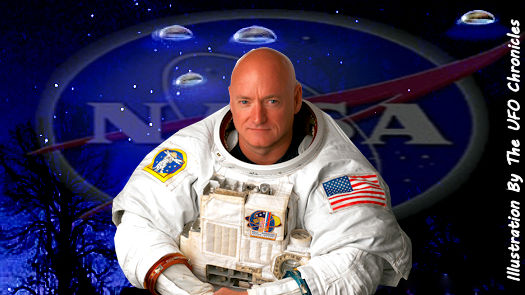
Former Astronaut Scott Kelly Joins NASA UFO Team

Former Astronaut Scott Kelly Joins NASA UFO Team


Do you ever look up into the sky and wonder about your place in the stars? Soon, we may know more about just that.
[...]
     A group of 16 researchers, including retired U.S. Navy captain and astronaut Scott Kelly, will spend the next nine months on a NASA team studying unidentified aerial phenomena, also known as UFOs.
By Jonathan Lehrfeld
www.navytimes.com
10-4-22
Using unclassified data, the team of scientific experts will “lay the groundwork for future study,” according to a NASA press release. The study begins Monday.

Wednesday, October 26, 2022

NASA Announces UAP / UFO Study Team Members

NASA Announces UAP / UFO Study Team Members

     NASA has selected 16 individuals to participate in its independent study team on unidentified aerial phenomena (UAP). Observations of events in the sky that cannot be
By NASA
10-21-22
identified as aircraft or as known natural phenomena are categorized as UAPs. The independent study will begin on Monday, Oct. 24. Over the course of nine months, the independent study team will lay the groundwork for future study on the nature of UAPs for NASA and other organizations. To do this, the team will identify how data gathered by civilian government entities, commercial data, and data from other sources can potentially be analyzed to shed light on UAPs. It will then recommend a roadmap for potential UAP data analysis by the agency going forward. The study will focus solely on unclassified data. A full report containing the team’s findings will be released to the public in mid-2023. “Exploring the unknown in space and the atmosphere is at the heart of who we are at NASA,” said Thomas Zurbuchen, associate administrator of the Science

Mission Directorate at NASA Headquarters in Washington. “Understanding the data we have surrounding unidentified aerial phenomena is critical to helping us draw scientific conclusions about what is happening in our skies. Data is the language of scientists and makes the unexplainable, explainable.”

Unidentified aerial phenomena are of interest for both national security and air safety and the study aligns with one of NASA’s goals to ensure the safety of aircraft. Without access to an extensive set of data, it is nearly impossible to verify or explain any observation, thus the focus of the study is to inform NASA what possible data could be collected in the future to scientifically discern the nature of UAP.

The NASA official responsible for orchestrating the study is Daniel Evans, the assistant deputy associate administrator for research at NASA’s Science Mission Directorate. As previously announced, the independent study team is chaired by David Spergel, president of the Simons Foundation.

“NASA has brought together some of the world's leading scientists, data and artificial intelligence practitioners, aerospace safety experts, all with a specific charge, which is to tell us how to apply the full focus of science and data to UAP,” said Evans. “The findings will be released to the public in conjunction with NASA’s principles of transparency, openness, and scientific integrity.”

The members of NASA’s independent study team on unidentified aerial phenomena are:

• David Spergel was selected to chair NASA’s independent study on unidentified aerial phenomena. He is the president of the Simons Foundation where he was the founding director of its Flatiron Institute for Computational Astrophysics. His interests range from the search for planets and nearby stars to the shape of the universe. He has measured the age, shape and composition of the universe and played a key role in establishing the standard model of cosmology. A MacArthur “Genius” Fellow, Spergel has been cited in publications more than 100,000 times.

• Anamaria Berea is an associate professor of Computational and Data Science at George Mason University in Fairfax, Virginia. She is a research affiliate with the SETI Institute in Mountain View, California, and a research investigator with Blue Marble Space Institute of Science in Seattle. Her research is focused on the emergence of communication in complex living systems and on data science applications in astrobiology, for the science of both biosignatures and technosignatures. She uses a wide range of computational methods to uncover fundamental patterns in the data.

• Federica Bianco is a joint professor at the University of Delaware in the Department of Physics and Astrophysics, the Biden School of Public Policy and Administration and the Urban Observatory. She is a cross-disciplinary scientist with a focus on using data-science to study the universe and find solutions to urban-based problems on earth. She also coordinates more than 1,500 scientists for the 2023 Large Synoptic Survey Telescope Science Collaboration to study the night sky in the southern hemisphere and discover new galaxies and stars. She has been published in more than 100 peer-reviewed papers and received that Department of Energy’s “Innovative Development in Energy-Related Applied Science” grant.

• Paula Bontempi has been a biological oceanographer for more than 25 years. She is the sixth dean and the second woman to lead the Graduate School of Oceanography at the University of Rhode Island (URI). She is also a professor of oceanography at URI. She spent eighteen years at NASA and was appointed acting deputy director of NASA’s Earth Science Division for the Science Mission Directorate. She also led NASA’s research on ocean biology, biogeochemistry, the carbon cycle and ecosystems, as well as many NASA Earth observing satellite missions in marine science. She is a fellow of The Oceanography Society.

• Reggie Brothers is the operating partner at AE Industrial Partners in Boca Raton, Florida. He previously served as CEO and board member of BigBear.ai in Columbia, Maryland. Brothers also was the executive vice president and chief technology officer of Peraton, as well as a principal with the Chertoff Group. Prior to his time in the private sector, he served as the undersecretary for Science and Technology at the U.S. Department of Homeland Security and as Deputy Assistant Secretary of Defense for Research at the Department of Defense. Brothers is also a Distinguished Fellow at Georgetown’s Center for Security and Emerging Technology and he is a member of the Visiting Committee for Sponsored Research at the Massachusetts Institute of Technology (MIT) in Cambridge, Massachusetts.

• Jen Buss is the CEO of the Potomac Institute of Policy Studies in Arlington, Virginia. Before she became CEO, Buss worked extensively with NASA to explore policy issues and strategic planning processes for astronaut medical care and cancer diagnostics and therapeutics. She is nationally recognized as an authority in her field for science and technology trends analysis and policy solutions.

• Nadia Drake is a freelance science journalist and contributing writer at National Geographic. She also regularly writes for Scientific American, and specializes in covering astronomy, astrophysics, planetary sciences, and jungles. She has won journalism awards for her work in National Geographic including the David N. Schramm Award from the High Energy Astrophysics Division of the American Astronomical Society and the Jonathan Eberhart award from the AAS Division of Planetary Sciences. Drake holds a doctorate in genetics from Cornell University.

• Mike Gold is the executive vice president of Civil Space and External Affairs at Redwire in Jacksonville, Florida. Prior to Redwire, Gold held multiple leadership roles at NASA, including associate administrator for Space Policy and Partnerships, acting associate administrator for the Office of International and Interagency Relations and senior advisor to the Administrator for International and Legal Affairs. He led for NASA, jointly with the Department of State, the creation and execution of the Artemis Accords, which established the norms of behavior in space. He also led the negotiation and adoption of binding international agreements for the lunar Gateway, the creation of new planetary protocols and the first purchase by NASA of a lunar resource. Gold was awarded NASA’s Outstanding Leadership Medal for his work in 2020.Additionally, Gold was appointed by the U.S. Secretary of Transportation to serve as Chair of the Commercial Space Transportation Advisory Committee from 2012 until he joined NASA in 2019.

• David Grinspoon is a senior scientist at the Planetary Science Institute in Tuscon, Arizona, and serves as a frequent advisor to NASA on space exploration. He is on science teams for several interplanetary spacecraft missions including the DAVINCI mission to Venus. He is the former inaugural Baruch S. Blumberg NASA/Library of Congress Chair in Astrobiology. His research focuses on comparative planetology especially regarding climate evolution and the implications of habitability on earth-like planets. He was awarded the Carl Sagan Medal by the American Astronomical Society and he is an elected Fellow of the American Association for the Advancement of Science. He is also an adjunct professor of Astrophysical and Planetary Science at the University of Colorado in Boulder, Colorado, as well as Georgetown University in Washington.

• Scott Kelly is a former NASA astronaut, test pilot, fighter pilot, and retired U.S. Navy captain. He commanded the International Space Station Expeditions 26, 45, and 46. He was also the pilot of Space Shuttle Discovery for the third Hubble Servicing Mission. He was selected for a year-long mission to the space station where he set the record at the time for the total accumulated number of days spent in space. Prior to NASA, Kelly was the first pilot to fly the F-14 with a new digital flight control system. He flew the F-14 Tomcat in fighter squadron VF-143 aboard the USS Dwight D. Eisenhower. He is a two-time New York Times bestselling author and was recognized by Time magazine in 2015 as one of the most influential people in the world.

• Matt Mountain is the president of The Association of Universities for Research and Astronomy, known as AURA. At AURA, Mountain oversees a consortium of 44 universities nationwide and four international affiliates who help NASA and the National Science Foundation build and operate observatories including NASA’s Hubble Telescope and James Webb Space Telescope. He also serves as a telescope scientist for Webb and is a member of its Science Working Group. He is the former director of The Space Telescope Science Institute in Baltimore, and the International Gemini Observatory in Hilo, Hawaii.

• Warren Randolph is the deputy executive director of the Federal Aviation Administration’s Accident Investigation and Prevention for Aviation Safety department. He has an extensive background in aviation safety at the Federal Aviation Administration (FAA) and is currently responsible for setting and implementing safety management system principles and using data to inform the assessment of future hazards and emerging safety risks. Prior to the FAA, Randolph served as an aerodynamicist for the U.S. Coast Guard and the U.S. Air Force for multiple flight simulations.

• Walter Scott is the executive vice president and chief technology officer of Maxar in Westminster, Colorado, a space technology company that specializes in earth intelligence and space infrastructure. In 1992, he founded DigitalGlobe which became part of Maxar in 2017. He has held leadership positions at the Lawrence Livermore National Laboratory in Livermore, California and was the president of Scott Consulting. In 2021, he was inducted into the David W. Thompson Lecture in Space Commerce by the American Institute of Aeronautics and Astronautics.

• Joshua Semeter is a professor of electrical and computer engineering as well as the director of the Center for Space Physics at Boston University. At Boston University, he researches interactions between Earth’s ionosphere and the space environment. Activities in Semeter’s lab include the development of optical and magnetic sensor technologies, radar experiment design and signal processing, and the application of tomographic and other inversion techniques to the analysis of distributed, multi-mode measurements of the space environment.

• Karlin Toner is the acting executive director of the FAA’s Office of Aviation Policy and Plans. Previously, she served as the director of the FAA’s global strategy where she led the FAA’s international strategy and managed threats to international civil aviation. Prior to the FAA, Toner served at NASA in multiple leadership positions including director of the Airspace Systems Program at NASA Headquarters. She is a NASA Exceptional Achievement Medal recipient and is an associate fellow for the American Institute of Aeronautics and Astronautics.

• Shelley Wright is an associate professor of physics at the University of California, San Diego’s Center for Astrophysics and Space Studies. She specializes in galaxies, supermassive black holes and building optical and infrared instruments for telescopes using adaptive optics such as integral field spectrographs. She is a Search for Extraterrestrial Intelligence (SETI) researcher and instrumentalist. She is also the principal investigator for the UC San Diego Optical Infrared Laboratory. Previously, she was an assistant professor at the University of Toronto’s Dunlap Institute.