|
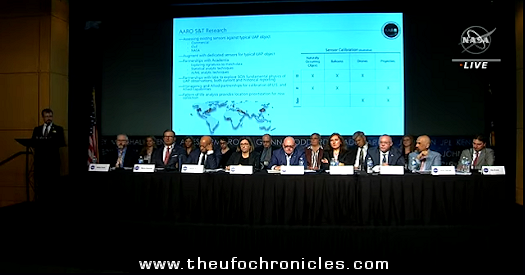
NASA has selected 16 individuals to participate in
its independent study team on unidentified aerial phenomena (UAP).
Observations of events in the sky that cannot be
|
By NASA
10-21-22
|
identified as aircraft or as known natural phenomena are categorized as UAPs.
The independent study will begin on Monday, Oct. 24. Over the course of nine
months, the independent study team will lay the groundwork for future study on
the nature of UAPs for NASA and other organizations. To do this, the team will
identify how data gathered by civilian government entities, commercial data, and
data from other sources can potentially be analyzed to shed light on UAPs. It
will then recommend a roadmap for potential UAP data analysis by the agency
going forward. The study will focus solely on unclassified data. A full report
containing the team’s findings will be released to the public in mid-2023.
“Exploring the unknown in space and the atmosphere is at the heart of who we are
at NASA,” said Thomas Zurbuchen, associate administrator of the Science
Mission Directorate at NASA Headquarters in Washington. “Understanding the
data we have surrounding unidentified aerial phenomena is critical to helping
us draw scientific conclusions about what is happening in our skies. Data is
the language of scientists and makes the unexplainable, explainable.”
Unidentified aerial phenomena are of interest for both national security and
air safety and the study aligns with one of NASA’s goals to ensure the safety
of aircraft. Without access to an extensive set of data, it is nearly
impossible to verify or explain any observation, thus the focus of the study
is to inform NASA what possible data could be collected in the future to
scientifically discern the nature of UAP.
The NASA official responsible for orchestrating the study is Daniel Evans, the
assistant deputy associate administrator for research at NASA’s Science
Mission Directorate. As previously announced, the independent study team is
chaired by David Spergel, president of the Simons Foundation.
“NASA has brought together some of the world's leading scientists, data and
artificial intelligence practitioners, aerospace safety experts, all with a
specific charge, which is to tell us how to apply the full focus of science
and data to UAP,” said Evans. “The findings will be released to the public in
conjunction with NASA’s principles of transparency, openness, and scientific
integrity.”
The members of NASA’s independent study team on unidentified aerial phenomena
are:
• David Spergel was selected to chair NASA’s independent study on
unidentified aerial phenomena. He is the president of the Simons Foundation
where he was the founding director of its Flatiron Institute for
Computational Astrophysics. His interests range from the search for planets
and nearby stars to the shape of the universe. He has measured the age,
shape and composition of the universe and played a key role in establishing
the standard model of cosmology. A MacArthur “Genius” Fellow, Spergel has
been cited in publications more than 100,000 times.
• Anamaria Berea is an associate professor of Computational and Data
Science at George Mason University in Fairfax, Virginia. She is a research
affiliate with the SETI Institute in Mountain View, California, and a
research investigator with Blue Marble Space Institute of Science in
Seattle. Her research is focused on the emergence of communication in
complex living systems and on data science applications in astrobiology, for
the science of both biosignatures and technosignatures. She uses a wide
range of computational methods to uncover fundamental patterns in the data.
• Federica Bianco is a joint professor at the University of Delaware
in the Department of Physics and Astrophysics, the Biden School of Public
Policy and Administration and the Urban Observatory. She is a
cross-disciplinary scientist with a focus on using data-science to study the
universe and find solutions to urban-based problems on earth. She also
coordinates more than 1,500 scientists for the 2023 Large Synoptic Survey
Telescope Science Collaboration to study the night sky in the southern
hemisphere and discover new galaxies and stars. She has been published in
more than 100 peer-reviewed papers and received that Department of Energy’s
“Innovative Development in Energy-Related Applied Science” grant.
• Paula Bontempi has been a biological oceanographer for more than 25
years. She is the sixth dean and the second woman to lead the Graduate
School of Oceanography at the University of Rhode Island (URI). She is also
a professor of oceanography at URI. She spent eighteen years at NASA and was
appointed acting deputy director of NASA’s Earth Science Division for the
Science Mission Directorate. She also led NASA’s research on ocean biology,
biogeochemistry, the carbon cycle and ecosystems, as well as many NASA Earth
observing satellite missions in marine science. She is a fellow of The
Oceanography Society.
• Reggie Brothers is the operating partner at AE Industrial Partners
in Boca Raton, Florida. He previously served as CEO and board member of
BigBear.ai in Columbia, Maryland. Brothers also was the executive vice
president and chief technology officer of Peraton, as well as a principal
with the Chertoff Group. Prior to his time in the private sector, he served
as the undersecretary for Science and Technology at the U.S. Department of
Homeland Security and as Deputy Assistant Secretary of Defense for Research
at the Department of Defense. Brothers is also a Distinguished Fellow at
Georgetown’s Center for Security and Emerging Technology and he is a member
of the Visiting Committee for Sponsored Research at the Massachusetts
Institute of Technology (MIT) in Cambridge, Massachusetts.
• Jen Buss is the CEO of the Potomac Institute of Policy Studies in
Arlington, Virginia. Before she became CEO, Buss worked extensively with
NASA to explore policy issues and strategic planning processes for astronaut
medical care and cancer diagnostics and therapeutics. She is nationally
recognized as an authority in her field for science and technology trends
analysis and policy solutions.
• Nadia Drake is a freelance science journalist and contributing
writer at National Geographic. She also regularly writes for Scientific
American, and specializes in covering astronomy, astrophysics, planetary
sciences, and jungles. She has won journalism awards for her work in
National Geographic including the David N. Schramm Award from the High
Energy Astrophysics Division of the American Astronomical Society and the
Jonathan Eberhart award from the AAS Division of Planetary Sciences. Drake
holds a doctorate in genetics from Cornell University.
• Mike Gold is the executive vice president of Civil Space and
External Affairs at Redwire in Jacksonville, Florida. Prior to Redwire, Gold
held multiple leadership roles at NASA, including associate administrator
for Space Policy and Partnerships, acting associate administrator for the
Office of International and Interagency Relations and senior advisor to the
Administrator for International and Legal Affairs. He led for NASA, jointly
with the Department of State, the creation and execution of the Artemis
Accords, which established the norms of behavior in space. He also led the
negotiation and adoption of binding international agreements for the lunar
Gateway, the creation of new planetary protocols and the first purchase by
NASA of a lunar resource. Gold was awarded NASA’s Outstanding Leadership
Medal for his work in 2020.Additionally, Gold was appointed by the U.S.
Secretary of Transportation to serve as Chair of the Commercial Space
Transportation Advisory Committee from 2012 until he joined NASA in 2019.
• David Grinspoon is a senior scientist at the Planetary Science
Institute in Tuscon, Arizona, and serves as a frequent advisor to NASA on
space exploration. He is on science teams for several interplanetary
spacecraft missions including the DAVINCI mission to Venus. He is the former
inaugural Baruch S. Blumberg NASA/Library of Congress Chair in Astrobiology.
His research focuses on comparative planetology especially regarding climate
evolution and the implications of habitability on earth-like planets. He was
awarded the Carl Sagan Medal by the American Astronomical Society and he is
an elected Fellow of the American Association for the Advancement of
Science. He is also an adjunct professor of Astrophysical and Planetary
Science at the University of Colorado in Boulder, Colorado, as well as
Georgetown University in Washington.
• Scott Kelly is a former NASA astronaut, test pilot, fighter pilot,
and retired U.S. Navy captain. He commanded the International Space Station
Expeditions 26, 45, and 46. He was also the pilot of Space Shuttle Discovery
for the third Hubble Servicing Mission. He was selected for a year-long
mission to the space station where he set the record at the time for the
total accumulated number of days spent in space. Prior to NASA, Kelly was
the first pilot to fly the F-14 with a new digital flight control system. He
flew the F-14 Tomcat in fighter squadron VF-143 aboard the USS Dwight D.
Eisenhower. He is a two-time New York Times bestselling author and was
recognized by Time magazine in 2015 as one of the most influential people in
the world.
• Matt Mountain is the president of The Association of Universities
for Research and Astronomy, known as AURA. At AURA, Mountain oversees a
consortium of 44 universities nationwide and four international affiliates
who help NASA and the National Science Foundation build and operate
observatories including NASA’s Hubble Telescope and James Webb Space
Telescope. He also serves as a telescope scientist for Webb and is a member
of its Science Working Group. He is the former director of The Space
Telescope Science Institute in Baltimore, and the International Gemini
Observatory in Hilo, Hawaii.
• Warren Randolph is the deputy executive director of the Federal
Aviation Administration’s Accident Investigation and Prevention for Aviation
Safety department. He has an extensive background in aviation safety at the
Federal Aviation Administration (FAA) and is currently responsible for
setting and implementing safety management system principles and using data
to inform the assessment of future hazards and emerging safety risks. Prior
to the FAA, Randolph served as an aerodynamicist for the U.S. Coast Guard
and the U.S. Air Force for multiple flight simulations.
• Walter Scott is the executive vice president and chief technology
officer of Maxar in Westminster, Colorado, a space technology company that
specializes in earth intelligence and space infrastructure. In 1992, he
founded DigitalGlobe which became part of Maxar in 2017. He has held
leadership positions at the Lawrence Livermore National Laboratory in
Livermore, California and was the president of Scott Consulting. In 2021, he
was inducted into the David W. Thompson Lecture in Space Commerce by the
American Institute of Aeronautics and Astronautics.
• Joshua Semeter is a professor of electrical and computer
engineering as well as the director of the Center for Space Physics at
Boston University. At Boston University, he researches interactions between
Earth’s ionosphere and the space environment. Activities in Semeter’s lab
include the development of optical and magnetic sensor technologies, radar
experiment design and signal processing, and the application of tomographic
and other inversion techniques to the analysis of distributed, multi-mode
measurements of the space environment.
• Karlin Toner is the acting executive director of the FAA’s Office
of Aviation Policy and Plans. Previously, she served as the director of the
FAA’s global strategy where she led the FAA’s international strategy and
managed threats to international civil aviation. Prior to the FAA, Toner
served at NASA in multiple leadership positions including director of the
Airspace Systems Program at NASA Headquarters. She is a NASA Exceptional
Achievement Medal recipient and is an associate fellow for the American
Institute of Aeronautics and Astronautics.
• Shelley Wright is an associate professor of physics at the
University of California, San Diego’s Center for Astrophysics and Space
Studies. She specializes in galaxies, supermassive black holes and building
optical and infrared instruments for telescopes using adaptive optics such
as integral field spectrographs. She is a Search for Extraterrestrial
Intelligence (SETI) researcher and instrumentalist. She is also the
principal investigator for the UC San Diego Optical Infrared Laboratory.
Previously, she was an assistant professor at the University of Toronto’s
Dunlap Institute.