Showing posts with label Roswell Incident. Show all posts

Wednesday, December 13, 2023

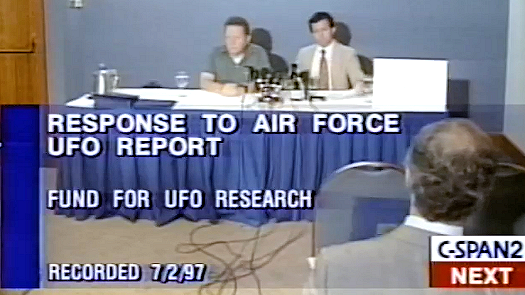
Roswell Incident: Response to UFO Air Force Report - Fund for UFO Research - 1997

Roswell Incident - Response to UFO Air Force Report - Fund for UFO Research - 1997


     Now response to last week's U.S. Air Force report on an alleged U.F.O. crash at Roswell New Mexico in1947. Today a group called the fund for U.F.O. research hosted this 40 minute event at the
By C-SPAN
7-2-1997
National Press Club. They outlined their position on the Roswell incident and the possibility of extraterrestrial life.

Don Berliner: My name is Don Berliner, this is Rob Swiatek. We are both members of the Executive Committee of the Fund for U.F.O. Research. The Fund is a nonprofit corporation set up to support scientific research and educational projects aimed at shedding some light on the U.F.O. mystery. We don't know what U.F.O.'s are. We would like to know. A long term mystery like this must be solved sooner or later. And we want to do our part by mainly by bringing the scientific community into this problem. Our reason for being here today concerns the latest Air Force attempt to explain the July, 1947 Roswell incident. And one of the things that keeps us going is not only the nuts and bolts of U.F.O. sightings, but the increasingly peculiar behavior of the U.S. government, in particular the United States Air Force. This latest report is far and away the least believable of a series of reports the Air Force has issued on this particular aspect of UFOs. Each one intended as a final answer to the question. And obviously not succesful.

Saturday, August 25, 2018

Roswell Documentation vs. Roswell Eyewitnesses

Bookmark and Share

Roswell Documentation vs. Roswell Eyewitnesses

     Since I have now annoyed all my friends with my analysis of the Roswell documentation and how some of it is quite suggestive that nothing alien fell there, I thought it time to annoy all my skeptical friends. Lining up against that documentation is the testimony of some people who were on the scene in 1947. This is based on the documentation we can find about them and the stories they tell us in the world today.

Walter Haut, for example, either wrote the press release claiming the 509th had found a flying saucer, or he took the
Kevin Randle
By Kevin Randle
A Different Perspective
8-18-19
Walter Haut being interviewed.
© Kevin Randle.
dictation from Colonel William Blanchard to create the press release. At this point it doesn’t really matter. The press release was issued and it claimed they had “captured” a flying saucer in the Roswell region. The definition of flying saucer confuses the issue, because in 1947, there was no universally accepted definition. It could mean almost anything you wanted it to mean. But here’s the deal. It is vague to the point of being opaque. We don’t know what it means.

I have never understood the reason for the press release. If Blanchard was attempting to grab credit for solving the flying disk mystery, the press release was unnecessarily obscure. Compare it to the story out of Circleville, Ohio, in which a farmer found the remains of a weather balloon and rawin reflector on his land. We have a story in the local paper that identifies the farmer as Sherman Campbell and includes what is claimed a picture of his wife. When I talked to the family, I learned it was actually his daughter holding the rawin target. The point is that the Circleville newspaper story was clear and it included a photograph. The Roswell press release told us nothing of real importance, provided little in the way of verification and had no photograph.

We do have testimony from Haut, which, if we limit it to what was said in the press release, and what he said to us for decades before expanding his story, we learn that what was found was something strange. No, it tells us nothing about the alien nature of the crash, just tells us that Blanchard and company were perplexed by something they should have been able to identify easily if it was a weather balloon. No reason not to supply the explanation if it was something mundane, like was done in Circleville.

If we wish to get to the extraterrestrial, then there is Edwin Easley, who was the provost marshal (please note the proper spelling of marshal here) in Roswell. When I asked him if we were following the right path, he asked what I meant by that. I told him that we (meaning Don Schmitt and I) believed that the craft had been extraterrestrial. He said, “Well, let me put it this way, it’s not the wrong path.”

Taking that a step farther, he told family members about the alien “creatures.” That was his word to them, not mine. Sure, that statement is second hand at best because we learned it talking to family members, but hey, it does confirm his mindset on this.

No, there is no reason for Easley to have lied about it. He was very reluctant to talk, didn’t grant much in the way of interviews, and you won’t see him showing up in any of the old documentaries. I was always of the impression he wished to help me, but he had taken an oath in 1947 and he wasn’t going to break the oath.

There is Joe Briley, the operations officer in 1947. He said a couple of things that don’t take us directly to the extraterrestrial but do lead us to the highly unusual. He told me, when I mentioned, “…You heard the stories…” that “And then the story was changed immediately. As soon as the people from Washington arrived.”

Jesse Marcel
Jesse Marcel
Yes, it is clear from the conversation on the tape that we’re talking about the UFO crash tale. I really don’t say anything specifically about it, but Briley knew why I had called him. In fact, later in the interview, he told me, “I just was not brought into that at all even though Butch [Blanchard] and I were extremely close.”

And later still, he said, “I don’t think Butch was stupid enough to call a weather balloon something else.”

Okay, this doesn’t get us to the extraterrestrial, but it does move us away from the conventional. It suggests things in Roswell were, well, up in the air in 1947.

I haven’t touched on Jesse Marcel, Sr. yet. He was quite clear in his statements about what had happened. There are any number of videos of him telling us that it was something “that wasn’t built on Earth but it had come to Earth.”

If he was stand alone, we could certainly dismiss his testimony. But it is not and while it is true that he seemed to drift all over the place before he died, he did say some provocative things about what he had seen and had done. These were backed up by his son and his wife. Still, we need to sound a note of caution when dealing with the senior Marcel.

Bill Brazel and Don Schmitt on the debris field
Before this gets too long, let’s move onto Bill Brazel. Here was another man extremely reluctant to talk about what he had seen. He did find a few scraps of the material that his father, Mack, described as having come from “that contraption I found.”

This debris included something that resembled fiber optics, a lead foil that seemed to have a memory, returning to its original shape when crumpled, and something that was as light a balsa but with a strength that rivaled steel. Although he lost the debris to Air Force personnel in 1949, he did show it to several others including Sallye Tadolini. Some of these witnesses, who handled the debris have affidavits about it.

Of course, Mack had shown a bit of the debris to Floyd and Loretta Proctor. She told me about the fire-resistant capabilities of the material. She mentioned, as did Marian Strickland, that Mack had been held by the military authorities for a number of days.

And I don’t want to forget Bill Rickett, the CIC NCOIC in Roswell in July 1947. He talked about his trip to see the crash site, some of the debris that he saw there, and some of the people on the scene including Sheridan Cavitt and Edwin Easley.

Karl Pflock
Karl Pflock
Here I could mention Frankie Rowe who wasn’t lying about what she said. True, she is second hand, having heard about the crash and the creatures from her father, fire fighter Dan Dwyer. But her sister confirmed the story and ironically, one of the fire fighters who Karl Pflock interviewed and used to dismiss the story, actually told me, that Dwyer had gone to the crash site in his private car. The fire fighter, C.J. Smith, told me about Dwyer’s trip when I asked, simply, “Did you know Dan Dwyer.” Smith’s response was, “He went out there in his car.”

These are some of the things that I think about when I’m not worrying about the documents that I mentioned in the last post. Most of the people mentioned here, and a dozen or two more that I could have brought up argue against the documents conclusion. While it is true that a few people might be inventing their tales, and we’ve had more than our share of them, there are some very solid people who had talked about their involvement. If I’m willing to concede some points based on the documentation, it seems only right that those at the other end of the spectrum admit that there are some disturbing testimonies. They all aren’t lying, looking for their fifteen minutes, and just wishing to have an interesting story to tell.

Oh, and before this degenerates into another long discussion about the foibles of human memory… yeah, I get it. But not all memories are flawed and inaccurate. Many times, the person gets the facts right as has been shown by numerous scientific investigations, and yes, I know about Elizabeth Loftus’ work on false memory. Her work demonstrates how such memories can be created, so we don’t really have to talk about that. We just have to remember that sometimes, the person relating the tale has the details right, was actually there, and is telling the truth as best he or she can…

Monday, August 20, 2018

The Decline of Roswell - Pt 2

Bookmark and Share

The Decline of Roswell - Pt 2

     Over the last several days I have received a number of comments, privately, about my post, “The Decline of Roswell.” What is disturbing about it is that many people missed the most important part. They focused on the statement by Colonel Howard McCoy to The Science Advisory Board about his wishing one would crash. But, that is not the critical comment.

To recap, briefly. Those who follow this blog know that a while back I mentioned that Captain Edward Ruppelt, in a briefing he conducted in the early 1950s, had mentioned the lack of
Kevin Randle
By Kevin Randle
A Different Perspective
8-18-18
Captain Edward Ruppelt
recovered crash debris. But Ruppelt had no need to know if there was crash recovered debris from earlier investigations. His mission was the investigation of sightings reported to the Air Force, and the gathering of what might be considered essential items of intelligence. He could do his job without being told that debris had been recovered from a crash. His statement isn’t particularly troubling, given the circumstances and his position in the UFO investigations.

There was another document, a top-secret report entitled Air Intelligence Report No. 100-203-79 and dated December 10, 1948, with a second version dated April 28, 1949. The officers responsible for it make no mention of crash recovered debris. But the officers involved suggested there could have been some project or information that would have explained everything about the flying saucers if a free flow existed. In other words, this report doesn’t exclude Roswell, given that the officers didn’t have access to everything, as they themselves, noted.

Lieutenant General Nathan Twining, in a letter he wrote on September 23, 1947, mentioned the lack of crash recovered debris. It might be important to know that the letter was probably written by McCoy for Twining’s signature. But the information used to form the opinion had been supplied by Lieutenant Colonel George Garrett through Brigadier General George Schulgen. The sightings and information supplied by Garrett contained no references to crash recovered material. Twining could accomplish his goal without referring to crash recovered debris and would have no motive for adding that information to his letter. The reference in the letter was about the lack of debris in the supporting documentation supplied, not actually saying that no such debris existed. It doesn’t close the Roswell door at all.

Then there was the quote from the Science Advisory Board in which McCoy said that they wished one would crash. The problem is that the information in the briefing was classified only as secret and some of the participants might not have held top secret clearances. Besides, we run into that pesky “need to know.” In other words, this is not the fatal bullet to the Roswell case, given the circumstances.

The real problem and the one that has been basically ignored by the various commentators here and in other arenas is McCoy’s letter to the Chief of Staff of the Air Force on November 3, 1948. It was a long letter discussing flying saucers. This was a recap of what they knew, or thought they knew about the “Flying Objects,” according to the documentation available. In paragraph 8, McCoy wrote:
The possibility that the reported objects are vehicles from another planet has not been ignored. However, tangible evidence to support conclusions about such a possibility are completely lacking (I have highlighted this because of its importance).
Colonel Howard McCoy
Colonel Howard
McCoy
This is the deadliest of the quotes. Because of who McCoy was, I believe that he would have known about any recovered crash debris. He had been running the unofficial UFO investigation until the Arnold sighting in June, 1947, when it became more of an official study. He was on the inside from the very beginning, and he was a key member of Twining’s primary staff.

The second real problem here is that McCoy would have no expectation that this letter would be seen by anyone other than those to which it was addressed and it was going to the top guy in the Air Force, especially since FOIA didn’t exist then. As I mentioned, he wouldn’t dare lie. If there had been a crash, he was writing to those who would know about it; more importantly these were the people who had to know about it because they would be directing policy. They might not have all the minutia of the crash or what had been learned by the reverse engineering, but they would know that there had been a crash of something that was highly unusual. They would know that this was a craft that had not been build on Earth.

When we look at those first few examples about a lack of crash debris, we can, I believe, with intellectually honest candor, suggest that this does not close the door on Roswell. There are cracks in those documents. But the last one, by McCoy, is the one we must look at carefully. There is very little wiggle room here. McCoy either didn’t know or he was lying to the Chief of Staff of the Air Force. Since it is clear that he wouldn’t lie to the top officer in the Air Force, we are left with the idea he just didn’t know. This seems to be preposterous. McCoy was in the inner circle…

That leads us to the conclusion, based solely on the documentation from that time frame that the answer to the Roswell crash does not lie with the stars.

There is, of course, always the possibility that there is missing information. And, we have to look at the testimony from those who seemed to have no reason to lie about this from Bill Brazel to Edwin Easley to Loretta Proctor and a dozen other low-ranking military men and to the civilians who lived in the area.

I can say, without fear of contradiction, that something fell near Corona, New Mexico in July 1947. The question is still, “What was it?” The answer, today, is less clear than it was a decade ago. All I can say is that this one letter from McCoy worries me greatly and it should worry anyone else who believes that Roswell has an alien solution.

Thursday, August 16, 2018

The Decline of Roswell

Bookmark and Share

The Decline of Roswell

     Back in 1988, when Don Schmitt and I began our investigation into the Roswell case, there were no documents available, other than newspaper articles and a single report from the FBI. The newspaper reports were less than accurate with misspellings of names, and descriptions of the debris. The FBI document, which was based on an interview with Major Kirton (misspelled as Curtan in the FBI report) suggested that the object found was a weather balloon and a radar reflector. It also mentioned that this analysis was not verified by other sources.
Kevin Randle
By Kevin Randle
A Different Perspective
8-11-18

It is unclear in the report if the FBI called the 8th Air Force to find out what was happening or if Kirton had called the FBI to tell them about the recovery. Given the timing of the telex and breaking news, it is more likely that Kirton had called the FBI. That actually isn’t overly important here. I just thought I would mention it as an interesting observation.

Neither the newspaper articles nor the FBI telex do anything to help us understand the Roswell case. There is too little information in them for any conclusive analysis. We are left with questions about the identity of the object found and both the telex and the newspapers can be used to support almost any explanation for Roswell.

But that isn’t the whole story and here I will probably annoy my pals who accept Roswell as an alien spacecraft crash, and may even offend those who believe the answer can be found somewhere on Earth. Since Don and I began our work, other documents have surfaced and been brought into the discussion.

One the first, which was published in its entirety in The MUFON UFO Journal for July 1985, is a top-secret report entitled Air Intelligence Report No. 100-203-79 and dated December 10, 1948. There is another version of it, or rather the same report, but it is dated April 28, 1949. Neither version of this report makes mention of crash recovered debris, and in fact, says that the origin of the objects cannot be determined. The thinking is that the men responsible for the report, who had top security clearances, would have been able to learn about the Roswell crash had it happened. Since they make no reference to it, this is circumstantial evidence that there wasn’t a crash.

There was a caveat in that report. The officers involved suggested that there needed to be better communication among the military branches to ensure a free flow of information. There could have been some project or information that would have explained everything about the flying saucers if such a free flow existed. In other words, this doesn’t exclude Roswell.

Colonel Howard McCoy
Karl Pflock, among others, found another document that reported on the Scientific Advisory Board Conference held on March 17 – 18, 1948, in the Pentagon. Colonel Howard McCoy was discussing Project Sign, the number of reports they had received, suggesting that there was something important going on. He said, “I can’t tell you how much we would give to have one of those crash in an area so that we could recover whatever they are.”

McCoy was the intelligence officer at Wright Field and the Air Materiel Command. He was Nathan Twining’s intelligence officer. If there had been a crash near Roswell, McCoy would have been involved in the study or reverse engineering of anything recovered. In fact, McCoy had been involved in the first of the investigations of unidentified aerial phenomena starting with the Foo Fighters in WW II. He was the guy who knew everything about them and was, you might say, Twining’s “go to guy.” If there had been a crash he would have known about it.

Nathan Twining
General Nathan F. Twining
There are those who say, me among them, that had Roswell involved the crash of an alien spacecraft, it would have been classified top secret. Given that, McCoy was restricted from mentioning this in a briefing that was only classified as secret and some of the participants in it might not have held the proper security clearances to hear top secrets.

But I have always worried about that analysis. While he might not be able to discuss a crash in a conference that was only secret, I wondered why bring it up at all. If none of the participants was thinking in terms of a crash, he had just planted the idea in their minds. True, he had told them that nothing had been recovered and if you know something doesn’t exist, you are not inclined to look for it. Still this was not a good idea. He planted the seed.

This wasn’t the only time that McCoy had brought up the possibility of crash debris. In a letter sent up the chain of command, to those who would have held the proper security clearances and who would have had the need to know. He expressed the same thought. Crash recovered debris would go a long way to answering questions about the identity of the flying saucers.

McCoy sent that letter to the Chief of Staff on November 3, 1948, discussing flying saucers. This was a recap of what they knew, or thought they knew about the “Flying Objects.” In paragraph 8, McCoy wrote:
The possibility that the reported objects are vehicles from another planet has not been ignored. However, tangible evidence to support conclusions about such a possibility are completely lacking.
This becomes more worrisome. McCoy would have no expectation that this letter would be seen by anyone other than those to which it was addressed and it was going to the top guy in the Air Force. He wouldn’t be telling stories out of school and he wouldn’t dare lie. If there had been a crash, he was writing to those who would know about it; more importantly these were the people who had to know about it. They might not have all the specifics, but they would know that there had been a crash of something that was highly unusual. They would know that the craft had been built somewhere else, meaning not on Earth. McCoy would have no reason to lie to them about a crash because of who he was addressing in the letter.

Here's where we stand on this. The documentation that does exist, that came from identified government sources, signed by the men involved who we are able to vet, suggest that they know nothing of crash recovered debris. Being who they were and what their jobs were, they would have known and the discussion would take a different track.


For those believing Roswell involved the crash of an alien spacecraft, this has to be worrisome. It is arrayed against testimony that suggests otherwise. The problem is that it is just testimony and over the years much of that testimony has been found to be inaccurate. The longer we investigate the more of these testimonies have fallen by the wayside.

There is some compelling testimonial evidence of a crash but there is this documentation that suggests otherwise. While that documentation might not completely close the door, it is certainly narrowing the possibility. As I say, for those of us who do attempt to look at all the evidence, this is quite worrisome.

Monday, February 22, 2016

Darwin Rasmussen and the Roswell Bodies

Bookmark and Share

Darwin Rasmussen and the Roswell Bodies

     In keeping with my series on Chasing Footnotes, I have found a subtopic that is almost as interesting (well, it is to me) which is finding original sources (which, of course, is sort of the same thing). Not all that long ago I ran across an analysis of the Roswell case in which it was claimed that Captain Darwin Rasmussen (later Colonel) had assisted Major Jesse Marcel in recovering the alien bodies. I have never heard anything like that and it puzzled me because, as far as I knew, only Stan Friedman and I had interviewed Rasmussen’s cousin, Elaine Vegh.

By Kevin Randle
A Different Perspective
2-20-16

Now that you all are thoroughly confused, let me explain. Back in 1990, I learned of Elaine Vegh whose claim to fame in this arena was that her first cousin, Darwin Rasmussen, had been a career Air Force officer who was stationed in Roswell in 1947. According to her, she had been standing near her father when Rasmussen reportedly said, “…never doubt that there is a cover up here. We did pick up bodies and the Air Force does have them.”

She also said, “He had seen what was picked up. He had seen the craft.”

First, before the skeptics all go nuts, let me point out that this is a second-hand story of an overheard conversation that had taken place at least a decade and a half prior to that. As evidence of anything, it isn’t worth very much. Elaine Vegh was probably relating the story as best she could remember, but see didn’t see anything herself and her memory of this is somewhat clouded… I’ll get back to this.

That was really all she said to me. Her cousin had been part of a retrieval team; he had seen bodies and the wrecked craft. She had nothing in the way of evidence, there are or were no family letters or documents, and according to Vegh, Rasmussen said, “I was there… but we were told to forget what we saw…”

Well, Rasmussen’s picture is not in the Yearbook, but that doesn’t matter. I have a copy of the Roswell base telephone directory published in August 1947, and his name is in there. That puts him in Roswell at the right time. I also found his name associated with a 509th flight crew.

Second, this little tale has not been used very often. Friedman seems to have ignored it, and given everything, I’m not overly surprised. It is second hand without any corroboration. Rasmussen died in 1975 and Vegh’s father died in 1983. No one else heard the conversation and there wasn’t much in the way of detail.

Yes, I used it in UFO Crash in Roswell and Tom Carey and Don Schmitt used it in Witness to Roswell, interestingly without providing credit for the interview. Their footnote just mentioned an interview in 1990 (March 1, 1990 to be precise) but failed to mention that I conducted it, taped it, and supplied a copy to Don. Anyone reading their book might conclude they had conducted the interview.
There was a reference to Rasmussen and what he had seen here.

In this case, it was suggested that Rasmussen had seen four bodies and Vegh did say that he, Rasmussen "... had first hand knowledge of four beings and their craft..." Here Rasmussen is described as the Operations Officer for the 715th Bomb Squadron which was part of the 509th. The referenced sources here are both UFO Crash at Roswell and Witness to Roswell. In Witness to Roswell he is described as a flight operations officer and in UFO Crash at Roswell as an Operations Officer (and unfortunately the organization is misidentified as the 718th). I have since located some records that showed he was assigned to an aircrew as a radar officer for Operation Crossroads. That information, which does not relate to Roswell, can be seen here.

Another reference found retold the story, clearly from UFO Crash at Roswell, but the text does identify the source, and it comes back to me. It adds nothing to it until that recent note that injected Jesse Marcel into it by someone else.

I can find nothing to explain where the idea came that Rasmussen had mentioned Marcel. Tracing the tale to the source, which is probably me given that Friedman didn’t use it, I know that Vegh did not say that to me. The conclusion that I draw is that someone somewhere just assumed that Marcel would have been involved and injected him into a tale in which his name had not surfaced. In Witness to Roswell Carey and Schmitt argue that Marcel had to have seen the bodies so it is not a large step to Marcel and Rasmussen being together at some point. This, I believe, is an assumption made by them but is not based on any testimony.

And finally let’s talk about that clouded memory. Vegh had said that she had overheard the story when she was 10 or 12. In 1990, and I’m sure she would be annoyed for me saying this, she was 62. She also said that she had graduated from high school in 1945… which means that, if she had the timing right, this had nothing to do with Roswell…

That’s a point she figured out later as we discussed this. I mentioned that the crash was in 1947 (is that such a big secret that I should have kept it to myself… and oh, she had seen the Unsolved Mysteries broadcast before we spoke so I wasn’t giving away anything and we had talked about the date throughout the interview) she said, “I graduated high school in 1945 so I must have been little older.”

So, we see that her original memory was of her overhearing this when she was younger was inaccurate, and I’m not sure that’s the real problem here. Misremembering her age seems fairly trivial in the overall scheme of things. The real problem is the lack of corroboration for the story. True, her cousin was in Roswell at the right time, and since he died in 1975, this would have been before all the Roswell information came out (she didn’t mention it until 1990 remember) but there is just nothing here we can prove. It is a story with almost no real foundation, told by a sincere woman who clearly believes it, but it is also told by a woman who did not accurately remember her age at the time. This tale is one of those little bits of trivia that seem to dot the Roswell landscape.

Saturday, February 06, 2016

Former Astronaut Edgar Mitchell Has Died


Bookmark and Share

Former Astronaut Edgar Mitchell Has Died

By www.palmbeachpost.com
2-5-16

     Astronaut Edgar D. Mitchell, who was part of the Apollo 14 space crew that flew to the moon in 1971, died late Thursday in West Palm Beach, according to his family.

Mitchell, 85, lived in suburban Lake Worth and died at a local hospice at about 10 p.m. Thursday, his daughter, former West Palm Beach City Commissioner Kimberly Mitchell told The Palm Beach Post. [...]

Wednesday, December 23, 2015

Stanton Friedman Argues The Case for UFOs on The Shulman File | VIDEO

Bookmark and Share
Stanton Friedman Argues The Case for UFOs on The Shulman File

By The Evergreens Project
YouTube
3-14-13

     Editor's Note: Stanton Friedman appeared on the The Shulman File (1977 – 1983 Canadian CITY-TV) to discuss UFOs with host, Morton Shulman; the latter’s bias is evident in the interview. Stan gets kudos for keeping his composure and staying on point–FW

Saturday, September 19, 2015

Who Told Walter Haut about the Rowell Debris Field?


Bookmark and Share

Walter Haut

By Kevin Randle
A Different Perspective
9-12-15

     Since this debate about the press release has gained a little traction here, I thought I’d add a few facts and perspective to see if we can’t reach some sort of a reasonable conclusion. We do have a great deal of information and while some of it is in dispute, there are aspects of it on which we all seem to agree.

Jesse Marcel Sr (Young)
Major Jesse Marcel, Sr.
Given the testimony we have and the articles that appeared in the newspapers of the time,it seems that Major Jesse Marcel, Sr. and Captain Sheridan Cavitt followed Mack Brazel out to the ranch sometime on Sunday July 6. Marcel, in his interview with Linda Corley suggested they had left in the early afternoon, but I think it was more likely they headed out later in the day. In today’s world, it takes about three hours to drive from Roswell to the ranch. In 1947 the roads wouldn’t have been quite so good and the route might not have been quite so direct. It might have taken four or five hours. With sunset coming sometime around 9:00 p.m., and Marcel’s suggestion they arrived about dusk, it seems they might not have left Roswell much before four in the afternoon.

There is also a question of where they stayed the night. We had heard that it was the “Hinds” house which in the 1990s was a one-room shack that was used to store hay. It was some five or six miles from the actual debris field. If, on the other had they stayed at the ranch house (which, I believe had been, at the very least, remodeled in the 1980s or so) then they were some fifteen or twenty miles from the debris field.

The Hinds House Near the Debris Field

Marcel said that they had cold beans and crackers for dinner. He said nothing about the time they might have gotten up the next morning which is July 7. We know, ironically, based on the Mogul records that sunrise was about five and in similar circumstances, meaning outside my comfort zone, that I would have awakened about dawn. Marcel said nothing about breakfast, what time they got up, or what they did before they went out to look at the debris field.

Don Schmitt & Bill Brazel
Bill Brazel showing us the Debris Field
Given all this, I would suspect that they arrived at the field no earlier than eight, but hell, that’s a wild ass guess. If I was Marcel or Cavitt, I’d want to get home as quickly as possible, so the earlier, the better. As I said in another post, Brazel saddled two horses and he and Cavitt rode out while Marcel drove his car. If they were at the Hines house, the travel time might have been thirty to sixty minutes. If they were farther north, at the location of the ranch house, travel time could have been longer. No one asked about that and there is no one to ask in the world today. All we can do is guess based on other timing.

Marcel said that the debris field was three-quarters to a mile long and a couple of hundred feet wide. Bill Brazel, when he took us out to the field showed us basically where it started and where it ended. We later measured that at about a mile long. This was based on what Brazel said was the length of the gouge, which is a detail that Marcel never mentioned.

Sheridan Cavitt
Sheridan Cavitt
We have no idea how long they spent on the field. Cavitt told Colonel Richard Weaver that he recognized the debris as the remains of a weather balloon

immediately, but no one asked Cavitt why he hadn’t mentioned that to either Marcel or to Blanchard. (I will note here that according to what Cavitt told me, he hadn’t been there… this was after he had given his interview to Weaver.) Anyway, Marcel eventually told Cavitt to head on back to the base. He stayed, and according to what Marcel told Corley, stuffed his car with the debris, which, of course, suggests something more than a weather balloon.

As I’ve said, I don’t understand how they could have spent more than an hour or so at the field, but if they were walking the whole thing to make sure they saw everything around there, it might have taken longer. I have no idea how long it might have taken Marcel to load his car, and we have no information if they had eaten breakfast. I mention this simply because if Marcel, on his way home, stopped for lunch, then that adds time to the trip. Again, according to what Marcel told Corley, he got home late, but we don’t know exactly what that means either. All we really know is that Marcel did not go out to the base that night. He went in the next morning, that is, July 8.

Walter Haut (Young)
Walter Haut
So now we come to the point of this long recap. How did Walter Haut learn about the debris recovery? Haut said that Blanchard had called him and either dictated the press release to him or gave him the major points and Haut wrote it. Marcel

said that they had an “eager beaver” press officer which tells us nothing about how Haut learned about the recovery or if he made a habit of issuing press releases on his own.

Here are a few facts that are new. Based on information in the Roswell airfield telephone directory, I know that Blanchard’s office was in building 810. Marcel had his office in building 31 and Haut’s office was in building 82. What this means is that Haut wouldn’t have run into Marcel in the hallway or near a coffeepot as they came to work or went about their duties. There is no evidence that they would have mingled in a professional sense other than both would have been in attendance at the staff meetings but Marcel would have been considered a member of the primary staff and Haut on the secondary. That means Haut’s job was not essential to the main operation of the bomb group but that Marcel’s was.

So again the question that must be asked is, “How did Haut learn about the recovery?”

And the only answer that works is that Blanchard told him. Cavitt, as the counterintelligence guy would not have wanted to talk to the PIO, nor would he want to be associated with any sort of investigation that would call attention to him, his subordinates or his duties. In fact, in 1947, even his rank was classified so that no one knew what rank any of the counterintelligence guys held or as Cavitt said to me, “You didn’t really want anyone to know that a sergeant was investigating a colonel so our ranks were classified. No one knew what rank we were.” The exception to that would have been Blanchard and some of the senior officers but not many.

Although Marcel lived on the same street as Haut, their houses were a few blocks apart and it seems they didn’t socialize that much. Since they worked in separate buildings, there is very little chance that they ran into each other on the morning of July 8 so that Marcel could tell Haut that he had picked up the debris. Even if they had met, it is unlikely that the topic would have come up. Marcel would have been reluctant to talk about it given the nature of his job. If you had no need to know, then you were outside the loop.

That leaves us with Blanchard. Haut told us that Blanchard called him and told him to issue the press release. Blanchard was the one to make that decision and Blanchard was the only one who had the information and the contact with Haut. There were only three people who knew about the recovery (and I exclude Brazel here because on that morning he was still at the ranch) and two of them wouldn’t have said a word about it to Haut if for no other reason than they wouldn’t have seen him that morning.

I think that we can now end the discussion of who authorized the press release. Without Blanchard telling Haut about the recovery and providing details, Haut wouldn’t have had the information. If Blanchard gave him the information, then it was a tacit approval of the press release. If Blanchard had not dictated it to him but only gave him the basic information, Haut could easily have called back to read him the final draft but, no matter how you slice it, Blanchard is the common denominator here.

I can see no other way, given the facts, which Haut would have learned about the recovery. He could not decide on his own to write the story because he didn’t know about it. He was given the information by Blanchard and told to issue the press release. This should stop the endless speculation about Haut issuing the release on his own.

Wednesday, September 09, 2015

The Roswell [Flying Saucer] Press Release and Colonel Blanchard (Pt II)

RAAF Captures Flying Saucer On Ranch in Roswell Region

By Kevin Randle
A Different Perspective
9-5-15

      I often assume a level of knowledge on the parts of those who visit here and shouldn’t do that. I thought the last posting was clear but there are questions that seem to transcend the point of that post. With that in mind, here is some clarification for everyone.

There were some variables that I have ignored. First was the timing of the story told by Brigadier General Thomas DuBose. We all believed that the flight made by Colonel Al Clark was on Sunday afternoon, but that might not be right. At the moment, this isn’t important to understanding the last post and I mention it only so that everyone is aware that DuBose had said that Clark made his flight to Washington, D.C. on Sunday, July 6, 1947 or on the same day that Mack Brazel went into Roswell. This is something that is the subject of another post.

The accepted timeline is that Brazel drove into Roswell on Sunday and eventually made his way to Sheriff George Wilcox, who in turn, called the base. That call eventually made its way to Major Jesse Marcel, though thinking about it, Wilcox would have been more familiar with Major Edwin Easley, the provost marshal, or the “chief of police” out at the base. Thinking about it further, and given the circumstances, it would be more logical for Wilcox to call Easley… Marcel might have been brought in if Easley was not immediately available. Remember, this is speculation on my part and something that I mention with trepidation. (And let’s not forget that we do have photographs in Brigadier General Roger Ramey’s office on July 8.)

Marcel said that he had been eating lunch in the Officer’s Club when he got the telephone call from Wilcox. Marcel would say that he met with the sheriff, saw the material that Brazel had brought in with him and returned to the base. He spoke with the commanding officer, Colonel William Blanchard, who mentioned that they now had the counterintelligence guys there and he, Marcel, should take one of them with him.

Marcel and Sheridan Cavitt met at the sheriff’s office, Marcel in his POV (privately owned vehicle, which is the military term for your car) and Cavitt, apparently in a military vehicle. They then followed Brazel to the ranch. Given all the moving around, it would seem that they probably left (note the qualification) around five in the afternoon, but Marcel would say later that it was early afternoon. They got out to the ranch about dusk, according to Marcel, which was too late for them to explore the debris field.

The next morning Brazel saddled a couple of horses and he and Cavitt rode out to the site. Marcel drove in his car and given the terrain, that wouldn’t have been all that difficult. I have driven cars cross country in that area, so Marcel could have easily done it.

They spent the morning out there, and given the descriptions of the debris field, I can’t see what they would have been doing for more than an hour or so. Marcel told Cavitt to head back in, so it would seem that Brazel and Cavitt rode back to their cars and Cavitt would have returned to Roswell. Marcel loaded his car with debris, or according to what he told Linda Corley in 1981, “I loaded my ’42 Buick to the hilt with it and I came on home cause I was late getting home.”

At this point we have the sheriff who had apparently seen some of the debris on Sunday, Marcel and Cavitt following Brazel to the ranch on Sunday afternoon, and then all of them out on the debris field on Monday, July 7. They spent time out there and eventually all leave, with Marcel getting home late on Monday.

Marcel, in the interview with Corley said, “…I brought some of the stuff and put it in the kitchen… So I put a lot of stuff on the floor in the kitchen. One thing I don’t remember is whether I picked up or you [Marcel’s wife] and Jesse picked it up and put it back in my car. Cause I didn’t get back to the base that night [emphasis added].”

Jesse Marcel holding a mock-up of the I-beam he saw in 1947.
This suggests that at the time Marcel didn’t see anything that suggested to him that it was alien in nature. Unusual yes, but metallic debris is basically metallic debris and if you don’t have something more than that, it is impossible to make the leap to the extraterrestrial. Marcel would tell Corley about a beam that was small and squared, not like the tiny I-beam described by his son. They agreed that it was small and that there were pinkish/purplish figures on it. He mentioned the foil that he said couldn’t be winkled and had said that it was about the thinness of the foil in a pack of cigarettes. He had found a piece that was about two feet long.

Marcel told Corley, “He [a fellow who worked for Marcel] said, ‘You see this piece of metal? ... I tried to bend it, tried to mark on it. You can’t mark it.’ … He took a sixteen pound sledgehammer and put the piece of metal on the ground and he hit it like that and it bounced off.” Marcel pointed the cigarette pack again and said that the foil was as thin as that.

Anyway, according to Marcel, he got home late, but that could easily mean that rather than arriving at five or six in the evening, he got there are seven or eight. He had nothing that caused him to believe he needed to go to the base that evening. Instead, according to this testimony given to Corley, he waited until the next morning. He might have alerted Blanchard that he was back and Blanchard told him to wait until morning.

Given my experience, realizing that it began some twenty years later, I would think that Marcel would have driven out to the base no later than seven-thirty the next morning. It was certainly fairly early and he would have reported to Blanchard, taking him samples of the material. Remember, this is 1947, and people aren’t thinking in terms of an alien spacecraft. Reading the newspapers of late June and early July, 1947, there are hints, but most of the speculation revolves around terrestrial-based technology. It might be Soviet, it might be the Navy, it might be something from White Sands, or it might be some kind of other experiment but no one really thought it was from outer space.

We can speculate that there was a lot of classified message traffic going into the Roswell base; most of it would have been routinely destroyed when it was no longer valid. A purging of the files of classified would be accomplished on a regular basis, eliminating that material that was not relevant to the operation of the 509th Bomb Group. Nothing nefarious there. All military facilities that receive classified material routinely destroy it as it is superseded and no longer useful. There might have been messages about the flying disks, but they would have been informational rather than offering much in the way of explanation. Some of that might not have been classified but those messages are long gone. There is no way to verify what was being transmitted.

There would have been nothing going into Roswell to suggest there was anything classified about these flying saucers at that point. The newspapers were filled with stories about them including explanations for them. The case out of Circleville, Ohio, is important to our discussion, because it suggests some sort of metallic material having been recovered, but again, it was nothing of a classified nature.

The Circleville story struck me as important, not only because everyone there seemed able to identify the balloon for what it was while those in Roswell could not but also because it suggested that what they had wasn’t all that extraordinary. Blanchard, maybe having seen that story, but certainly having seen many of the others printed in the newspapers of the time, issued his press release about capturing a flying saucer.

Given all that, Blanchard called Haut (Marcel certainly wouldn’t have thought to call the public relations guy) and either read to him a press release or gave him the information to write it himself according to what Haut would tell me later. Haut then passed it around Roswell where both George Walsh and Frank Joyce put it on their respective news wires.

At this point nothing was classified. It was just some rubble recovered in a rancher’s pasture seventy or so miles northwest of Roswell. It was unusual material, but no one was talking about anything classified, and even if you wish to bring in Mogul, that material, if it was what had been found, was not classified. Nobody was violating regulations at this point.

For those who believe Roswell was alien, it would be clear that the second site where there was a craft and bodies was found sometime after the press release had been delivered. It seems, based on the documentation, that about fifteen minutes or so after Walsh received the press release, he put it on the wire. It was then too late to recall it, if that had been in their minds.

The answer to the question about Marcel and Blanchard compromising classified information seems to be that they didn’t. At the time they acted, nothing was classified and they did what they thought to be the best thing to do. Blanchard thought they had a partial though mundane answer to the flying saucer mystery and ordered the press release. It was later that they received other, better information, but by that time the high headquarters had taken over. I think this covers the questions that are being asked. It does address some of the concerns and makes sense. Blanchard just wanted people to know that the Army was on top of things and had pieces of one. The press release was designed to make the Army look good to the public and he couldn’t have envisioned the explosion of interest in the topic or the direction some research would take. He just thought he was doing something important for the community.