Showing posts with label Roswell Debris Field. Show all posts

Tuesday, October 06, 2015

The Size of the 'Roswell Debris Field'

Rowell Debris Field - Circa Early 1990's
The Debris Field as identified by Bill Brazel as it appeared in the early 1990s. (© Kevin Randle)

By Kevin Randle
A Different Perspective
9-30-15

      Since I posted the article that suggested that Bessie Brazel’s testimony might be in error and that it was contradicted by that given by so many others, we have been all over the board. Nearly everyone was selecting that data which tended to support their position and ignore everything else. So, I thought I would take some of those points and provide the data available about them. I realize that some of you are so far to one side or the other that any sort of compromise is impossible, but for those who are interested in all the information, I will try to publish a series of articles that look at some aspect of this case.

First, I’ll tackle the size of the debris field because it seems to range from a square mile down to an area about 200 feet in diameter. That’s quite a big difference, and I know that we’ll never reach a consensus, but heck; we might have a little fun and learn something by accident.

The testimonies given after 1978 which is when Jesse Marcel, Sr. was identified as having recovered pieces of a flying saucer provide some of the data. Marcel himself told Bill Moore (The Roswell Incident, p. 63) that it was “about three quarters of a mile long and a couple of hundred feet wide.”

Stan Friedman, in his book, Crash at Corona (p.10) wrote of Marcel’s description, “The area covered with wreckage was roughly three quarters of a mile long and several hundred yards wide.”

Moore also quotes Walt Whitmore, Jr. as giving a description. Whitmore hadn’t seen the field before the Army cleaned it up, according to his testimony at that time. Moore wrote (p. 89), “Several days later Whitmore, Jr., ventured out to the site and found a stretch of about 175 – 200 yards of pastureland uprooted in a sort of fan-like pattern with most of the damage at the narrowest part of the fan.”

Whitmore told Karl Pflock (p. 154), “The debris covered a fan- or roughly triangle-shaped area, which was about 10 or 12 feet wide at what I thought was the top end. From there it extended about 100 to 150 feet, widening out to about 150 feet at the base. This area was covered with many, many bits of material.”

Bill Brazel, who hadn’t seen the debris in the field except for the small pieces he said he had found, also talked of a gouge that ran through the pasture. He said that it was narrow at one end spread out toward the center and then narrowed again. Although he didn’t give us a length of the gouge, he eventually took us to what he thought of as the top of the gouge. Later, during the CUFOS archaeological dig there, we measured down from that point, about three quarters of a mile, placing little flags along the way.

Bud Payne, who was a judge in New Mexico, said that he had been out to the debris field but had been turned back by the military cordon. He did get close to it and this would be irrelevant, except he took me out to the location he thought was the debris field. When he stopped his vehicle and we got out, I nearly stepped on one of those little flags we had placed there. We have attempted to gather them all but had missed the last one. Payne took me to the same three quarter of a mile stretch of New Mexico desert and through this provided, to a degree, the size of the field.

And, of course, there is the testimony in the affidavit signed by Bessie Brazel. She said, “There was a lot of debris scattered sparsely over an area that seems to me now to have about the size of a football field [or about an acre].”

The most widely quoted size of the field is that given by Marcel. It can be found in a number of books but as noted here, it is traceable to that interview supplied to Bill Moore.

We are told, of course, that these memories are decades old and might be unreliable. Studies of memory and how it works suggest that confabulation (as opposed to lying) can often fill in gaps in memory, that each time a memory is accessed it is subject to alteration, and sometimes the memories simply no longer exist, yet the witness (I can think of no other word that fits here because they were involved in 1947) as he or she concentrates begins to put together a story that seems plausible.

We do have quite a few newspaper stories that were written in 1947, literally within hours of some of the men walking the fields, so that their memories should be clear and accurate. I say this knowing full well that some of the information given to the reporters was less than accurate and some of it that was published had been misunderstood.

The Roswell Daily Record, for example, reported, “The rubber [from the debris] was smoky gray in color and scattered over an area about 200 yards in diameter.”

The Fort Worth Star-Telegram, in a later edition of their “Disc-overy Near Roswell Identified as Weather Balloon by FWAAF Officer,” reported, “Brazell [sic], whose ranch is 30 miles from the nearest telephone and has no radio, knew nothing about flying discs when he found the broken remains of the weather device scattered over a square mile of his land.”

The Albuquerque Tribune, in a story attributed to Jason Kellahin on July 9 reported, “Scattered with the materials over an area about 200 yards across were pieces of gray rubber.”

What does this tell us about the size of the debris field? Not much, actually. Those who wish to believe it was small, have several sources they can quote. Cavitt, in his interview with Colonel Richard Weaver didn’t provide a very vivid account of the size. He said that it was about twenty feet, but the statements were somewhat confusing. He might have been describing what he suspected was the size of the object or he might have been describing the distribution of the debris. He told Weaver, “Some here, some here, some here. No concentration of it. No marks on the ground, dug up, anything hidden or anything like that, just out on the territory around the bottom of New Mexico…”

I don’t believe Whitmore’s testimony on this is reliable but suspect there was some collusion between Max Littell of the Roswell museum and Whitmore to come up with some debris, no matter what it was. They talked about creating a display in Roswell, but I don’t believe that Littell had thought that through. If Whitmore’s debris were pieces of a balloon, as he suggested to Pflock, then the mystique of the Roswell case eroded at that point and not many people would drive out of the way to look at a museum dedicated to a weather balloon.

Whitmore had told Moore that the site had been cleaned before he got there but contradicted that when he told Pflock that he saw the debris and even claimed to have some of it. The debris had been locked in his safe deposit box, but when the box grew too full, he moved the debris to his “junk room.” Although searches were made, nothing was ever found. It was just one more bit of debris that vanished.

There is Jesse Marcel’s testimony about the size of the field which he gave after 1978, but there is one story that provides some corroboration which was published in 1947. In Linda Corley’s book, Marcel said, “It was about a mile long and several hundred feet wide of debris.”

Brazel, according to one newspaper account agreed with that size, saying it was scattered over a square mile of the land. This was in a story other than the one written by J. Bond Johnson.

Returning to the Roswell Daily Record, Brazel, it seems, was saying that the debris field was about 200 yards in diameter and the Albuquerque Tribune changed the wording to 200 yards across which is not quite the same thing but is close. The by-line on the Albuquerque Tribune story, as noted, was by Kellahin, so he was apparently working from his notes made in Roswell.

All this means is that if you are a skeptic, you have some evidence that the size of the debris field was relatively small. If you are a believer, you have some evidence that the debris field is relatively large. You have the majority of the testimonies suggesting a large field from the record after 1978 but Bessie Brazel suggests it was about 100 yards by 50 yards, or about the size of a football field.

Or, in other words, this is a wash. Whatever side you come down on, there is testimony to support it. Not exactly a profound finding but just an observation that suggests there are facts for everyone to cherry pick.

Saturday, September 19, 2015

Who Told Walter Haut about the Rowell Debris Field?


Bookmark and Share

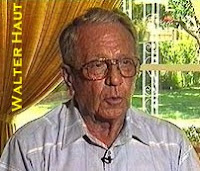
Walter Haut

By Kevin Randle
A Different Perspective
9-12-15

     Since this debate about the press release has gained a little traction here, I thought I’d add a few facts and perspective to see if we can’t reach some sort of a reasonable conclusion. We do have a great deal of information and while some of it is in dispute, there are aspects of it on which we all seem to agree.

Jesse Marcel Sr (Young)
Major Jesse Marcel, Sr.
Given the testimony we have and the articles that appeared in the newspapers of the time,it seems that Major Jesse Marcel, Sr. and Captain Sheridan Cavitt followed Mack Brazel out to the ranch sometime on Sunday July 6. Marcel, in his interview with Linda Corley suggested they had left in the early afternoon, but I think it was more likely they headed out later in the day. In today’s world, it takes about three hours to drive from Roswell to the ranch. In 1947 the roads wouldn’t have been quite so good and the route might not have been quite so direct. It might have taken four or five hours. With sunset coming sometime around 9:00 p.m., and Marcel’s suggestion they arrived about dusk, it seems they might not have left Roswell much before four in the afternoon.

There is also a question of where they stayed the night. We had heard that it was the “Hinds” house which in the 1990s was a one-room shack that was used to store hay. It was some five or six miles from the actual debris field. If, on the other had they stayed at the ranch house (which, I believe had been, at the very least, remodeled in the 1980s or so) then they were some fifteen or twenty miles from the debris field.

The Hinds House Near the Debris Field

Marcel said that they had cold beans and crackers for dinner. He said nothing about the time they might have gotten up the next morning which is July 7. We know, ironically, based on the Mogul records that sunrise was about five and in similar circumstances, meaning outside my comfort zone, that I would have awakened about dawn. Marcel said nothing about breakfast, what time they got up, or what they did before they went out to look at the debris field.

Don Schmitt & Bill Brazel
Bill Brazel showing us the Debris Field
Given all this, I would suspect that they arrived at the field no earlier than eight, but hell, that’s a wild ass guess. If I was Marcel or Cavitt, I’d want to get home as quickly as possible, so the earlier, the better. As I said in another post, Brazel saddled two horses and he and Cavitt rode out while Marcel drove his car. If they were at the Hines house, the travel time might have been thirty to sixty minutes. If they were farther north, at the location of the ranch house, travel time could have been longer. No one asked about that and there is no one to ask in the world today. All we can do is guess based on other timing.

Marcel said that the debris field was three-quarters to a mile long and a couple of hundred feet wide. Bill Brazel, when he took us out to the field showed us basically where it started and where it ended. We later measured that at about a mile long. This was based on what Brazel said was the length of the gouge, which is a detail that Marcel never mentioned.

Sheridan Cavitt
Sheridan Cavitt
We have no idea how long they spent on the field. Cavitt told Colonel Richard Weaver that he recognized the debris as the remains of a weather balloon

immediately, but no one asked Cavitt why he hadn’t mentioned that to either Marcel or to Blanchard. (I will note here that according to what Cavitt told me, he hadn’t been there… this was after he had given his interview to Weaver.) Anyway, Marcel eventually told Cavitt to head on back to the base. He stayed, and according to what Marcel told Corley, stuffed his car with the debris, which, of course, suggests something more than a weather balloon.

As I’ve said, I don’t understand how they could have spent more than an hour or so at the field, but if they were walking the whole thing to make sure they saw everything around there, it might have taken longer. I have no idea how long it might have taken Marcel to load his car, and we have no information if they had eaten breakfast. I mention this simply because if Marcel, on his way home, stopped for lunch, then that adds time to the trip. Again, according to what Marcel told Corley, he got home late, but we don’t know exactly what that means either. All we really know is that Marcel did not go out to the base that night. He went in the next morning, that is, July 8.

Walter Haut (Young)
Walter Haut
So now we come to the point of this long recap. How did Walter Haut learn about the debris recovery? Haut said that Blanchard had called him and either dictated the press release to him or gave him the major points and Haut wrote it. Marcel

said that they had an “eager beaver” press officer which tells us nothing about how Haut learned about the recovery or if he made a habit of issuing press releases on his own.

Here are a few facts that are new. Based on information in the Roswell airfield telephone directory, I know that Blanchard’s office was in building 810. Marcel had his office in building 31 and Haut’s office was in building 82. What this means is that Haut wouldn’t have run into Marcel in the hallway or near a coffeepot as they came to work or went about their duties. There is no evidence that they would have mingled in a professional sense other than both would have been in attendance at the staff meetings but Marcel would have been considered a member of the primary staff and Haut on the secondary. That means Haut’s job was not essential to the main operation of the bomb group but that Marcel’s was.

So again the question that must be asked is, “How did Haut learn about the recovery?”

And the only answer that works is that Blanchard told him. Cavitt, as the counterintelligence guy would not have wanted to talk to the PIO, nor would he want to be associated with any sort of investigation that would call attention to him, his subordinates or his duties. In fact, in 1947, even his rank was classified so that no one knew what rank any of the counterintelligence guys held or as Cavitt said to me, “You didn’t really want anyone to know that a sergeant was investigating a colonel so our ranks were classified. No one knew what rank we were.” The exception to that would have been Blanchard and some of the senior officers but not many.

Although Marcel lived on the same street as Haut, their houses were a few blocks apart and it seems they didn’t socialize that much. Since they worked in separate buildings, there is very little chance that they ran into each other on the morning of July 8 so that Marcel could tell Haut that he had picked up the debris. Even if they had met, it is unlikely that the topic would have come up. Marcel would have been reluctant to talk about it given the nature of his job. If you had no need to know, then you were outside the loop.

That leaves us with Blanchard. Haut told us that Blanchard called him and told him to issue the press release. Blanchard was the one to make that decision and Blanchard was the only one who had the information and the contact with Haut. There were only three people who knew about the recovery (and I exclude Brazel here because on that morning he was still at the ranch) and two of them wouldn’t have said a word about it to Haut if for no other reason than they wouldn’t have seen him that morning.

I think that we can now end the discussion of who authorized the press release. Without Blanchard telling Haut about the recovery and providing details, Haut wouldn’t have had the information. If Blanchard gave him the information, then it was a tacit approval of the press release. If Blanchard had not dictated it to him but only gave him the basic information, Haut could easily have called back to read him the final draft but, no matter how you slice it, Blanchard is the common denominator here.

I can see no other way, given the facts, which Haut would have learned about the recovery. He could not decide on his own to write the story because he didn’t know about it. He was given the information by Blanchard and told to issue the press release. This should stop the endless speculation about Haut issuing the release on his own.