Showing posts with label Colonel William Blanchard. Show all posts

Wednesday, March 11, 2026

Roswell Revisited - Are UAPs Nuclear Sentinels? (Pt. 2)

Roswell Revisited - Are UAPs Nuclear Sentinels? Pt. 2 - www.theufochronicles.com © All Rights Reserved
3-9-2026


     Roswell Army Air Base was located 150 air miles from Sandia Base, south of Albuquerque, the lab where nuclear weapons were being developed and assembled. In July 1947, as the two key nuclear installations conducted joint operations, a startling event occurred halfway between them.
By David Marks
The UFO Chronicles
© All Rights Reserved
3-11-2026

Near the village of Corona, a rancher reported wreckage from a strange crashed aircraft. An intelligence team from Roswell assessed the site and collected debris, reporting back to the base Commander, Colonel William Blanchard. On July 8, 1947, with his consent, the press officer issued a news release:

The many rumors regarding the flying discs became a reality yesterday when the intelligence office of the 509th (atomic) Bomb Group of the 8th Air Force, Roswell Army Air Field, was fortunate enough to gain possession of a disc through the cooperation of one of the ranchers and the sheriff's office of Chaves County. The flying object landed on a ranch near Roswell sometime last week. Not having phone facilities, the rancher stored the disc until such time as he was able to contact the sheriff's office, who in turn notified Jesse A Marcel of the 509th Bomb Group Intelligence Office. Action was immediately taken and the disc was picked up at the rancher's home. It was inspected at the Roswell Army Air Field and subsequently loaned by Major Jesse Marcel to higher headquarters.

The Roswell Daily Record published the spectacular headline: RAAF Captures Flying Saucer On Ranch In Roswell Region. The coverage was picked up by the national and international press.© The UFO Chronicles. All rights reserved.

Thursday, March 05, 2026

Are UFOs, UAPs Nuclear Sentinels? (Pt. 1)

Are UAPs Nuclear Sentinels - www.theufochronicles.com


New evidence confirms what military witnesses have reported since the dawn of the nuclear age: unidentified aerial phenomena (UAP) have been monitoring humanity's most dangerous weapons. With the last arms control treaty expiring and an increase in the number of nuclear warheads worldwide, government denial of these incursions poses an existential risk.

Missouri Congressman Eric Burlison has said, "Without jeopardizing legitimate national-security interests, our government should be as forthcoming as possible with the American people about what it knows about UAP.” New Mexico Senator Martin Heinrich has supported legislation urging government transparency, stating, "Americans don’t want speculation on UAP; they want answers."

The insistence of an increasing number of leaders for disclosure reflects a growing trend in public interest. This analysis demonstrates why the topic needs to be brought to light.


The Destroyer Of Worlds

Spanish Conquistadors named a desolate basin in southern New Mexico with prophetic insight: the Jornada del Muerto—Dead
By David Marks
The UFO Chronicles
3-5-2026
Man's Journey. In the summer of 1945, in the middle of this barren stretch of desert, humanity crossed a threshold from which there was no return.

At 5:29 on the morning of July 16, a hundred-foot steel tower at the White Sands Proving Ground held aloft a device conceived by physicists experimenting with the building blocks of reality. Soldiers and scientists lay face-down behind concrete barricades six miles away, eyes squeezed shut against the coming inferno.

The tower vanished in a brilliant flash visible for hundreds of miles, including above the planet. At that moment, the largest man-made explosion that had ever occurred embodied Einstein's equation—atoms transformed into fire like a newborn sun. The desert sand melted into jade-green glass, spreading in every direction.

Wednesday, September 09, 2015

The Roswell [Flying Saucer] Press Release and Colonel Blanchard (Pt II)

RAAF Captures Flying Saucer On Ranch in Roswell Region

By Kevin Randle
A Different Perspective
9-5-15

      I often assume a level of knowledge on the parts of those who visit here and shouldn’t do that. I thought the last posting was clear but there are questions that seem to transcend the point of that post. With that in mind, here is some clarification for everyone.

There were some variables that I have ignored. First was the timing of the story told by Brigadier General Thomas DuBose. We all believed that the flight made by Colonel Al Clark was on Sunday afternoon, but that might not be right. At the moment, this isn’t important to understanding the last post and I mention it only so that everyone is aware that DuBose had said that Clark made his flight to Washington, D.C. on Sunday, July 6, 1947 or on the same day that Mack Brazel went into Roswell. This is something that is the subject of another post.

The accepted timeline is that Brazel drove into Roswell on Sunday and eventually made his way to Sheriff George Wilcox, who in turn, called the base. That call eventually made its way to Major Jesse Marcel, though thinking about it, Wilcox would have been more familiar with Major Edwin Easley, the provost marshal, or the “chief of police” out at the base. Thinking about it further, and given the circumstances, it would be more logical for Wilcox to call Easley… Marcel might have been brought in if Easley was not immediately available. Remember, this is speculation on my part and something that I mention with trepidation. (And let’s not forget that we do have photographs in Brigadier General Roger Ramey’s office on July 8.)

Marcel said that he had been eating lunch in the Officer’s Club when he got the telephone call from Wilcox. Marcel would say that he met with the sheriff, saw the material that Brazel had brought in with him and returned to the base. He spoke with the commanding officer, Colonel William Blanchard, who mentioned that they now had the counterintelligence guys there and he, Marcel, should take one of them with him.

Marcel and Sheridan Cavitt met at the sheriff’s office, Marcel in his POV (privately owned vehicle, which is the military term for your car) and Cavitt, apparently in a military vehicle. They then followed Brazel to the ranch. Given all the moving around, it would seem that they probably left (note the qualification) around five in the afternoon, but Marcel would say later that it was early afternoon. They got out to the ranch about dusk, according to Marcel, which was too late for them to explore the debris field.

The next morning Brazel saddled a couple of horses and he and Cavitt rode out to the site. Marcel drove in his car and given the terrain, that wouldn’t have been all that difficult. I have driven cars cross country in that area, so Marcel could have easily done it.

They spent the morning out there, and given the descriptions of the debris field, I can’t see what they would have been doing for more than an hour or so. Marcel told Cavitt to head back in, so it would seem that Brazel and Cavitt rode back to their cars and Cavitt would have returned to Roswell. Marcel loaded his car with debris, or according to what he told Linda Corley in 1981, “I loaded my ’42 Buick to the hilt with it and I came on home cause I was late getting home.”

At this point we have the sheriff who had apparently seen some of the debris on Sunday, Marcel and Cavitt following Brazel to the ranch on Sunday afternoon, and then all of them out on the debris field on Monday, July 7. They spent time out there and eventually all leave, with Marcel getting home late on Monday.

Marcel, in the interview with Corley said, “…I brought some of the stuff and put it in the kitchen… So I put a lot of stuff on the floor in the kitchen. One thing I don’t remember is whether I picked up or you [Marcel’s wife] and Jesse picked it up and put it back in my car. Cause I didn’t get back to the base that night [emphasis added].”

Jesse Marcel holding a mock-up of the I-beam he saw in 1947.
This suggests that at the time Marcel didn’t see anything that suggested to him that it was alien in nature. Unusual yes, but metallic debris is basically metallic debris and if you don’t have something more than that, it is impossible to make the leap to the extraterrestrial. Marcel would tell Corley about a beam that was small and squared, not like the tiny I-beam described by his son. They agreed that it was small and that there were pinkish/purplish figures on it. He mentioned the foil that he said couldn’t be winkled and had said that it was about the thinness of the foil in a pack of cigarettes. He had found a piece that was about two feet long.

Marcel told Corley, “He [a fellow who worked for Marcel] said, ‘You see this piece of metal? ... I tried to bend it, tried to mark on it. You can’t mark it.’ … He took a sixteen pound sledgehammer and put the piece of metal on the ground and he hit it like that and it bounced off.” Marcel pointed the cigarette pack again and said that the foil was as thin as that.

Anyway, according to Marcel, he got home late, but that could easily mean that rather than arriving at five or six in the evening, he got there are seven or eight. He had nothing that caused him to believe he needed to go to the base that evening. Instead, according to this testimony given to Corley, he waited until the next morning. He might have alerted Blanchard that he was back and Blanchard told him to wait until morning.

Given my experience, realizing that it began some twenty years later, I would think that Marcel would have driven out to the base no later than seven-thirty the next morning. It was certainly fairly early and he would have reported to Blanchard, taking him samples of the material. Remember, this is 1947, and people aren’t thinking in terms of an alien spacecraft. Reading the newspapers of late June and early July, 1947, there are hints, but most of the speculation revolves around terrestrial-based technology. It might be Soviet, it might be the Navy, it might be something from White Sands, or it might be some kind of other experiment but no one really thought it was from outer space.

We can speculate that there was a lot of classified message traffic going into the Roswell base; most of it would have been routinely destroyed when it was no longer valid. A purging of the files of classified would be accomplished on a regular basis, eliminating that material that was not relevant to the operation of the 509th Bomb Group. Nothing nefarious there. All military facilities that receive classified material routinely destroy it as it is superseded and no longer useful. There might have been messages about the flying disks, but they would have been informational rather than offering much in the way of explanation. Some of that might not have been classified but those messages are long gone. There is no way to verify what was being transmitted.

There would have been nothing going into Roswell to suggest there was anything classified about these flying saucers at that point. The newspapers were filled with stories about them including explanations for them. The case out of Circleville, Ohio, is important to our discussion, because it suggests some sort of metallic material having been recovered, but again, it was nothing of a classified nature.

The Circleville story struck me as important, not only because everyone there seemed able to identify the balloon for what it was while those in Roswell could not but also because it suggested that what they had wasn’t all that extraordinary. Blanchard, maybe having seen that story, but certainly having seen many of the others printed in the newspapers of the time, issued his press release about capturing a flying saucer.

Given all that, Blanchard called Haut (Marcel certainly wouldn’t have thought to call the public relations guy) and either read to him a press release or gave him the information to write it himself according to what Haut would tell me later. Haut then passed it around Roswell where both George Walsh and Frank Joyce put it on their respective news wires.

At this point nothing was classified. It was just some rubble recovered in a rancher’s pasture seventy or so miles northwest of Roswell. It was unusual material, but no one was talking about anything classified, and even if you wish to bring in Mogul, that material, if it was what had been found, was not classified. Nobody was violating regulations at this point.

For those who believe Roswell was alien, it would be clear that the second site where there was a craft and bodies was found sometime after the press release had been delivered. It seems, based on the documentation, that about fifteen minutes or so after Walsh received the press release, he put it on the wire. It was then too late to recall it, if that had been in their minds.

The answer to the question about Marcel and Blanchard compromising classified information seems to be that they didn’t. At the time they acted, nothing was classified and they did what they thought to be the best thing to do. Blanchard thought they had a partial though mundane answer to the flying saucer mystery and ordered the press release. It was later that they received other, better information, but by that time the high headquarters had taken over. I think this covers the questions that are being asked. It does address some of the concerns and makes sense. Blanchard just wanted people to know that the Army was on top of things and had pieces of one. The press release was designed to make the Army look good to the public and he couldn’t have envisioned the explosion of interest in the topic or the direction some research would take. He just thought he was doing something important for the community.

The Roswell [Flying Saucer] Press Release and Colonel Blanchard

RAAF Captures Flying Saucer On Ranch in Roswell Region

By Kevin Randle
A Different Perspective
9-5-15

      I’ve been thinking about this press release issued by Colonel Blanchard that has the skeptics in such turmoil and I must confess worries me a bit as well. There just doesn’t seem to be any logic in it if we start with the premise that they thought they were finding parts of an alien spacecraft on the debris field.

But as I was driving across Nebraska, which is fairly boring, I got to thinking about this and what the press release actually said. The terminology is important and the lack of any real detail is also important. If we look at what was said about what was found on the ranch managed by Mack Brazel and what was seen by Jesse Marcel, Sr. and Sheridan Cavitt, we might be able to figure some of this out.

For those unfamiliar with what the press release said, this is the Associated Press version based on the information supplied by Walter Haut:
Roswell, N.M. – The army air forces here today announced a flying disc had been found on a ranch near Roswell and is in army possession.

The Intelligence office reports that it gained possession of the ‘Dis:’ [sic] through the cooperation of a Roswell rancher and Sheriff George Wilson [sic] of Roswell.

The disc landed on a ranch near Roswell sometime last week. Not having phone facilities, the rancher, whose name has not yet been obtained, stored the disc until such time as he was able to contact the Roswell sheriff’s office.

The sheriff’s office notified a major of the 509th Intelligence Office.

Action was taken immediately and the disc was picked up at the rancher’s home and taken to the Roswell Air Base. Following examination, the disc was flown by intelligence officers in a superfortress (B-29) to an undisclosed “Higher Headquarters.”

The air base has refused to give details of construction of the disc or its appearance.

Residents near the ranch on which the disc was found reported seeing a strange blue light several days ago about three o’clock in the morning.
According to the best evidence available today, Brazel found a field that was covered in metallic debris a few days before heading into Roswell. He provided almost no descriptions of it but did want to know who was going to clean up the mess. Tommy Tyree, a sometimes ranch hand working for Brazel, explained that the material was so tightly packed that the sheep refused to cross it but that doesn’t tell us much about the density. All we know is that the material, and I’ll guess some of it stirring in the wind, frightened the sheep. There was enough of it to make it a chore to collect. Jesse Marcel, Sr., would later suggest that it was an area that was about three quarters of a mile long and a couple of hundred feet wide. Bill Brazel would talk about a gouge through the center of the area that was a half mile or so long which tells us nothing about the amount of debris but does suggest something about the length of the debris field.

We know, based on the records, that Brazel did drive into Roswell to talk with the sheriff and that the sheriff contacted the Roswell Army Air Field. Jesse Marcel, along with Sheridan Cavitt accompanied Brazel back to the ranch, arriving late in the day. It was too late that night to go out to the field, so they made that trip the next morning according to Marcel. Cavitt, according to what he told Colonel Richard Weaver, went out with Bill Rickett, his NCOIC, and thought that Marcel might have gone out with them (and it is here we see some of the trouble with memories that are decades old).

Marcel said that he, Cavitt and Brazel went out the next morning and gathered some of the debris. Marcel said that he told Cavitt to head back to the base and he would stay, though I don’t know why he would have done that. Marcel said that he filled his car with the debris and that he then drove back to Roswell.

And here we encounter the beginnings of the real problems. Even if Marcel moved slowly, it shouldn’t have taken no more than an hour to fill his car, and even if he drove slowly back to Roswell, it shouldn’t have taken no more than four or five hours, which would seem to put him in town in the early evening at the latest. Which, of course, suggests that he didn’t have to wake up his wife and son to show them the debris, which, according to Jesse Marcel, Jr., his father called a “flying saucer.” He might have stopped at the house to show them what he had found because it was parts of what he thought of as a flying saucer and for that reason it was mildly interesting. Flying saucer didn’t necessarily mean alien spacecraft at the time, though that was certainly one of the interpretations, one of the least likely of the interpretations, given the tone of most newspaper and radio reports.

The Circleville Flying Saucer
Now, here is what I’m thinking about this. On July 6, 1947, newspapers around the country carried the story of a flying disk recovered in the Circleville, Ohio area by a farmer, Sherman Campbell. Pictures of it were published in the newspapers, including one with Campbell’s daughter holding up what are clearly parts of a rawin radar reflector. Campbell identified it as did the local sheriff and newspaper reporters. Campbell though if it was high aloft with the wind causing the reflective surface to spin, it might look like a disk from the ground.

I don’t know if they saw or heard this story in the Roswell area, but it was national news and it certainly offered a plausible answer for some of the flying saucer/flying disk reports. Some sort of strange metallic debris with a nearly intact radar target had been found in Ohio. This might have suggested something to Blanchard.

So Marcel shows up early the next morning (which in the military wouldn’t have been all that early when you remember that flight operations as well as other tasks might start at four or five in the morning) and I would guess somewhere around seven or seven-thirty. According to what he would later say, and given the descriptions of the material recovered provided by Bill Brazel, Loretta Proctor, Bud Payne and Tommy Tyree, there wasn’t much in the way of diversity. They had some light weight wood that had the density of balsa, some wires that Bill Brazel suggested were like monofilament fishing line but that would transmit light, some foil and some parchment. Nothing to suggest an alien spacecraft, only some materials that were sort of familiar but a little bit different and nothing that would suggest any sort of identification. Besides all that, we have Cavitt telling Weaver that it was all a balloon (though Cavitt told me personally in 1991 that he had been too busy in July 1947 to go chasing balloons).

Blanchard probably (and note the qualification) looked at the debris, thought it nothing all that extraordinary but would be something that might be associated with the flying saucer stories. As far as he was concerned, there was nothing classified about the material. They hadn’t found a craft. They hadn’t found bodies. There was nothing to suggest that it was a project from White Sands or an experimental aircraft that had crashed. It was just a field filled with metallic debris… strange debris to be sure but nothing that would lead to the conclusion that it was extraterrestrial.

If Blanchard was aware of the report from Circleville, that might have inspired him to order Haut to issue the press release. Even if he hadn’t seen that story, he had certainly seen many others. Given the time, that is July 1947, few of the explanations suggested interplanetary craft as opposed to interstellar. Scientists, military officers and government officials were offering their take on the sightings but there was certainly nothing that was classified about it. Blanchard’s message center would have been receiving directions and intelligence about a wide variety of subjects on a daily if not hourly basis but I doubt that much space was wasted on flying saucers in those early days.

What this means is that on the morning of July 8, when Blanchard ordered Walter Haut to issue the press release, they weren’t dealing with classified material. They were dealing with some strange debris found by a rancher. They might not have known exactly what it was, but they weren’t thinking in terms of classified material. This explains the press release because it demonstrates that Blanchard was telling the local community they had found elements that might have been part of a flying saucer, whatever that might have meant at that time.

And it explains Marcel taking the material home to show his wife and son. In fact, given the nature of the debris, Marcel might not have felt it necessary to report it to Blanchard until the next morning. He stopped at his house, not necessarily to show them the debris, but because it was on his way to the base, the duty day was over, and there was nothing classified or critical in his possession. He could wait until the morning.

This would, of course, alter the various timelines created about these events, but it doesn’t change anything radically. All it does is provide an answer for why the press release was issued and why Marcel took the material home to show his wife and son. At that point nothing was classified. That would come later, when additional wreckage was found, but at that precise moment, they were dealing with the mundane and not the extraordinary.

Thursday, July 19, 2012

Former Nuclear Weapons Expert Was Told Roswell UFO Recovery Involved an Alien Craft


Robert Hastings By Robert L. Hastings
www.ufohastings.com
© 9-20-09 – 2012
     Persons familiar with my three decades of research on the UFO-Nukes Connection know that declassified U.S. Air Force, FBI and CIA documents, as well as eyewitness testimony from ex-Air Force personnel, confirm an intermittent but ongoing UFO presence at America’s nuclear weapons sites. Indeed, some of the former/retired Minuteman missile launch and targeting officers I have interviewed unequivocally state that, on a few occasions, those piloting the unidentified craft actually knocked our ICBMs off-line,
at least temporarily.

(See http://www.nicap.org/babylon/missile_incidents.htm)

Furthermore, as I and other researchers have noted, there also appears to be a link between nuclear weapons and the world-famous Roswell Incident.

At the time of the alleged UFO crash, in July 1947, nearby Roswell Army Airfield was home to the world’s only atomic bomber squadron, the 509th Bombardment Group. Only two years earlier, in August 1945, the elite unit had destroyed the Japanese cities of Hiroshima and Nagasaki, effectively ending World War II. In July 1946, the squadron participated in Operation Crossroads, involving two atomic bombing exercises conducted in the Marshall Islands in the Pacific. By the summer of 1947, the 509th was routinely engaged in training designed to prepare it for future atomic conflict with America’s new postwar enemy, the Soviets.

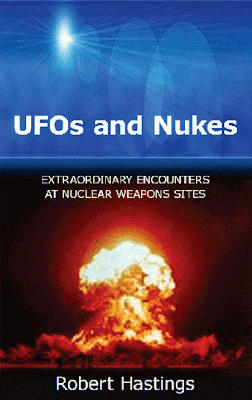
UFOs and Nukes By Robert HastingsConsidering the great many nuclear weapons-related UFO sightings which have come to light—as described in various declassified documents and the military eyewitness testimony found in my book UFOs and Nukes—the atomic bombardment squadron aspect of the Roswell Incident is perhaps not that surprising.

Fortunately, a former, high-level nuclear weapons specialist has now provided dramatic, hitherto unknown information about the controversial case. In 1998, I conducted a taped interview with former Atomic Energy Commission (AEC) supervisor Chester “Chet” W. Lytle Sr., whose work in the early 1950s put him in the right place, at the right time, to hear a very interesting story about Roswell. Lytle told me that he was “absolutely” certain that the mysterious object secretly recovered in the New Mexico desert was an alien spacecraft. According to Lytle, the unimpeachable source of this information was none other than William H. Blanchard, the commander of Roswell Army Airfield at the time of the incident.

Atom Bomb Detonation Trinity Site, Alamogordo Test Range 7-16-1945But we are getting ahead of ourselves. During World War II, Chet Lytle had provided engineering support for the seminal Manhattan Project, which produced the first atomic bomb. His company, Lytle Engineering, was secretly contracted by the U.S. Army to design and manufacture the explosive “lenses” used on the tower-mounted device detonated near Alamogordo, New Mexico, on July 16, 1945. The disc-shaped lenses uniformly focused a conventional high explosive blast inward, thereby crushing the two halves of the bomb’s plutonium core into a single “critical mass” and triggering a nuclear chain-reaction.

After the war, Lytle’s company continued to manufacture various components for nuclear weapons and was also involved with a number of other highly-classified military R&D projects, ranging from radar development to aircraft autopilot design. His own supervisory position with the AEC involved weapons-stockpiling activities related to the U.S. military’s burgeoning atomic and thermonuclear arsenal.

Because of these diverse, highly-sensitive activities over the years, Lytle held, at one time or another, Top Secret clearances with several government departments and agencies, including the Atomic Energy Commission, the Department of Defense, and the Central Intelligence Agency.

Kevin RandleIn January 1990, I was introduced to Lytle by UFO researcher Kevin Randle and his associate at the time, Donald Schmitt, during one of their many visits to New Mexico to investigate the Roswell Incident. Over dinner, Lytle unexpectedly and cryptically remarked to me that he had both direct and indirect knowledge of certain nuclear weapons-related UFO sightings. However, when I asked if he would consent to be interviewed about those incidents, he quickly declined, saying that he was reluctant to jeopardize ongoing relationships his company, now called Communications Diversified Incorporated, had with various departments of the U.S. government.

There the matter rested for several years. Between 1990 and 1996, I had dinner with Lytle three or four times, always in the company of Randle and, sometimes, Schmitt. On each occasion, I politely asked Chet if he would be willing to speak with me at length about his UFO-related experiences. Each time, he politely but firmly declined to be interviewed.

In September 1998—realizing that I would not have forever to pursue the matter, given Lytle’s advanced age—I doggedly called him at his office. Much to my surprise, he actually answered a few of my questions over the phone, so I quickly pressed him to grant me a full-length interview. After a few seconds of silence, he hesitantly agreed.

As I was ushered into Lytle’s spacious office, I noted several plaques on the walls. Each had been presented to his company by one U.S. government group or another, commemorating some aspect of its distinguished, decades-long service to the nation’s defense establishment.

After a few pleasantries, I clipped a small microphone onto Lytle’s tie and began to ask him questions about the nuclear weapons-related UFO incidents to which he had alluded in 1990. As soon as he began speaking, I knew that my frustrating, drawn-out efforts to persuade him to go on-the-record had been worth the wait. Over the next two hours, he divulged some of the most intriguing information I had ever heard. . . .

Wednesday, July 18, 2012

"[Colonel] Blanchard Then Told Lytle That An Alien Craft Had Crashed Near Roswell . . . Four Bodies Had Been Recovered"

Bookmark and Share

Roswell Daily Record and Blanchard

Blanchard, Lytle and Roswell

By Kevin Randle
A Different Perspective
© 8-30-08 – 2012
     Before we start, let me say this. I have known Robert Hastings for nearly twenty years and I have always been impressed with his integrity and his intellect. I knew Chester Lytle for a long time. He was a man of impressive credentials who had no reason to embellish his position and suggest UFO knowledge if he had none. In other words, talking about flying saucers wouldn’t have done him much good and certainly could have hurt him.

Now both of these men come together in Hastings’ UFOs and Nukes: Extraordinary Encounters at Nuclear Weapons Sites. Hastings had the opportunity to interview Lytle on a number of occasions and Lytle shared an interesting story about the Roswell UFO crash. I will note that Hastings had shared this information with me prior to the publication of his book, so I have known about it for some time, but he asked that I say nothing until his book was available.

According to Hastings, he was interviewing Lytle about his involvement with atomic energy and what he might know about UFO sightings near nuclear plants or facilities. Hastings said that with no prompting from him, Lytle moved on to the Roswell crash and told Hastings that William Blanchard (right), who had command of the 509th Bomb Group in Roswell at the time of the crash confirmed the alien nature of the event.

Lytle told Hastings that in February 1953, with Blanchard now a general officer, they were in Alaska while Lytle’s wife was in Chicago about to give birth. Lytle was desperate to get home and Blanchard said that they could take an Air Force aircraft to Illinois, land at one of the bases close to Chicago and Lytle could get home from there.

While on the flight, somehow the subject of UFOs came up, maybe because of a couple of sightings at Elmendorf Air Force Base near Anchorage sometime earlier. Blanchard then told Lytle that an alien craft had crashed near Roswell. According to Hastings, Blanchard told Lytle that four bodies had been recovered.

Surprised by this, Hastings asked Lytle, "Blanchard actually told you that the Roswell object was an alien spacecraft."

Lytle said, "Oh, absolutely."

In break with the traditional story, Blanchard said that some of the bodies had gone originally to Muroc Army Air Field (now Edwards Air Force Base), but that they all wound up at Wright Field.

Now, granted, this is second-hand testimony about what Blanchard said, but there is no reason for Lytle to invent it, and it is quite clear that Lytle held many clearances and had been trusted with the secrets of the Manhattan Project. He was a credible man who would not have made up the story.

Of course, it fails on one point and that is that we can’t verify it with either Lytle or Blanchard. Both men are dead. The documentation that exists is quite limited and subject to various interpretations. At this point, this is an anecdote that provides a bit of insight into the crash... and it is the first time that Blanchard, through Lytle, put gave us a number of bodies. Blanchard, according to Lytle, said, "Four."

So what do we do? Add this to the list of stories about the UFO crash at Roswell and continue the search. Look for some additional corroboration but note that we had some reliable information that puts Blanchard in the center of this, just where he would have been as the commanding officer at the Roswell Army Air Field in July 1947.

For those interested in more of what Robert Hastings has reported, you can only order UFOs and Nukes: Extraordinary Encounters at Nuclear Weapons Sites at ufohastings.com.

Monday, July 09, 2012

General's Widow Reveals That the Roswell UFO Crash was in Fact an Extraterrestrial Event


Bookmark and Share


By Anthony Bragalia
The UFO Iconoclast(s)
© 1-6-10/2012

     Captivating and credible testimony recently obtained from the elderly widow of a highly-placed U.S. Air Force General reveals that the Roswell crash of 1947 was in fact an extraterrestrial event. Her confession affirms that the true nature of the wreck has been shrouded in secrecy for decades- even from those at the highest levels of government.

Her husband, General Harry Nations Cordes, who possessed Top Secret/SCI clearance, was uniquely positioned to be "in the know" on such matters. Perhaps no other military man in history can lay claim to having been stationed at Roswell Army Air Field in July of 1947; later with Wright Patterson Air Force Base; to have worked at Area 51; been employed by the CIA; to have acted as Deputy Chief of Staff at Intelligence Headquarters for the Strategic Air Command (SAC) and still later to have led many intelligence functions at the Pentagon.

The Cordes story is a telling one- and leaves little doubt that what fell from the skies to the desert floor in New Mexico six decades ago was not from Earth. . . .

Monday, January 18, 2010

The General's Widow: A Roswell Tell-All

Roswell Army Airfield
By Anthony Bragalia
The UFO Iconoclast(s)
1-6-10

     Captivating and credible testimony recently obtained from the elderly widow of a highly-placed U.S. Air Force General reveals that the Roswell crash of 1947 was in fact an extraterrestrial event. Her confession affirms that the true nature of the wreck has been shrouded in secrecy for decades- even from those at the highest levels of government.

Her husband, General Harry Nations Cordes, who possessed Top Secret/SCI clearance, was uniquely positioned to be "in the know" on such matters. Perhaps no other military man in history can lay claim to having been stationed at Roswell Army Air Field in July of 1947; later with Wright Patterson Air Force Base; to have worked at Area 51; been employed by the CIA; to have acted as Deputy Chief of Staff at Intelligence Headquarters for the Strategic Air Command (SAC) and still later to have led many intelligence functions at the Pentagon.

The Cordes story is a telling one- and leaves little doubt that what fell from the skies to the desert floor in New Mexico six decades ago was not from Earth.

The General

General Harry N. CordesHarry Cordes graduated from Emory University in Atlanta, GA and received an MBA from the George Washington University in Washington, DC. Shortly after the outbreak of WWII, duty called and Harry enlisted in the Army Air Force, graduating first in his class at navigation school. There, his love of flying developed and he was accepted for flight training as a pilot. Spanning over four decades, Cordes' career involved him in many historical events. He flew over 25 types of different planes. He flew combat and reconnaissaince missions in Europe, the Pacific, and Vietnam. Gary Powers, who gained global attention during the height of the Cold War, served under Cordes.Cordes was a U-2 pilot and was the first human to fly in a space suit. Cordes saw action in the Bay of Pigs, the Cuban Missille Crisis and the A-Bomb tests at Bikini Atoll. He served at the highest level of decision-making for many of the nation's most confidential matters, including "Star Wars" - the Strategic Defense Initiative.

Time at Roswell

In 1947 Cordes was stationed at Roswell (RAAF) as a Radar Operator. It was there that he met he met Rogene, his future wife. Rogene's father's cattle and sheep ranch was adjacent to the Roswell crash site. It is Rogene Cordes with whom this author has had extensive dialogue over several months. It is Rogene Cordes -the General's widow- who felt compelled in the winter of her life to now tell all about what she and her husband knew about the Roswell crash and its history-making implications.

Their Roswell Story

US Army To Examine A Flying Disk
Both Rogene and Harry were well aware of the crash of a "flying disk" at the time of its occurence in the summer of 1947. As Roswell residents at the time, they read the papers and they personally knew many of the involved principals. But it was not until the 1980s when the Roswell story was brought back into the public eye that they began to discuss the meaning of the event and the truth of what has crashed there. Rogene recounts that she knew her husband knew much about the incident. She too wanted to know what really had happened.

Rogene told me that she used every tool she could to get him to talk. This included what she called "beauty" and "pillow talk" to coax him to reveal more about what he knew about the crash. Harry told her that he was not physically at the base the week of the crash and that he was on travel during that time period. She hints that she did not believe that he told her all that he knew. When she pressed him further he told her, "many of the guys there knew what had really happened. But it was a matter of duty to country to never talk." Finally, after repeated attempts, Harry told her, "I was a radar operator at RAAF as you know. The object was flying and it was unidentified. The machine was tracked by White Sands radar and those folks didn't know what the hell was happening." She pressed further. She said, "Just tell me, was it a balloon?" Harry replied, "It was no balloon. Jesse Marcel told the truth. But if I tell you the details you will never view life the same." He beseeched her to ask no more. But she did. Harry blurted out, "Rogene, if I tell you...I will have to kill you." She thought he was joking. But Harry was not laughing.

Much later Rogene much decided to approach her by-then retired husband on the Roswell matter more assumptively. She asked him directly, "Where do they keep the craft honey, at Area 51?" She knew of course that he had worked at the Nevada Test Site for some time. He told her that it was not stored there. "Maybe at one time it was at Wright Patt, in off-limits area."

Still later Rogene brought up the issue with her husband, remembering that he was in the CIA at one time. She asked him, "What did you learn about the crash when you were at the CIA?" The last thing he would utter on the matter to her was, "When I went to work for the CIA one of the first things that I did was to look for the Roswell file. I know it exists, but it was missing. Either that or they were hiding it from me."

Rogene told me that "I know that he wondered his whole life why there was a coverup- why they would not tell the people."

Though Harry Cordes was sparse in details about Roswell, he would tell her more general stories about UFOs that were encountered during his time in service. He told his family (including both of his daughters) that at one time when he was flying at 70,000 feet (the highest anyone has ever flown up to that time) he had personally witnessed what he said, "could only have been an alien craft."

Rogene's Roswell Secrets

Rogene, born and raised outside Roswell, NM, grew up on a ranch. She was employed at a Roswell bank in the summer of 1947. Rogene knew many of the people in the community whose names today are well-known in relation to the Roswell crash.
Col William 'Butch' BlanchardShe spoke cryptically of Butch Blanchard, who was Commander of RAAF at the time of crash, "Butch was a believer." She states that she knew he had told "all the guys involved at the base" (many of whom she and her husband entertained at their home with dinners, card games and BBQ's) to say nothing of the crash event. Whenever she brought up the subject with the "military fellows" she was met with stoney silence. She said to me, "Anyone who wanted to stay in the military simply didn't talk about it! It was their patriotic duty to not say much and to not ask too many questions." She also knew Blanchard's wife at the time, Ethel. She believes that Ethel was emotionally distressed over her husband Butch's involvement in the retrieval- and that it may well have contributed to their eventual divorce.

Sheriff George WilcoxRogene lived just a few doors down from Roswell Sheriff George Wilcox and his wife, Inez. Rogene even today does not like to talk about the Wilcox involvement, "George Wilcox and Inez were threatened and were afraid for their own reasons. They really did not want to ever discuss it, not even to talk about it with their friends. George changed after all of that."

Mortician Glenn DennisThough Rogene is unsure about the totality of the truth of embalmer and undertaker Glenn Dennis' Roswell tales, she said that she went to high school with Glenn. She knew him to be "on the straight and narrow." But one story he told she knows was true. The day after the Roswell crash Rogene was trying to get ice for the soda and beer for the holiday weekend. She made the "usual rounds" for ice, including at Clardy's- the general store in town. She was told that Roswell base personnel had already been in and that "they cleared out all the ice, they bought it all." She then went to the train station, where dry ice could be purchased. To her amazement, she was told that the Roswell base personnel had already been there too and "had bought it all out." Rogene felt that the entire town had it's entire supply of ice and dry ice depleted. This had never happened before or since the crash weekend. Later, when Glenn told about the need for ice to help preserve the bodies from the crash, she "put two and two together."

Most interestingly, Rogene confirms that there were military cordons around surrounding ranch lands to the crash site. With her own eyes she saw "military men with guns at their sides" who would not let people pass. Their paths were diverted away from the area. Later she also overheard talk at the bank "from early-rising ranchers" about long trucks covered in canvas going to the base.

Walter Haut Finally, she explained that she knew Walter Haut well. Haut was the public information officer at the Roswell Army Air Field who issued the story of a "flying disk" that had fallen near Roswell. Rogene believed that the original story issued was the true story. The news story was recanted the following day. She said, "I know Walter finally confessed that it was not from Earth at the end of his life. Walter finally told the truth."

The woman from Roswell -the General's widow- had cleared her conscious. She concluded her conversations with me, "Harry died in 2004. He didn't want to say everything he could have. But I feel better telling what I know. People should know. And now they will. Roswell really happened."

Thursday, September 04, 2008

Blanchard, Lytle and Roswell

Roswell Daily Record and Blanchard
By Kevin Randle
A different Perspective
8-30-08
Before we start, let me say this. I have known Robert Hastings for nearly twenty years and I have always been impressed with his integrity and his intellect. I knew Chester Lytle for a long time. He was a man of impressive credentials who had no reason to embellish his position and suggest UFO knowledge if he had none. In other words, talking about flying saucers wouldn’t have done him much good and certainly could have hurt him.

     UFOs and Nukes: Extraordinary Encounters at Nuclear Weapons SitesNow both of these men come together in Hastings’ UFOs and Nukes: Extraordinary Encounters at Nuclear Weapons Sites. Hastings had the opportunity to interview Lytle on a number of occasions and Lytle shared an interesting story about the Roswell UFO crash. I will note that Hastings had shared this information with me prior to the publication of his book, so I have known about it for some time, but he asked that I say nothing until his book was available.

Robert HastingsAccording to Hastings, he was interviewing Lytle about his involvement with atomic energy and what he might know about UFO sightings near nuclear plants or facilities. Hastings said that with no prompting from him, Lytle moved on to the Roswell crash and told Hastings that William Blanchard (seen above top), who had command of the 509th Bomb Group in Roswell at the time of the crash confirmed the alien nature of the event.

Lytle told Hastings that in February 1953, with Blanchard now a general officer, they were in Alaska while Lytle’s wife was in Chicago about to give birth. Lytle was desperate to get home and Blanchard said that they could take an Air Force aircraft to Illinois, land at one of the bases close to Chicago and Lytle could get home from there.

While on the flight, somehow the subject of UFOs came up, maybe because of a couple of sightings at Elmendorf Air Force Base near Anchorage sometime earlier. Blanchard then told Lytle that an alien craft had crashed near Roswell. According to Hastings, Blanchard told Lytle that four bodies had been recovered.

Surprised by this, Hastings asked Lytle, "Blanchard actually told you that the Roswell object was an alien spacecraft."

Lytle said, "Oh, absolutely."

In break with the traditional story, Blanchard said that some of the bodies had gone originally to Muroc Army Air Field (now Edwards Air Force Base), but that they all wound up at Wright Field.

Now, granted, this is second-hand testimony about what Blanchard said, but there is no reason for Lytle to invent it, and it is quite clear that Lytle held many clearances and had been trusted with the secrets of the Manhattan Project. He was a credible man who would not have made up the story.

Of course, it fails on one point and that is that we can’t verify it with either Lytle or Blanchard. Both men are dead. The documentation that exists is quite limited and subject to various interpretations. At this point, this is an anecdote that provides a bit of insight into the crash... and it is the first time that Blanchard, through Lytle, put gave us a number of bodies. Blanchard, according to Lytle, said, "Four."

So what do we do? Add this to the list of stories about the UFO crash at Roswell and continue the search. Look for some additional corroboration but note that we had some reliable information that puts Blanchard in the center of this, just where he would have been as the commanding officer at the Roswell Army Air Field in July 1947.

For those interested in more of what Robert Hastings has reported, you can only order UFOs and Nukes: Extraordinary Encounters at Nuclear Weapons Sites at http://ufohastings.com.