Showing posts with label Review. Show all posts

Monday, July 07, 2025

UFO Cultism at the Wall Street Journal?

UFO Cultism at the Wall Street Journal? - www.theufochronicles.com

"The 'just isn't possible' cult (yes, CULT) of editors and reporters is alive and well among what fragments remain of real, hard-hitting journalism in the USA ..."


     By now it's easy-peasy to regard George Adamski's alleged flying saucer photos and wild tales as the concoctions they were, and I certainly have no less curiosity in what drives "contactees" such as Buck Nelson, who enthralled us -- make that a specifically narrow segment of us -- with his adventures as laid out in his obscure book, My Trip to Mars, the Moon and Venus. The "space brother" cult enjoyed a veritable field day of public interest during the 1950s, is probably gone for good, but one should never say never.
Robert Barrow - www.theufochronicles.com
By Robert Barrow
The UFO Chronicles
7-6-2025

However, as if smacked with behemoth-sized bird droppings from the sky, UFO research is suddenly drenched with poisonous excretions from something of a different cult: That of respectable journalists who work for a respectable newspaper who insist upon ignoring perfectly good UFO evidence in exchange for pure bull you-know-what with no respect whatsoever. Unfortunately, this is not merely sporadic cult-nouveau territory in many American newsrooms.

I've long been appreciative of the Wall Street Journal as a source of fair reporting, but this time around, with two articles tackling the UFO subject in June, the WSJ got it wrong, disastrously wrong. If you stayed current with my links to Frank Warren's UFO Chronicles, Kevin Randle and The Black Vault you already know the facts.

These days, I'm far removed from the UFO issue which once consumed my writing hours for newspaper and magazine articles, but I can still smell journalistic decay when its stinking fragrance becomes widespread enough to draw flies. It's a funny thing how every once in a while some esteemed publication or public figure emerges from the shadows and performs an incredibly absurd jack-in-the-box hatchet job on the entire history of the UFO subject, totally disregarding tons of hard-mined evidence acquired for eyes willing to see over the decades.

In June, the Journal bungled it all up via an editorial policy which apparently wasn't editing for facts and reporters who flat-out ignored the documentation placed on a platter before them. If they weren't also pleasantly guided along by intentional government-generated misinformation with a clear agenda I would be very surprised. After all, the formula hasn't changed much despite ongoing official promises to get to the truth. Deep state or freak state may be in charge ultimately, take your choice.

The very concept that a SIGNIFICANT percentage of UFO observations and dramatic encounters going back decades can be chalked up to top secret devices, classified testing, gullible military personnel and pilots and joking diversionary tactics is just ridiculous, and even a cursory examination of even lesser known but admirable cases clearly indicates suitable explanations lacking.

In my declining years I'm a "one trick pony" in that I've put all my eggs into one UFO basket, and that basket is the Pascagoula, MS incident of 1973 in which two now deceased fishermen, Charles Hickson and Calvin Parker reported an encounter with a UFO complete with bizarre creatures which examined them physically. Multiple witnesses have come forth over the years and there was clear electronic evidence of something tangible emerging from the sky. Yet, as is the instance with multiple cases of crushing interest and intrigue, you won't find this one highlighted by the WSJ in June, nor in many other "respectable" publications. Believe me, I know firsthand how, particularly at the editorial staff level, the most important UFO-related stories and topics get squashed. Or ridiculed out of existence.

Many of us thought a new day had dawned in recent years as the UFO issue appeared to gain value and even urgency among public officials and the media. Maybe we were wrong. All we can do now is wait as government inquiries continue in the face of poorly researched, blatantly stupid or purposefully misguided reportage destined to influence public minds already perpetually unfamiliar with UFO history and facts. The "just isn't possible" cult (yes, CULT) of editors and reporters is alive and well among what fragments remain of real, hard-hitting journalism in the USA, and we dare suggest that the sun will continue revolving around the Earth for this bunch, innately blinded by the comforts of mass conventionality.

Welcome back, deja vu, welcome back, though we all know you never really left.

Sunday, July 06, 2025

The Black Vault Lays Bare the Fallacies of the WSJ Articles

The Black Vault Lays Bare the Fallacies of the WJS Articles  - www.theufochronicles.com


     The Wall Street Journal (WSJ), long considered a bastion of serious journalism, as readers know recently published a two-part series on UFOs/UAP. For those of us paying attention to these matters, on its face it, prior to the read it was presumed given
By The UFO Chronicles
6-30-2025
WSJ’s long-held good standing that they would approach the topic with journalistic neutrality, being fair and balanced (no pun intended) if you will; however, rather than serving as a balanced entry into a complex field, the articles—according to veteran researcher John Greenewald (and many others) of The Black Vault—represent a glaring case study in narrative bias, selective sourcing, and evidentiary omission.

John Greenewald - www.theufochronicles.com
Greenewald’s critique (video below) delivered in a detailed livestream dated June 28, 2025, raises several scientifically and journalistically significant concerns. His experience—as an extensively interviewed source who saw none of his evidence-based input included—offers a unique vantage point for assessing not only the WSJ’s reporting, but the broader implications for public understanding of UAP data.

Misdirection by Design: Framing the UAP Topic as Disinformation

At the heart of Greenewald’s critique lies the assertion that the WSJ framed the entire UAP issue as an orchestrated disinformation campaign—primarily by the U.S. military to mask classified aerospace technologies. This framing is not novel; Cold War-era narratives often suggested that UAP sightings were encouraged to conceal stealth aircraft like the U-2 or SR-71.

What is problematic, Greenewald contends, is not the inclusion of this hypothesis but its presentation as the primary explanatory model, unsupported by robust sourcing. The series leaned heavily on anecdotal recollections, such as a story of an Air Force colonel allegedly planting fake UFO photos in a Nevada bar. According to Greenewald, such stories were offered without corroborating documentation, effectively reducing decades of global UAP data to the level of rumor and myth.

Selective Silence: Ignoring Documented, Declassified Evidence

Perhaps the most serious allegation Greenewald levels against the WSJ is the deliberate omission of government-verified documentation. According to Greenewald, he provided the paper’s reporters with hundreds of pages of primary source material—obtained legally through the Freedom of Information Act (FOIA)—showing long-term, classified interest in UAPs across multiple agencies including the DIA, CIA, NSA, and DoD.

These “heavily redacted and classified UFO specific documents” span decades before and beyond Project Blue Book’s official closure in 1969. Greenewald emphasizes that if UAPs were nothing more than Cold War-era misidentifications or misinformation, such persistent classification—well into the 2000s and beyond—would make little logical sense.

By omitting these materials, the WSJ not only narrowed the scope of the article but arguably misled its readers about the state of official knowledge and concern. The result is a narrative vacuum—one that falsely suggests there is no "there" there, when in fact substantial government documentation confirms otherwise.

The “Yankee Blue” Incident: Reporting Without Verification

The WSJ series introduced a claim about “Yankee Blue,” an alleged Air Force hazing ritual in which personnel were tricked into believing they were part of a classified UAP retrieval program. The articles claimed this practice was so persuasive that it led individuals to whistleblow under false assumptions, and that even Director of National Intelligence Avril Haines was briefed and stunned by the discovery.

While intriguing, Greenewald sought to verify this account by filing multiple FOIA requests with the Air Force Office of Special Investigations (AFOSI) and other oversight agencies. As of his broadcast, no records confirming investigations or official documentation of Yankee Blue were found.

Again, the WSJ’s failure to corroborate this sensational claim—or even provide the alleged memo—violates basic journalistic standards. In the absence of documentation, presenting such narratives as fact risks crossing the line from skepticism to disinformation by omission.

Ignoring the Global Scope: The Helicopter & Nuclear Incursions

Another significant gap in the WSJ reporting was the failure to address documented incidents of UFO/UAP incursions over nuclear facilities and military installations, both in the U.S. and internationally. Greenewald referenced declassified reports from the 1970s describing encounters with unidentified helicopters and craft over Strategic Air Command bases and nuclear storage facilities.

Whether these were terrestrial, foreign adversary, or genuinely unknown in origin, they represent verifiable, unresolved cases involving national security infrastructure. The WSJ not only ignored these cases but also failed to investigate how often UAP sightings involve highly restricted airspace—an analytical dimension critical to any good-faith inquiry.

Instead, the paper chose to cast doubt on one well-known nuclear incident involving Robert Salas in 1967, by citing an EMP weapons test document that was not contemporaneous with the event and appears to misalign with the technological timeline. No sourcing or technical analysis was provided to support the implication that EMP testing could explain the missile shutdowns.

Bias by Comparison: Hypocrisy in Evidentiary Standards

Greenewald also highlights a double standard in how evidence is weighed. Critics of whistleblowers like David Grusch and Luis Elizondo often decry the lack of hard documentation supporting their claims. Yet many of those same critics celebrated the WSJ article, which itself provided no documentation to substantiate its central claims about misinformation campaigns, safe contents, or hazing rituals.

Misused Authority: Mistaking Mastheads for Truth

Perhaps the most important theme in Greenewald’s video-editorial is the misplaced trust in journalistic prestige. The Wall Street Journal, he notes, is a masthead that commands credibility. But when that reputation is used to publish poorly sourced claims under the guise of investigative reporting, it becomes a vehicle for institutional bias rather than public service.

Greenewald makes clear that the WSJ had every opportunity to tell a more complete, balanced story. They had interviews with researchers, access to primary source documentation, and ample time to investigate claims. That they did not reflects not a lack of information, but a lack of editorial will.

The call for UFO/UAPs transparency has been extant since the birth of modern day Ufology in 1947. Conversely, this is goal has been led by independent researchers, such as John Greenewald and or Independent UFO organizations along the way—the Fourth Estate which should be the spearhead in this endeavor has been a hindrance at best and or erroneous propaganda machine at its worst. The Wall Street Journal’s recent articles, as criticized by John Greenewald continue in this vein.

Conclusion: A Call for Scientific Integrity in Journalism

The call for UFO/UAPs transparency has been extant since the birth of modern day Ufology in 1947. Conversely, this is goal has been led by independent researchers, such as John Greenewald and or Independent UFO organizations along the way—the Fourth Estate which should be the spearhead in this endeavor has been a hindrance at best and or erroneous propaganda machine at its worst. The Wall Street Journal’s recent articles, as criticized by John Greenewald continue in this vein.

They present a narrow hypothesis (disinformation) as definitive explanation. They ignore decades of declassified documentation. They promote unverified anecdotes over publicly available evidence. And they selectively report claims that align with their narrative, while excluding equally credible counterpoints.

In doing so, the WSJ has not advanced the public conversation—it has obscured it. And that is perhaps the greatest disservice of all: Not the conclusion the paper drew, but the conversation it chose not to have.

As Greenewald reminds us, skepticism is not the rejection of possibility. It is the insistence on evidence—consistently applied, transparently sourced, and fairly examined. That principle must guide all inquiry into UFOs/UAPs, from FOIA requests to front-page stories. Anything less is not journalism. It’s misdirection.

Monday, June 30, 2025

Analysis of “Was It Scrap Metal or an Alien Spacecraft?” (WSJ)

Analysis of “Was It Scrap Metal or an Alien Spacecraft?” (WSJ) - www.theufochronicles.com

"... the WSJ article’s dramatization of UFO investigations contains several misrepresentations. It overstates what AARO was tasked to do, mischaracterizes Kirkpatrick’s role, and repeatedly uses loaded language to mock UAP research ..."


     The Wall Street Journal’s two-part investigation of UFOs (parts titled “The Pentagon Disinformation that Fueled America’s UFO Mythology” and “Was It Scrap Metal or an Alien Spacecraft?”) presents an out of character, specious narrative that various UFO
By The UFO Chronicles
6-25-25
accounts, imagery, etc., over decades were spawned by the Pentagon itself to mask highly classified aircraft and weapons programs. In part II, it misrepresents the mission of the Pentagon’s All-domain Anomaly Resolution Office (AARO) and the role of its director, Sean Kirkpatrick, and it repeatedly uses loaded language to marginalize UAP (unidentified anomalous phenomena) reports. Crucially, the story relies heavily on second-hand anecdotes without citing any verifiable documents, omitting key contextual facts, and contradicting established government findings. Below we point out these issues, contrasting the article’s claims with the public record.

AARO’s Official Mission vs. WSJ Portrayal

By law and Pentagon directive, AARO’s purpose is to collect and analyze data on unexplained aerial (and other) objects around U.S. military and sensitive sites, and to “mitigate any associated threats to safety of operations and national security”. The Department of Defense announcement establishing AARO (July 2022) explicitly states its mission as “synchronize efforts…to detect, identify and attribute objects of interest in, on or near military installations…This includes anomalous, unidentified space, airborne, submerged and transmedium objects”. In short, and generally speaking—AARO was created to bring scientific rigor and intelligence tradecraft to UAP sightings (e.g. determine if they are foreign drones, balloons, sensor glitches, etc.), not to hunt for aliens per se. Its official mission statement is to “minimize technical and intelligence surprise” by systematic detection, identification and analysis of UAP.

The WSJ article, by contrast, characterizes AARO’s work almost entirely as debunking a phantom “secret U.S. alien program.” Phrases like “CIA-sponsored UFO study groups,” “mythology,” “UFO true believers,” and “secret program to harvest alien technology” pervade the text. This framing is misleading. The article implies Kirkpatrick and AARO were on a crusade to prove or disprove extraterrestrial hypotheses. In reality, Congress directed AARO to review historical UAP claims and produce a “Historical Record” report, but as one part of its tasking under the NDAA – a task described as separate from its core safety mission. The AARO website explicitly notes it “accepts reports” from government personnel about programs dating to 1945 “to inform AARO’s congressionally directed Historical Record Report”. In other words, Kirkpatrick’s inquiries into decades-old UFO anecdotes were undertaken because Congress mandated them, not simply to prove or disprove alien accounts.

Likewise, the article’s emphasis on Kirkpatrick as a maverick or lone truth-seeker is at odds with the facts of his appointment. Defense.gov records show Dr. Sean M. Kirkpatrick was officially named AARO director on July 15, 2022 by the Under Secretary of Defense for Intelligence & Security. He was brought in for his scientific background (he had been Chief Scientist at DIA’s Missile and Space Intelligence Center), not as an alien hunter or debunker. The DoD announcement presents AARO’s charter under his leadership in formal terms: dealing with “objects of interest … to mitigate any associated threats”. There is nothing in the official mandate about hunting aliens or reverse-engineering “off-world technology.” Indeed, Congress on its face gave AARO unprecedented access to classified programs to determine the truth about UAP claims, not to conceal it.

Rhetorical Framing and Language Choices

Throughout the WSJ piece, the authors use loaded language that trivializes legitimate inquiry into UAPs. For example, they describe Pentagon investigators as a “growing collection of UFO true believers” who had spent years in “the outer reaches” of intelligence researching “psychic powers and teleportation…not to mention…werewolves”. This innuendo primes readers to view all UAP-related efforts as fringe fantasy rather than a serious matter. The article repeatedly calls UFO lore “mythology” and recounts (at length) anecdotes – from chupacabras to tortilla reflections – suggesting UAP reports are laughable. Headlines and phrases like “Was it scrap metal or an alien spacecraft?” and “spoiler alert: the idea didn’t fly” sensationalize the subject while minimizing its complexity.

By contrast, official U.S. science and defense sources treat UAP as a potentially real phenomenon worthy of careful study. A 2023 NASA panel on Unidentified Anomalous Phenomena emphasizes a “rigorous, evidence-based approach” and notes UAP study is “a unique scientific opportunity” (with NASA working “within the broader whole-of-government framework led by” AARO). The Airborne Object Identification and Management Synchronization Group (AOIMSG), AARO’s predecessor, explicitly collected and analyzed hundreds of UAP reports to inform safety protocols (many were ultimately attributed to mundane causes). But the WSJ article itself never acknowledges this official context. Instead, its consistent framing – “true believers,” “myths,” “legend” – serves to marginalize UAP reports as mere belief or fantasy, ignoring that Congress and the military have taken them seriously enough to stand up a dedicated office.

Lack of Verifiable Evidence Behind Claims

The WSJ narrative rests almost entirely on unnamed witnesses and colorful anecdotes – “thousands of pages of documents, emails, text messages and recordings” are referenced, but none are shown or cited.

Similarly, the Journal’s account of “witnesses” is imbalanced. It quotes David Grusch and Luis Elizondo (notable UFO whistleblowers) at length, then quickly notes that investigators found no records to support their stories. But it provides no source or evidence of what investigators did find (beyond hearsay).

Omissions of Context and Contradictory Facts

The WSJ story omits many publicly documented facts that would put its narrative in perspective. The Journal casually rehashes the Roswell events again and melds the account with “UFO culture.”

Likewise, the authors fail to acknowledge that Congress and federal agencies treat UAP as legitimate security and science issues. Apart from AARO’s formal mandate, there is a bipartisan “House Caucus on UAP” overseeing investigations, and government agencies (DOD, DNI, FAA, NASA) have published annual UAP reports, launched scientific studies, and encouraged reporting via established channels. None of this consensus is mentioned. NASA’s recent Unidentified Anomalous Phenomena Independent Study Report, for instance, explicitly endorses data-driven inquiry into UAP, yet the WSJ article never acknowledges that a major federal science agency has invested resources into UAP research.

Comparison with Official Sources

Contrasting the WSJ narrative with public records highlights the discrepancies. The Pentagon’s own press release announces AARO’s creation as a normal counterintelligence measure, not an admission of aliens. The WSJ article, however, largely ignores these mainstream assessments and instead highlights only the more dramatic unsubstantiated claims.

By contrast, citing official documents yields a very different tone. In short, the government’s own vocabulary treats UAP sightings as data points to analyze, not as gospel. The WSJ piece substitutes that nuance with sensationalism, e.g. in its headline question “scrap metal or an alien spacecraft?”, as if the only alternative explanation is an alien one.

Tone and Bias Assessment

Taken together, the WSJ piece exhibits a clear skeptical bias toward UAP claims. It consistently frames UFO investigators as gullible or conspiratorial, while portraying Pentagon denials as obvious truth. The narrative voice is that of debunking journalists rather than detached reporters. Almost every sentence about UFO proponents is laced with sarcasm or disbelief (e.g. calling witnesses “UFO true believers” or describing paranoia about stock markets and religion if aliens were disclosed). In contrast, statements from official sources are often described dismissively or in passing. For example, the article quotes a Pentagon spokeswoman’s denial of any UFO cover-up but does not interrogate that denial; the quote appears only as a perfunctory “Pentagon spokeswoman said… inaccurate,” without further analysis.

This tone suggests the authors came in with a presumption that UFOs are largely myth. Even when reporting facts (the alloy test result, Grusch’s claims, etc.), the language is chosen to diminish their significance (“material isn’t from outer space,” followed immediately by “spoiler alert…” sarcasm). By comparison, more neutral outlets would balance such reporting with the broader significance of a government probe and the reasons why it was undertaken. The WSJ's framing sets up an “us vs. them” scenario: on one side, enlightened officials and skeptics; on the other, credulous fringe figures. (Sound familiar?) That kind of agenda-setting undermines journalistic neutrality.

In conclusion, the WSJ article’s dramatization of UFO investigations contains several misrepresentations. It overstates what AARO was tasked to do, mischaracterizes Kirkpatrick’s role, and repeatedly uses loaded language to mock UAP research. It makes grand claims based on unnamed sources without providing documentary evidence. Those facts should temper the wildest implications of the article.

Sources: Official DoD releases and AARO documents on mission and findings; AARO website (reporting guidelines); NASA UAP Independent Study final report; U.S. Air Force Roswell investigations report; Wall Street Journal, Schectman & Viswanatha (June 2025), excerpts; etc.

Thursday, December 30, 2021

Analysis of Council Bluffs UFO / UAP Debris

Analysis of Council Bluffs UFO Debris

Vallee-Nolan et al, peer reviewed analysis 
of unusual materials paper published

Peer reviewed article

     The Journal "Progress in Aerospace Sciences" is an "...invitation only international review journal, designed to be of broad interest and use to all those concerned with research in aerospace sciences and their applications in research establishments, industry and universities."

Volume 128, January 2022 contains an article by authors Garry P. Nolan, Jacques F. Vallee, Sizun Jiang, and Larry G. Lemke. Its title is "Improved instrumental techniques including isotopic analysis, applicable to the characterization of unusual materials with potential relevance to aerospace forensics." The article
Keith Basterfield
By Keith Basterfield
The UFO Chronicles
12-28-21
was made available on line on 9 December 2021. Many thanks to researcher Jonathan Davies for pointing me to this article.

Contents

The introduction spells out that precisely identifying unknown material is an issue, in a number of areas, e.g. medicine, space exploration, and military intelligence.

The first section of the article reviews analytical processes which are currently in use, e.g. mass spectrometry and x-ray spectroscopy. The second section "Basic approaches for the initial characterization of unknown materials" reports on the material analysis using Inductively Coupled Plasma Mass Spectrometry (ICP-MS) and Secondary Ion Mass Spectrometry (SIMS.) These determine the masses of atomic components of the material. Other analytical processes are also discussed.

Council Bluffs, Iowa, a case study
Analysis of Council Bluffs UFO Debris

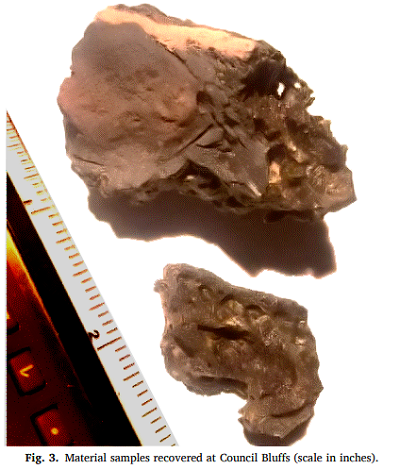
Section 3 "Investigating unknown material collected in the field: A Case Study" concerns an incident on the 17 December 1977, which occurred in Council Bluffs, Iowa. At 1945 CST "...a red, luminous mass was observed by two Council Bluffs residents, as it fell to Earth near the northern city limits..." At the scene the witnesses found an area "...covered by molten metal that glowed red-orange, igniting the grass. Police and fire brigade personnel who attended the scene within 15 minutes all saw the mass, estimated at 35-55 pounds. An investigation was conducted with three initial thoughts in mind. These were, an industrial accident, an aeronautical malfunction or a meteorite (despite there being no cratering.) After investigations, it was concluded that it was not re-entering space debris; not falling material from an aircraft, not a meteorite, nor was it a hoax. It was also noted that two witnesses of the eleven witnesses, described a round object hovering in the sky, edged by red blinking lights.

The retrieved material had three components, namely "solid metal, slag and white ash inclusions in the slag." Vallee provided a piece of the original material for further testing. "...our initial conclusion was that sample components were consistent with a terrestrial origin." A recently developed Multiplexed Ion Beam Imaging" (MIBI) instrument was used which is capable of measuring a broader range of isotopes. Using this instrument investigators concluded that "All isotopic ratios were similar between the samples and did not show any statistically significant deviations from expected terrestrial normal except for 57Fe..." However, there was a suggested conventional explanation for this 57Fe deviation.

Speculative conclusions

Section 5, "Speculative conclusions" includes the statement:

"Our experience with the Council Bluffs case study shows how difficult such a determination can be, even when abundant evidence is collected within minutes of an event, supported by reliable testimony from multiple witnesses and in well-defined meteorological conditions."
The authors speculate about the hovering, round object edged with red lights; that "Such an object might have ejected the mass of material observed by the other witnesses and recovered by police." They note that "The materials from Council Bluff show no evidence suggesting it was (sic) been engineered or designed. The material would not be expected to form naturally, and has been shown does have unusual inhomogeneity."

Comments

1. An excellent, peer reviewed paper in a significant international journal, which introduces the topic to the broader aerospace community.

2. Some UAP / [UFO] researchers might suggest that the paper doesn't go far enough in taking a look at other unusual samples associated with UAP / [UFO]. However, the authors note that:

"The objective is to provide data in an open-source manner so that others might replicate the analytic approaches or divine a testable hypothesis of why and how such materials are deposited or left behind . To many this will feel incomplete or insufficient, but this would be a premature conclusion. In the case of Council Bluffs, however, the data is verifiable...it is only the origin and nature of the material (and the phenomenon in general) that remains open."

3. On page 3 of the article there is reference to one of the Defense Intelligence Reference Documents produced by the Advanced Aerospace Weapon System Applications Program, namely the one on "Metallic Spintronics."

4. There is also mention of the fact that the authors are conducting other analyses on other pieces of unusual materials.

5. All in all, it is the paper most of us were waiting for. Hopefully, just the first of many similar articles.

Thursday, July 15, 2021

The UAP Pentagon Report - Commented abstract

Pentagon UFO Report - Prelimary Assessment UAP


     The unclassified document that has been published1 is described as a “preliminary assessment” on UAPs by the Office of the Director of National Intelligence (June 25, 2021). The US Senate, accompanying the Intelligence Authorization Act for Fiscal Year 2021, had requested an intelligence assessment of the threat posed by unidentified aerial phenomena (UAP) and the progress made by the pertinent Department of Defense UAP Task Force set up in August 2020.

17 US agencies, including the Air Force, the Navy and the Army have provided input to the report. The first assumption is that
Vicente-Juan Ballester Olmos
By Vicente-Juan Ballester Olmos
The UFO Chronicles
7-12-21
“Various forms of sensors that register UAP generally operate correctly and capture enough real data to allow initial assessments, but some UAP may be attributable to sensor anomalies.”

The 9-page report starts with an executive summary. It begins stating that “The limited amount of high-quality reporting on unidentified aerial phenomena (UAP) hampers our ability to draw firm conclusions about the nature or intent of UAP.” As a result, the UAPTF concentrated its review on reports that occurred between November 2004 and March 2021. While “Most of the UAP reported probably do represent physical objects…[and] In a limited number of incidents, UAP reportedly appeared to exhibit unusual flight characteristics,” the report follows to say that “These observations could be the result of sensor errors, spoofing, or observer misperception and require additional rigorous analysis.”

The review of 144 reports insinuates that “when individual UAP incidents are resolved they will fall into one of five potential explanatory categories: airborne clutter, natural atmospheric phenomena, USG or U.S. industry developmental programs, foreign adversary systems, and a catchall “other” bin.” It fairly coincides with the findings of UFO research in the last decades: cases are explained by an array of solutions. No aliens whatsoever.

For the national Intelligence office, “UAPs clearly pose a safety of flight issue and may pose a challenge to U.S. national security,” in contradiction with 70 years of UFO phenomenology, with zero UFO-related air accidents and in the experience of so many countries which declassified their UFO records on the basis of UFOs not posing any danger to national security. The US Intelligence must, however, have serious reasons to think that some UAPs would potentially represent “foreign adversary collection platforms … or breakthrough … technology.”

The report lists needed steps for a sophisticated study of the issue, being “resource-intensive and would require additional investment.” This is translated as: if you want us to analyze this problem, please be prepared to pay for it. And this will not be Blue Book, or the Condon Committee. For sure, we are speaking of millions of US dollars, all in the name of national safety!

Main conclusions point to “reporting largely inconclusive,” however it is amazing the low score in identifying the nature and source of the objects. The Task Force investigators were only able to identify one reported UAP with high confidence (a deflating balloon), out of 144 (0.7%). The others remain unexplained. A lousy case resolution ratio, considering that French GEIPAN has solved 98% of UFO sighting in the last 10 years.2 I believe military UAP investigators must learn a lot from UFO investigation.

Nevertheless, the report guesses that “Some Potential Patterns Do Emerge.” In spite of the fact that “there was wide variability in the reports and the dataset is currently too limited to allow for detailed trend or pattern analysis,” it advances that there are some clustering of UAP observations regarding shape, size, and, particularly, propulsion. Diversity prevents pattern-recognition or not? Propulsion clusters? I believe it is fruit of reviewers imagination, not used to analyze pilots reporting exaggerations, or speculations. The only clear-cut cluster is that UAPs appear around U.S. training and testing grounds, “but we assess that this may result from a collection bias,” the report wisely asserts.

The report consigns reported unusual UAP movement pattern, remain stationary in winds aloft, move against the wind, maneuver abruptly, or move at considerable speed, radio frequency energy associated with UAP sightings, acceleration or a degree of signature management, etc. Apparent features, we rush to add, as, like the report continues to state, “Additional rigorous analysis are necessary by multiple teams or groups of technical experts to determine the nature and validity of these data.“

As we have also concluded with the analysis of raw UFO reports 1947-2021, “The UAP documented in this limited dataset demonstrate an array of aerial behaviors, reinforcing the possibility there are multiple types of UAP requiring different explanations.” The Pentagon study today reveals lack of sufficient information in their dataset “to attribute incidents to specific explanations.” Nothing extraordinary has been found.

Their database includes 11 reports of documented instances in which pilots reported near misses with a UAP. Does it mean UAPs represent an “ongoing airborne concern”? With an airspace filled with flying objects, controlled and out-of-control, every drone or missile may be considered a hazard to aviators. This is out of the question with the ETH UFO enthusiasts promote. Concerning potential National Security challenges, it is up to the State to monitor if US adversaries are spying near military facilities or by aircraft carrying advanced sensor systems. Unrelated to ETI as well.

This report states that “explaining UAP will require analytic, collection and resource investment, “ inter-agency coordination, standardization of incident reporting across U.S. military services, Federal Aviation Administration robust input, and expand data collection from standard and novel areas. The bottom line is increase investment in R&D: “The UAPTF has indicated that additional funding for research and development could further the future study of the topics laid out in this report. Such investments should be guided by a UAP Collection Strategy, UAP R&D Technical Roadmap, and a UAP Program Plan.”

In summary, a new area of research seems to have been identified, as if it was not something being regularly pursued by Intelligence on a routine basis. With the public attraction to flying saucers, UFOs and UAPs, incoming financing is ensured. The US government is, again, studying UFOs. The XXI century Blue Book program is to be started. The media will rejoice. Science, probably less.

Apparently (according to Twitter), one classified version of this report has 70+ pages, 200 pages of annexes, plus 14 videos for ~40 minutes.3

Notes

(1) https://www.dni.gov/files/ODNI/documents/assessments/Prelimary-Assessment-UAP-20210625.pdf

(2) https://www.cnes-geipan.fr/fr/actualites/baisse-cas-d

(3) Laurent Chabin, communication to EuroUFO forum list, June 26, 2021.

Wednesday, June 30, 2021

Don’t Dismiss the Alien Hypothesis

Don’t Dismiss the Alien Hypothesis


     The United States has the most advanced aerospace capabilities of any country and spends more than twice as much on defense as Russia and China combined.

The Administration and Congress concur that these objects are not classified U.S. aircraft.

In the Nimitz incident and other cases, some of these vehicles have been observed doing things that we cannot replicate and do not understand.

Official records from the U.S. and other countries indicate that
Chris Mellon
By Chris Mellon
The UFO Chronicles
6-28-21
this is a global phenomenon that has been occurring since at least WW2 and perhaps far longer.

We have no reason to believe that many of these objects are from Russia or China, and in fact it seems improbable. Especially when we consider how long this phenomenon has been observed.

Consequently, the “not invented here” hypothesis is the only theory currently consistent with the known facts.

From any vantage point, we are more likely to encounter probes than signals from ET because probes are far safer, more efficient, and more effective for purposes of space exploration.

The radical capabilities and mysterious appearance of some of the vehicles being observed are consistent with what we'd expect of probes or craft from a space-faring civilization. As Arthur Clarke famously observed, “Any sufficiently advanced technology is indistinguishable from magic."

There is no scientific barrier to interstellar travel even if superluminal travel is impossible. My grandfather was born before the Wright brothers got off the ground. Now there are already a number of nations with robots on Mars and a consortium led by Yuri Millner is designing the first probe to visit another star system. It would take only a tiny fraction of the age of the Milky Way for a space-faring civilization, travelling at one-fifth the speed of light, to explore the entire galaxy.

Our government should establish a cleared panel of UAP, intelligence and scientific experts to study this issue. Mainstream scientists currently lack any detailed understanding either of the phenomenon or its long history, nor do they understand the range of sensor capabilities available to the U.S. or have the knowledge needed to understand where to look within our vast national security apparatus for answers. This has been shockingly evident in recent months with astronomers expressing their ignorance of the UAP topic by asking embarrassing questions such as “If UFOs are real how come commercial pilots never see them?” and “How come only Americans report UFOs?”

To be effective, the panel therefore needs to include people familiar with the long but obscure international and U.S. Government history of the issue as well as the classified data and capabilities our government possesses that can be used to obtain more information. Large expenditures are not required; progress will largely be a function of leadership, intellectual integrity, data access and organization.

Someone at a high level urgently needs to be assigned responsibility to find out where these objects are coming from, how they work and why they are here. Engineering and scientific efforts to replicate observed capabilities also require a high priority.

We can no longer deny that someone has mastered technology beyond our understanding and is using it to monitor U.S. military forces and probably much else. In some cases, such as the famous encounters of the Nimitz Carrier Strike Group, non-human origin is presently the theory that best fits all the facts. Until a better explanation emerges it is time to squarely confront the data and accord this revolutionary discovery the attention it deserves. Regardless of the source, we need a serious national effort to understand and emulate the capabilities we are observing.

Regardless of the origin of these craft, the stakes could not be higher. Ignorance is not a national security strategy, and we have never before been a nation deterred by fear of the unknown. The benefits that might result could include massive technological breakthroughs and revolutionary advances and insights that might otherwise take eons to acquire. The only responsible course of action is to proceed expeditiously with open minds, perhaps jointly with other nations to make faster progress and mitigate growing international tensions and rivalries.

How can we turn aside knowing what we now know? There is really no choice other than to press forward in pursuit of the truth with the hope and expectation that new frontiers of knowledge will be discovered for our nation and hopefully for the benefit of all mankind.