Showing posts with label Susan Clancy. Show all posts

Monday, August 31, 2020

'Alien Abductions, The Most Radioactive Element in The UFO Spectrum'

'Alien Abductions, The Most Radioactive Element in The UFO Spectrum'


Rolling The Bones, Upping The Ante


     With the Senate Select Committee on Intelligence expecting a transparent military audit on UFOs by December, the brass is warming up by blowing off its own foot. No sooner had the History channel wrapped the finale of its “Unidentified” second season last weekend, than John Greenewald’s Black Vault detailed a bureaucracy’s determination to stonewall at the expense of its own internal logic. And in so doing, the Navy has demonstrated it won’t hesitate to toss its own people under the bus to cling to an increasingly uneasy status quo.

Greenewald’s coup, published Monday, is the latest dispatch
Billy Cox
By Billy Cox
De Void
8-28-20
from his long-running FOIA odyssey to learn more about the military’s UFO investigation, the Advanced Aerospace Threat Identification Program. What it tells us is that the Defense Department not only continues to deny that former Office of Undersecretary of Defense for Intelligence agent Luis Elizondo ran the AATIP show, despite ample evidence to the contrary. The Navy’s counsel, Judge Advocate General’s Litigation Division, now says it can find – get this – “no evidence” that its own PIO stated for the record that “The AATIP program involved offices across the Department of Defense, including Navy.” Even though the Pentagon subsequently confirmed to Greenewald that, yep, the Navy PIO actually did issue “an accurate statement.” And blink, just like that, the Navy JAG just turned itself into a cartoon panel right out of “Family Circus.”

Want more? The legal department also insists that all AATIP records – “if they ever existed,” and that covers all documents, photos, vids, emails, etc. – “may have been permanently transferred, destroyed or otherwise no longer able to be located by the (Initial Denial Authority).”

May have been. But the Navy’s top legal eagle doesn’t even know for sure “if they ever existed.” Perfect.

Anyone sitting on the Senate Intel Committee expecting a routine accounting of what the military does and doesn’t know about The Great Taboo is naïve and should maybe recuse themselves to preserve the integrity of this inquiry. Yes, it’s fabulous that the Pentagon acknowledges it’s in damage-control mode now and needs a platform to reassure taxpayers that it’s on top of this longstanding national-security breach. On August 4, it established the Unidentified Aerial Phenomena Task Force, naming Deputy Defense Secretary David Norquist to coordinate the effort. The bio suggests Norquist is a stickler for details. But the project will continue to operate under the Navy umbrella. Which means this is going to be a long slog, likely rutted with misdirection and evasion.

It’s not hard to figure why powerful corners of the defense establishment are still trying to discredit retired counterintelligence operator Elizondo. This is the guy who actually took his UFO assignment seriously enough to march his mission statement and those jet-fighter videos to the NY Times in 2017 after he couldn’t unclog his findings from the stovepipe and shoot it up the chain of command. Furthermore, this summer, Elizondo and History’s eight-part series left a trail of breadcrumbs so obvious for lawmakers to follow that even Mr. Magoo could read the map.

The most promising trail leads to North American Aerospace Defense Command, which watches everything in the continental skies. NORAD uses an international treaty with Canada to shield its data from the prying eyes of FOIA. In “Unidentified’s” S2E5, retired USAF Col. Jim Cobb and onetime Senior Command Director at NORAD’s base in Cheyenne Mountain went on camera to tell producers about an incident that left “the entire room standing” in 2008.

Sensors tracked a southbound blip without a transponder as it traversed the entire U.S. eastern seaboard. The bogey’s flight path into commercial corridors was so unnerving, multiple squadrons of warplanes were scrambled to investigate; unfortunately, the pilots may have had better luck on a snipe hunt. Which begs the question: How many unknowns like that are in the NORAD case files? And where’s the Air Force? Remember those guys?

But Elizondo and his To The Stars Academy colleagues collaborating on “Unidentified” didn’t stop at NORAD. They didn’t stop with a presentation on UFOs’ unimpeded surveillance of American nuclear assets. Or with riveting personal testimony from dozens of military eyewitnesses, pilots, and other trained observers.

In a flourish of chutzpah, knowing their target audience included buttoned-down Beltway wonks, the shot-callers decided in last Saturday’s season-ender to roll the bones and go full monty with alien abductions, the most radioactive element in the UFO spectrum. And how better to tee it off than with than a couple of USAF security-patrol veterans who bore witness to the famous “northern tier” wave sweeping Strategic Air Command bases in 1975? Stationed at South Dakota’s Ellsworth AFB, they recounted a simultaneous and life-altering missing-time incident visited upon them while checking out the penetration of America’s most restricted airspace by a UFO.

The only reason we know about what happened to Ellsworth airman Mario Woods, and others like him, is because his story appeared last year in Robert Hastings’ Confession: Our Hidden Alien Encounters Revealed. Renowned as the researcher who convinced well over 100 veterans and contractors to share their stories of security lapses in his 2008 book UFOs and Nukes – Extraordinary Encounters at Nuclear Weapons Sites, Hastings himself was featured in S2E8.

Hastings offered De Void a reminder that, since 2008, he had declined 18 invitations to appear on related shows prior to cooperating with History. On balance, he says, his aversion to overexposure in sensationalist formats finally paid off.

“Compared to the vast majority of so-called UFO documentaries on TV,” he said from his home in rural Colorado, “I think the ‘Unidentified’ series was far superior. They very credibly presented multiple encounters by military personnel with these unidentified aerial phenomena, which is a very productive thing to do, in terms of promoting public awareness and education.”

Some of his quibbles were widely shared, like the producers’ wasted-time formula of regurgitating what viewers had already seen immediately before the commercial breaks. However, despite his qualified endorsement of the series, other editing decisions left him “surprised and disappointed.”

The most conspicuous flaw was excluding Hastings from the S2E3 episode “UFOs vs. Nukes.” This is the guy who literally wrote that book. Instead, his face time was restricted to the abduction episode, and all connections to his UFOs and Nukes research was omitted. And even within those constraints, specific details of what Hastings saw, vivid descriptions of confrontations with otherworldly beings, were omitted as well. For the record, he calls the producers’ choices “overly cautious.”

Not that long ago, Hastings himself chose self-censorship over personal disclosure. He harbored a legitimate fear that discussing his apparent history of abductions – which became impossible to ignore after a camping encounter in 1988 – would damage his reputation as a researcher. But as his career neared a close, he decided to spill the beans in 2019. By then, however, interest in all dimensions of The Great Taboo had evolved light years beyond Reagan’s dog whistles on the floor of the United Nations. But with a lingering caveat.

“Even though the media now has suddenly taken a serious interest in the UFO phenomenon, for most journalists, the abduction topic is still taboo,” he says. “As it is, I’m sure, with many people in government. It’s just a bridge too far for most people at this point.”

Maybe TTSA insisted on including abductions in the series, however soft-pedaled the material, because the issue is getting too big to ignore inside influential circles. Hastings alluded to one possibility in an essay early this year. But, he adds, you can only thread that needle for so long.

“I understand that people need to crawl before they walk. This is still a new and very strange and sometimes frightening subject for many, many people. And I understand that one needs to proceed slowly, in terms of presenting the evidence to the public and to congressional oversight personnel.

“But ultimately that extra step is going to have to be taken, there’s so much credible data now confirming this aspect of the UFO phenomenon.”

Whether or not it was the right call at this point remains to be seen. But Elizondo & crew have just upped the ante. If in fact abduction material is waiting at the end of the trail, beyond the hardware, beyond the physics, it’s not difficult to imagine admirals and generals burning the house down before giving that up. We got a sneak peek this week when they Navy wouldn’t even confirm the obvious.

Sunday, August 30, 2020

Unidentified’s 'Extraterrestrial Encounters' Episode: Robert Hastings’ Critique

Unidentified’s 'Extraterrestrial Encounters' Episode - Robert Hastings’ Critique


     Regarding my appearance in the final episode of the History channel’s Unidentified, Season Two, the show was fairly credible in my opinion, despite the unfortunate inclusion of psychologist Dr. Susan Clancy’s fallacious, uninformed commentary about the three abduction cases covered in the program.

But I am getting ahead of myself.

As I wrote in my 2019 book, Confession, I am a lifelong “experiencer” and have had multiple encounters with what I have concluded were non-human entities associated with the
Robert Hastings
By Robert Hastings
The UFO Chronicles
8-27-20
CONFESSION – Our Hidden Alien Encounters Revealed
UFO phenomenon. I kept this very personal secret hidden from public view for decades because I understood that to openly admit it would negatively impact my reputation as a reliable nuts-and-bolts investigator of UFO incursions at nuclear weapons sites during the Cold War era.

For example, although CNN live-streamed my September 27, 2010 press conference in Washington D.C.—during which seven U.S. Air Force veterans discussed witnessing UFO-related incidents at ICBM sites and nukes storage depots—the cable network would have undoubtedly declined to cover the event if I had candidly mentioned my apparent alien abductee-status in the press release that I sent out beforehand. (Or if I had mentioned that two of the veterans, Bob Salas and another individual whom I won’t identify, are experiencers as well.)

Most of us know that the media’s now-heightened interest in the UFO phenomenon is a relatively recent and rare development resulting from revelations in 2017, concerning the existence of a secret US Department of Defense UFO project at the Pentagon—the Advanced Aerospace Threat Identification Program, or AATIP—and the related release of three videos of unidentified, ultra-sophisticated aerial craft encountered by US Navy pilots in 2004 and 2015. Consequently, serious, in-depth media coverage of the UFO/UAP subject is steadily becoming the rule rather than the exception. Even so, the alien abduction topic is still decidedly taboo for most journalists, as it is among the great majority of the American public, and is likely to be treated by the media with extreme skepticism and even outright derision.

Therefore, I believe that the History channel’s Unidentified series is to be commended for devoting at least one episode to the abduction phenomenon, even though they stumbled badly by not challenging Dr. Clancy’s deceptive, erroneous remarks regarding the specific cases covered in the show. Allow me to explain.

When I was invited to participate in the program, the producers asked me to suggest a few US Air Force veterans they might interview—persons who had already openly acknowledged having had alien entity-related experiences, who might also be willing to appear in the Extraterrestrial Encounters episode. So, I recommended that they approach former missile security policeman Mario Woods, retired ICBM-handling specialist Jeff Goodrich, and former Minuteman missile launch officer Bob Salas—all of whom are featured in Confession. For reasons known only to the producers, Salas did not appear in the show, even though he was interviewed at length by former AATIP director and Unidentified consultant Luis “Lue” Elizondo earlier this year.

Fortunately, Woods and Goodrich were allowed to present their entity encounter narratives in a fairly straightforward manner, although certain key elements in their stories were oddly omitted by the producers. This was true regarding my own account as well. Comparing notes following the program, it seemed to the three of us that a deliberate decision had been made to avoid mentioning aspects of our experiences that would have strengthened our argument that we had actually been physically confronted by alien beings and that our recollections of the events were not, therefore, merely based on false memories resulting from hypnosis, as Elizondo and Clancy speculated on camera.

In Mario Woods’ case, when I first interviewed him in August 2017—months before he underwent hypnosis—he told me that he recalled seeing “five or six” shadowy, small figures approaching his security police vehicle shortly after he and his team partner observed a huge spherical object hovering over an ICBM silo outside of Ellsworth AFB, South Dakota, in November 1977. At that moment, a terrified Woods heard a chorus of voices in his head, repeatedly saying “Do not fear.” Following the encounter, his team partner, Sgt. Michael Johnson, revealed to Woods that he too had heard the voices, saying “Do not fear” over and over, and that the words were not audible sounds but seemed to enter directly into his mind.

In other words, the two men independently experienced the same apparently telepathic message emanating from the approaching diminutive figures. Although Woods described this readily-remembered aspect of his encounter to the Unidentified producers, an aspect confirmed by Johnson shortly after the event, they chose not to mention it in the show, and instead allowed Dr. Clancy to unequivocally assert that abductees’ recollections about seeing aliens are only false memories inadvertently generated during hypnosis sessions. Once again, Woods told me about seeing the small figures approaching his vehicle, and of hearing their voices telepathically, months before he underwent hypnosis.

Furthermore, immediately following the encounter, Woods discovered two mysterious identical scars on his body—perfectly circular depressions exhibiting a small, centrally-located protuberance—which were also noted by medical staff at the Ellsworth AFB hospital, where he had been examined under orders from his Air Force squadron commander. Woods tried to show the scars to the Unidentified team sent to interview him but, as he told me, “They didn’t seem interested nor did they film them.” This baffles me and makes me wonder whether impartial reporting was the paramount objective on the part of the producers when presenting Woods’ account.

In the case of Jeff Goodrich, the episode did in fact include his on-camera comment about seeing small entities entering his bedroom and approaching his bed, at which point he was temporarily paralyzed. But then they allowed abduction skeptic Dr. Clancy to say in response, “That sounds exactly like a textbook case of sleep paralysis.” Whether or not Elizondo had mentioned to Clancy that a guest staying overnight at Goodrich’s house, who was sleeping in an adjacent room, also reported being paralyzed—at the exact same time—is unknown. If he did tell her, we didn’t see that in the program. Regardless, the neurological phenomenon known as sleep paralysis could not possibly have accounted for Goodrich’s inability to move, which occurred just as the small entities entered his bedroom, given that his house guest independently, simultaneously experienced the same unexplained paralytic effect. Unfortunately, the show’s producers let Clancy’s invalid pronouncement of “textbook sleep paralysis” go unchallenged. Very poor judgement on the part of someone!

Clancy further asserted that therapists often ask leading questions of persons under hypnosis, thereby inadvertently planting suggestions in their minds. Well, first, Jeff Goodrich’s memories of his entity encounter event were readily accessible the following morning and did not emerge via hypnotic recall later on, as Elizondo mistakenly told Clancy at one point. Actually, upon his retirement from the Air Force, Goodrich was ordered to sign a written statement, dictating that he never undergo hypnosis, for any reason, probably because he had handled nuclear missile launch codes during his career and held a Top Secret/Crypto clearance.

Furthermore, I can assure the reader that no—zero—leading questions were asked of Mario Woods or myself during our hypnosis sessions and I have the recordings of all of them to prove it. In fact, the producers were given the video of Woods’ hypnosis session and, therefore, had the opportunity to refute Clancy’s unfounded suggestion that he had been influenced by hypnotist Robert Upson’s style of questioning. But, for whatever reason, that did not happen. Consequently, Clancy was permitted to make her unequivocal, blanket statement implying that all abductees’ memories have been influenced by therapists’ leading questions. While I freely admit that this issue is potentially problematic in some cases, it was demonstrably not relevant to the specific cases covered in the program. Again, a very poor decision on the producers’ part not to refute Clancy’s off-base insinuation.

As for my own dramatic entity encounter experiences over the years, most were recalled without the use of hypnosis. However, regarding the August 13, 1988 incident that was presented in the show, I did eventually undergo hypnotic regression to attempt to learn more about the events in question—which occurred during a camping trip—after a number of strange, suggestive developments had already taken place, prompting my curiosity.

Specifically, on the night of the alleged abduction, multiple persons, including myself, witnessed the presence of an anomalous aerial craft—an unilluminated disc with two bright strobes, one on either end—rapidly moving away in the sky at very low altitude. That sighting was presented reasonably accurately in the Unidentified episode. However, more importantly—but not mentioned in the program—was the fact that one terrified member of our party was able to detect the object’s presence on the ground in the immediate vicinity of our tents, as it illuminated them and the surrounding trees and bushes with an intensity “as bright as daytime”, even though it was 3 a.m. when we all suddenly awoke to watch the object fly away. Further, another camper subsequently had a repetitive nightmare every night during the week following the outing, in which she saw three of the campers—a woman, her eight-year-old daughter, and me—walking single-file “like zombies” toward a brightly illuminated object sitting on the ground. Significantly, the young girl later recalled—without the use of hypnosis—the sensation of sleepwalking that night. These events were not mentioned in the show either.

In any case, given the intriguing developments noted above, I decided to explore the mysterious camping trip using hypnosis and eventually utilized the services of a very UFO-skeptical clinical psychologist, whom I won’t identify, who regressed me six times in 1992. As I said on-camera in the Unidentified episode, while under hypnosis I at one point recalled entering an extremely bright room with walls that curved into, and were inseparable from, the ceiling. What I also said to Elizondo, who interviewed me for the episode, was that directly in front of me I saw a metallic table with a short, Gray alien-type figure standing behind it. After a moment or two, the entity rushed at me and touched my head, at which point I apparently lost consciousness. But that important portion of my statement was not included the program, for whatever reason. (Just as Mario Woods’ key comments to the producers about remembering seeing aliens, both prior to being hypnotized and again during his session with Robert Upson, were not featured in the show. The producers only presented Mario, via voice-over, saying that at one point he felt as if he were immersed in a gel of some kind.)

Regardless, I emphasize again that at no time did my own therapist ask me any leading questions like, “Do you see anybody in the room with you,” as Dr. Clancy implied would have occurred, thereby tainting the data. And, once again, nor were such leading questions asked of Woods.

Summarizing, the reasonably credible “Extraterrestrial Encounters” episode is unfortunately compromised by errors of commission and omission. Nevertheless, I respect Lue Elizondo’s publicly-stated agnostic position on the abduction topic, as when he said, “There is no empirical way I can prove or disprove” the claim that some humans are being abducted by aliens. I have said much the same thing about my own experiences. Indeed, in my book Confession I noted that while unusual scars and retrieved implants (in some cases) are compelling, as are multiple, identical witness accounts that reinforce each other, they probably do not represent the type of irrefutable, verifiable evidence required by scientists. I fully understand this skeptical stance and regret that completely unimpeachable evidence for the reality of the abduction phenomenon seems to remain perpetually elusive. But this does not mean that the issue won’t be unequivocally proven one day.

However, if it were the intention of the Unidentified producers to try to raise valid questions about self-described alien abductees’ claims, if only for the sake of balance, they should have interviewed someone who is actually scientific in their approach to analyzing the problem, which Dr. Susan Clancy clearly is not. In my opinion, her fallacious position, which may be characterized as, “It can’t be, therefore it isn’t”, is downright embarrassing, except to other irrational debunkers. She seems to think that bragging that she has a Ph.D. from Harvard University when spouting her pseudoscience in public somehow makes the foolishness she promotes more credible.

A scathing but factually-accurate analysis of Clancy’s unacknowledged personal biases and fatally flawed research methodology regarding the alien abduction phenomenon may be read here.

Monday, August 24, 2020

UFO Abduction Reports and The Faith-Based Science of Susan Clancy (Redux)


     The literate world is well aware that a controversy about the reality of the UFO phenomenon has raged for decades. Arrayed on one side are the enthusiasts - the casual, the serious and the bizarre - along with thousands of highly qualified pilot-witnesses, high-ranking military personnel, intensely interested scientists, and even an astronaut or two. All regard the hundreds of thousands of global sighting reports as a scientific problem of major significance, and all demand that science finally conducts a thorough, objective investigation. Centrally opposed to this position are a large number of mainstream scientists, most of whom are not only indifferent to the subject
Budd Hopkins
By Budd Hopkins
The UFO Chronicles
2005-2020
of UFOs, but also grossly uninformed about the weight of the evidence. Allied with them is a strange amalgam of groups that includes official spokesmen for the United States Air Force, Bible Belt Fundamentalist preachers such as Pat Robertson, and a small but vociferous band of self-described "rationalist" debunkers (who probably look upon their religious brethren as hopelessly superstitious). Clearly, the battle against a scientific investigation of the UFO phenomenon makes strange bedfellows.

Richard McNally and Susan Clancy
A few years ago, when those of us in the research community heard rumors of a two-tiered scientific investigation to be undertaken at Harvard University by experimental psychologists Richard McNally and Susan Clancy, we were curious but wary. Dr. McNally, we were told, intended to test a group of self-described UFO abductees for the presence of certain symptoms of post-traumatic stress disorder. He would employ as a model a similar test used years before, in which a group of Vietnam veterans tape recorded their traumatic war experiences and then, at a later time, were scientifically measured for signs of stress as they heard their taped accounts played back. Dr. Clancy planned to employ a word memorization test, which was supposed to reveal a subject's tendency towards false memories. Unfortunately, neither McNally nor Clancy intended to carry out any actual investigations of UFO abduction reports or examine any physical evidence. They would remain in the laboratory, limiting their project to the ostensibly scientific testing of their abductee subjects' veracity.

Early in the Susan Clancy enterprise, any hopes I had for her objectivity evaporated when I learned that her purported abductee subjects were to be self-selected. She had placed ads in a number of newspapers, asking for those who believed they had had UFO abduction experiences to contact her. Little or no vetting took place, and her unscientific protocol thus opened the laboratory door to anyone who claimed to be an abductee. Her subjects were not a group whose accounts had been investigated and accepted as reliable by experienced researchers, but instead, Clancy accepted virtually anyone who came in off the street and told her they were, indeed, abductees. Some of her subjects had such tenuous, even vapid reasons for believing they were abductees - a "mysterious bruise" or a "vague feeling" - that knowledgeable researchers would have immediately shown them the door. The uncritical Dr. Clancy, however, made them part of the "abductee" group she studied!

Anyone familiar with the phenomenon is aware that very few abductees will come forward to discuss their experiences publicly, or to subject themselves to "testing" of any kind by people or organizations that they do not know and trust. Doing so would be to run the very real risk of becoming targets for career-threatening ridicule. Obviously, the more highly credentialed abductees are the most hesitant to volunteer as test subjects because they have the most to lose. Neither the NASA research scientist, the NASA engineer, nor the many psychiatrists, psychologists, police officers and military professionals who, over the years, have reported their abduction experiences to me, would ever involve themselves in what might well turn out to be sensationalist and incompetently mounted tests of one kind or another. Adding to that basic flaw in her study, my second concern had to do with the fact that neither Clancy, whom I had twice met, nor McNally made any attempt to contact Dr. David Jacobs or me. They were both undoubtedly aware that the two of us have accumulated between us masses of data after decades of work with literally hundreds of abductees. We were never consulted on any issue, nor was our help in vetting test subjects called for. In retrospect, Dr. Jacobs and I could have easily prevented the two testers - innocent of the complex work of actual investigation - from making many of the egregious errors which have so seriously damaged their work.

The results of McNally's test for signs of posttraumatic stress disorder were significant. Those reporting abductions showed virtually the same intensely emotional reactions upon hearing their taped accounts replayed as did the Vietnam vets when they heard the tapes of their traumatic war experiences. But as we soon learned in McNally's analysis of the test results, the devil was not in the details themselves but in his interpretation of the details. He announced that, since we "know" that UFO abductions don't exist, all of his subjects' accounts have to be false memories. And since they registered just as powerfully as "true" memories, what the test shows, he explained, is that "false" memories can be just as traumatic as "real" memories! This classic illustration of "heads I win, tails you lose" circular reasoning provides a perfect example of ideology trumping science. Unfortunately, as astronomer J. Allen Hynek once remarked, science is not always what scientists do. In effect, McNally seemed to be saying that even if his own test results support the traumatic reality of the abduction phenomenon, that fact changes nothing since UFO ABDUCTIONS JUST DO NOT EXIST, and that somehow, someway, he will make his test results fit his hypothesis! McNally's ideological interpretation of the test results - a clear example of "faith-based science" - is just as rigid in its way as the creationists' willful denigration of evolution, no matter what the fossil records have revealed.

Susan Clancy's word memorization test as an indication of false memories is far more tenuous than McNally's test for the presence of posttraumatic stress. (This is perhaps not the place to go into its technical inadequacies, other than to reiterate what I have already said about its fatal flaw - the reliance upon an unvetted, self-selected sample. I will return to the specifics of her work in a later paper.) Instead, the problem I would like to discuss is her use of a rather simple word memorization protocol to ratify her belief that a subject's demonstrably traumatic memories are false. Clancy baldly stated in an early newspaper interview that she assumed everyone would accept the idea that all abduction experiences were false memories, because "everyone" knew there were no such things as UFO abductions. This, she apparently thought, was settled truth - and another illustration of irrational, faith-based science. So, at the outset of their work, neither she nor McNally intended to raise even the possibility that such things as UFO abductions might have occurred, let alone to actually investigate that possibility. The ideology they shared assumed that such experiences were, ipso facto, false memories, a theory the two seem to believe as fervently as the Pope believes in the virgin birth.

Another analogy comes to mind. Instead of a group of abductees, imagine an equal number of women who have reported rape experiences and who are now to be tested by a pair of experimental psychologists. The psychologists state at the outset that they do not believe any of these women were actually raped and are proceeding on that assumption. Thus their goal is not to investigate the veracity of the women's claims but to discover a way of establishing their "tendencies to fantasize and form false memories." Since the testers "know" in advance that these rape memories are false, no police investigation into the alleged rape accounts is necessary - no examination of physical or medical evidence, no visits to alleged crime scenes, no interviews with possible witnesses, and no checks on the reputations of the rape victims. In short, nothing will be undertaken that might support the reality of their experiences. An outrageous, even inhumane idea, of course, but analogous to the Clancy-McNally attitude to UFO abductees.

As I pointed out above, Clancy carried out no investigation of any of her subjects' abduction reports - no inquiries into supporting witnesses, no visits to alleged sites, no search for physical evidence, no interviews with friends and family members. Everything she did apparently took place in the laboratory, by way of her word memorization test and personal interviews, though she apparently lacked a firm grounding in the literature, history or complexity of the UFO phenomenon. Recently I appeared on "Larry King Live," along with Clancy and several others, when one of the guests showed a blow-up of the world-famous Trent UFO photographs from McMinnville, Oregon, arguably the best-known UFO photos in existence. They were prominently featured in "Life" magazine in 1950, and have been reproduced hundreds of times since in many publications. What's more, in 1969, after careful analysis, an investigator for the skeptical Condon Committee described the McMinnville photo case this way: "This is one of the few UFO reports in which all factors investigated, geometric, psychological, and physical, appear to be consistent with the assertion that an extraordinary flying object, silvery, metallic, disc-shaped, tens of meters in diameter, and evidently artificial, flew within sight of two witnesses." Optical physicist Dr. Bruce Maccabee has investigated this case thoroughly, flying to McMinneville, interviewing the Trents, their family and neighbors, taking his own test photos from the same location, and carrying out literally months of optical analysis of the original pictures. Maccabee's work has been published widely, but the photos themselves should be familiar to anyone with even a cursory involvement in UFO study and research. Yet, during the Larry King program, abduction authority Susan Clancy glanced at the photos on the monitor and said something like this: "that could be anything...someone who threw up a hubcap or a Frisbee or something." Her evident ignorance of this case, and, by extension, of the literature and history of the UFO phenomenon, was aptly illustrated by this glib, contemptuous wisecrack, a remark one might expect to hear late at night in a Texas barroom, but not from someone holding a Ph.D. degree from Harvard. Earlier, when King asked her how she became interested in the subject of UFO abductions, she began her answer this way: "I've been studying aliens for..." Studying aliens? Again, this peculiar description of her work in the laboratory is not what one would expect to hear from an experimental psychologist on an ostensibly serious TV program.

Though as a faith-based scientist, Susan Clancy has no problem asserting her absolute belief that all UFO abduction accounts are nothing more than false memories, she is left with the problem of explaining how these memories are generated. By what process can many thousands of extremely similar accounts from around the world come into the heads of this multitude - especially since her colleague, Richard McNally, has established that abduction memories have essentially the same traumatic qualities as memories of the Vietnam War? Clancy's solution was to cobble together a melange of theories, many of them mutually contradictory, in an attempt to account for the power and similarity of these "false" memories. Abduction researchers have long been familiar with the explanations Clancy offers, and over the years we have refused to deal with many individuals whose abduction accounts are either extremely tenuous, lacking in evidence, or easily explained away. Where we differ from Clancy is that she insists upon her a priori belief that every abduction case can be explained away by her various theories and that no actual investigation is necessary, whereas experienced investigators, being scientific skeptics, believe that abduction accounts, accompanied by supporting evidence of various types, deserve investigation before firm conclusions about their credibility can be drawn.

Her first explanation - one that is currently popular with debunkers of every stripe - is that abduction memories are formed during episodes of sleep paralysis, a relatively rare neurological event that usually lasts a matter of seconds. The sleep paralysis explanation has been eagerly seized upon because a sizeable percentage of UFO abductions occur at night, in the subject's bedroom. There are, of course, myriad objections to the sleep paralysis theory, but it clearly self-destructs before one central problem: the large percentage of UFO abductions which occur in the daytime, when the abductee is up and about, driving a car, taking a walk, playing in the front yard, or even, in one case, driving a tractor. In fact, for the first twenty years of UFO abduction accounts, I am aware of none that reportedly took place inside one's home or bedroom. So, as science decrees, if a theory does not fit the data, it must be rejected.

Clancy also indicts the use of hypnosis as the medium by which false memories are implanted in unsuspecting clients by unscrupulous hypnotists. The problem with this theory is that about 30% of the thousands of UFO abduction reports researchers have investigated were recalled without the use of hypnosis. Beyond that, virtually all abductees recall at least some aspects of their experiences without hypnosis. Otherwise, they would have had no reason to contact an investigator in the first place. In the light of these facts, the "hypnosis explanation" as to how "false" abduction recollections are generated also collapses.

It should be added that further doubts about the efficacy of hypnosis in inducing false memories have been raised by recent experimental studies, such as the work of psychologists Steven Lynn and Irving Kirsch. They summarize their results this way: "The most appropriate conclusion that can be drawn from the evidence is that hypnosis does not reliably produce more false memories than are produced in a variety of non-hypnotic situations in which misleading information is conveyed to participants." It is also a matter of record that many hypnotherapists with no knowledge of the abduction phenomenon have, to their surprise, uncovered traumatic abduction recollections in subjects with whom they were working. In fact, Dr. Benjamin Simon, a psychiatrist highly skeptical of UFO reality who was treating Betty and Barney Hill for post traumatic stress, uncovered details of their terrifying abduction experience in what is now seen as the first systematically investigated UFO abduction case. Obviously, during hypnosis, his personal skepticism had no effect whatsoever on the Hills' recollections. There are many reasons to trust the process of hypnosis, if it is handled carefully and skeptically, with the use of false leads and other validating techniques (all of which I have discussed elsewhere). But it should be clear by now that objective science must reject Clancy's theory that hypnosis per se is implicated in the wholesale generation of false memories.

One of the early theories used to explain UFO abduction reports insisted that such experiences were nothing more than a new "space age religion." Since the gods are supposedly dead, abductees have invented encounters with "godlike" alien beings to replace them. But that highly speculative theory was discounted years ago by serious researchers on both sides of the issue because of yet another major problem: the vast majority of UFO abductees feel that their abductions have been deeply traumatizing - sometimes even physically painful and injurious - and that the small, hairless, big-eyed UFO occupants they describe are anything but godlike. (Richard McNally's own test results buttress this abductee view). It should be pointed out, however, that one occasionally comes across an abductee who is fully aware of the emotional trauma he has suffered, but who is nevertheless willing to regard these experiences as being, in some way, spiritually uplifting. For such people, this positive view of traumatic events is probably a coping strategy, similar to that of certain battered wives who will not complain to the police, but instead insist that their abusive husbands really do love them. Perhaps, for some battered wives as well as for some traumatized abductees, this kind of coping strategy is a way of retaining one's self esteem by fighting off the sense of being a helpless victim and by insisting that somewhere, somehow their ordeals must have a silver lining. One is reminded of the many victims of Hurricane Katrina who have lost everything but whom, when interviewed on television, cling to the idea that their ghastly experiences have somehow been transformative and spiritually uplifting.

Equally damning of Clancy's religious explanation is the fact that the UFO reports of many abductees in more primitive cultures describe exactly the same details as do abductees in more advanced cultures, and yet these more primitive people work assiduously to make their UFO experiences fit into the schema of their traditional religions. Thus, in a well-known Zimbabwe incident, the natives who described small, white-skinned aliens in shiny one-piece jumpsuits insisted that they were the ghosts of their ancestors, who can now, apparently, fly around in wingless metal discs. Clancy would have us believe that many previously religious people have simply dropped their traditional beliefs and begun to worship the abducting aliens in a new kind of "false-memory religion," but in cases such as this African incident, the natives did the opposite. They forced the conventional "space age" UFO and the white-skinned aliens they had actually observed into strained conformity with their pre-existing religious beliefs. Thus their UFO experience can be seen as strengthening their traditional beliefs, rather than replacing them.

Another shaky explanation Clancy mentions is that of media contamination. According to this idea, perfectly normal people are so influenced by something they've seen on TV or read in a book that, like helpless sponges, they adopt details from other people's abduction accounts and thus weave tenaciously held false memories from "an odd bruise" or a "strange feeling" or something equally tenuous. It is unnecessary to point out that experienced investigators would, at the outset, recognize these "wannabes" for what they were and refuse to deal with them. Furthermore, it seems obvious that these newly minted "wannabes" would be among the first to answer Clancy's ads soliciting abductees for her tests, because, in doing so they would achieve legitimacy by becoming part of her sample. Thus the central point of her "contamination" argument brilliantly exposes the original and most damaging flaw in her methodology: the self-selected and therefore completely unrepresentative nature of her subjects.

So who were the people Clancy was attempting to test? Were there some apparently legitimate abductees among her sample? Possibly. Were there wannabes, publicity seekers and emotionally unstable people among her sample? Undoubtedly. And under these conditions, what kind of valid generalizations could she possibly make about the UFO abduction phenomenon?

In the light of these crippling problems in her methodology, we must briefly consider which areas of the complex, many-sided abduction phenomenon which Clancy's faith-based attitude refused to consider. What kinds of data did she overlook? Here, briefly, are some examples:

1). She included no study of the patterns of well-known and clearly defined physical sequelae - scoop marks and straight-line cuts - that frequently appear on individuals after their abductions.

2). She included no reference to the patterns of ground traces - altered soil, tree branches snapped off from the top down, affects on the surrounding foliage, etc. that are often discovered at UFO landing sites after abductions.

3). She made no mention of the eye-witness testimony of neighbors observing a UFO hovering over a house where an abduction is taking place; of witnesses who search in vain for an abducted child who is later found outside a fully locked house; of the incidents in which the police are summoned because of the temporary disappearance of a baby from his crib or a child from her bedroom, but who turn up, unobserved, an hour or so later; or hundreds of similar cases in which abductees are known to be inexplicably missing.

4). She made no mention of the bizarre errors the UFO occupants often make, such as returning individuals from group abductions wearing someone else's clothes; replacing abductees in the wrong room or building after an abduction; or returning an individual to her bedroom in a locked and bolted house with her feet soiled and the back of her nightgown covered with damp leaves; or any of the scores of other such significant errors.

5). She made no mention of the hundreds of cases in which two or more individuals are abducted at once, and whose traumatic memories match in every detail.

6). She made no mention of a few accounts - such as the Travis Walton case or the Linda Cortile abduction - in which numerous witnesses see all or part of the abduction as it is being carried out.

7). She made no effort to interview the friends and family members of the people in her sample, or in fact anyone who might have insight into their general trustworthiness and emotional soundness. Instead, Susan Clancy alone, because of her faith in the non-existence of UFO abductions, decided that all of her subjects' abduction accounts were false, and that all of their traumatic recollections were nothing more than false memories. She is therefore implying - indirectly but absolutely - that none of her subjects can tell the difference between dream and reality. To the public at large, this means, in effect, that an experimental psychologist with a Harvard degree believes everyone claiming UFO abduction experiences is suffering from a form of mental illness.
For me, in the absence of any actual investigation of their accounts, such a radical, blanket condemnation by Susan Clancy of her innocent and naively trusting subjects is both ethically reprehensible and a disgrace to science.

Wednesday, August 19, 2009

Coping with Abduction Coverage

PrimeTime - The Outsiders
By Billy Cox
De Void
8-19-09

Billy Cox     If, in times past, De Void had watched the sort of soft chewed cud that ABC “Primetime” served up last night, there might’ve been a small blurb in the obits about a forensics mystery in a south Sarasota apartment, with investigators wondering about a missing head, and how the splattered fragments wound up on the paddlewheel fan above. Fortunately, with an assist from Lao Tzu and controlled breathing techniques, De Void now knows how to avert needless tragedy.

Even as reporter Juju Chang’s package on alien abductions twice plucked “UFO enthusiasts” from the cliche bin, then swerved into a formulaic nonsequitur riff about SETI and radiotelescopes, De Void held the Buddha pose, imagining inhaled oxygen molecules as particles of white cleansing light. Consequently, Chang’s entire feature imploded into a harmless flash of deja vu, no better or worse than all those other canned network takes on abductions over the last 20 years.

No, the hook — in this case, three seconds of video footage of an alleged space alien peeping into the window of controversial alleged abductee Stan Romanek — didn’t merit the hype. And yes, the subsequent pros and cons of the “sleep paralysis” debate was right out of the playbook.

But in the context of De Void’s new-found coping mechanisms, Chang’s conclusion to the hour-long piece — “Psychologists say we will always be intrigued with the possibility of the unknown” — wasn’t lame or insulting at all. It was wise. Because it’s true. We will always be intrigued with the possibility of the unknown.

But if, at some point, any network actually contemplates going off-script with UFOs and wonders about a package that won’t require a massive budget, De Void offers a few suggestions:

Get an interview with John Podesta and ask what he’s done to advance federal transparency on UFOs since Obama came to office. Put a bee in Hillary Clinton’s bonnet by asking about her interest in the Rockefeller Initiative. Ask the military why it can’t produce radar records about the UFO that surged towards President Bush’s Crawford, Tex., ranch in January 2008.

Seriously — it won’t cost a lot of money. And you won’t have any competition.

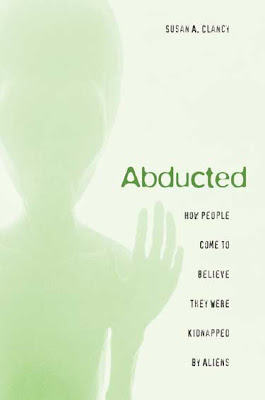
A Review of Susan Clancy's
Book On Abduction
by Stanton T. Friedman

Abducted:<br />How people Come to Believe They Were Kidnapped by Aliens
Review of Susan Clancy’s
Abducted:
How people Come to Believe They Were Kidnapped by Aliens
Harvard University Press 2005
179 pages


By Stanton T. Friedman
www.stantonfriedman.com
© 2006-2009

Stan Friedman     I hadn’t had high hopes for the book Abducted: How people Come to Believe They Were Kidnapped by Aliens by Dr. Susan A. Clancy. After all, the segment about abductions which featured her on Peter Jennings’s grossly-misleading “documentary” on February 24, 2005, was definitely unscientific. The focus was on sleep paralysis with no recognition being given to multiple persons being abducted at once, the fact that most abductions have taken place other than when the abductee was sleeping in bed, and that many people have recalled the details without the use of hypnosis. This despite the fact that all of these had been discussed by Budd Hopkins during his PJ interview, but never made the program. I also was not impressed with what she had to say on last July’s Larry King TV show. Still I was shocked by how much bias and prejudice she shows in the book. She should have been flunked for her gross inaccuracy in her accounts, brief though they were, of various cases about which I am well informed. Remember that her so-called research was conducted at Harvard University using government research grants and the book was published by Harvard University Press. I guess they couldn’t afford a fact checker.

She describes how she got into abduction research because she had been working on the false memory syndrome with regard to sexual abuse of children. There was always the problem of determining whether any abuse had ever taken place. Abductions would be much easier because “Here was a group that had ‘repressed memories,’ but the memories would be much less painful to hear about than memories of childhood sexual abuse.” No basis is given for this silly proclamation. Dr. Benjamin Simon, an outstanding psychiatrist who used medical hypnosis to help numerous shell shock war veterans regain horrifying memories and work through them, had even told Dr. James McDonald that the intensity of emotion in the Betty and Barney Hill sessions was sometimes more intense than any he had found in the military cases he had treated. I have seen the movie the Army made starring Dr. Simon about treatment of a host of anguished war veterans and their amnesia.

She goes on, “Even better, alien abductees were people who had developed memories of a traumatic event that I could be fairly certain had never occurred. A major problem with my research on false memory creation by victims of alleged sexual abuse was that it was almost impossible to determine whether they had in fact, been abused. I needed to repeat the study with a population that I could be sure had ‘recovered’ false memories.” Alien abduction seemed to fit the bill. She notes how she would use the same techniques with the abductees as with the sexual abuse people, and addressed the “corroboration issue since it was certain the event hadn’t happened.” It is hard to imagine so-called research starting out with such strong bias. Is this what passes for research at Harvard University?

Dr. Clancy describes how she got her study population. She advertised in newspapers seeking subjects “Have you been abducted by aliens?” Would she have asked for pilots or brain surgeons or persons speaking Croatian without checking their credentials?

She dumped any she thought were psychotic, for which, I suppose, we should be grateful. It isn’t clear that she accepted any subjects who claimed that they had been abducted with somebody else and not out of their beds and who hadn’t been hypnotized. She does admit her preconceptions that people thinking they had been abducted played Dungeons and Dragons as a kid, were computer programmers or sci-fi buffs and had attended Star Trek conventions. What is really crazy here, to me as a scientist, is that normally one expects somebody beginning research in a new area to do a literature search first. She couldn’t be bothered. However, she insists “I believe I have read every account of alien abduction ever published, and just about everything that social psychologists, psychoanalysts, post modernists, journalists, physicists, biologists and ex-military personal [sic] have to say about them... I’ve watched nearly every American movie and TV show ever made about aliens.” If she did, she must have been sleep-walking, as she seems to get almost everything wrong.

Here is a typical example of her gross inaccuracy. Speaking of a meeting with a number of abductees she says, “Highlight of Saturday evening was a conversation with two brothers from Manchester, New Hampshire. These men were relatively well known abductees who had written a book about their experiences. One night in the late 1960s they had been canoeing on a lake in Maine and had seen some weird lights across the water. A few years later one had fallen down an elevator shaft at work; he’d suffered brain damage, developed epilepsy and became severely depressed.” The simple fact of the matter is that there were four people involved, not two; the event took place in August, 1976, not in the 1960s. The book The Allagash Abductions was written by an experienced investigator, engineer Raymond Fowler, not by the brothers. It was based on data obtained independently from each of the four. The book is, of course, not referenced though she has 14 pages of noted references including 146 items. Her own “research” papers were each cited several times.

Clancy not only seems to consider herself a truly knowledgeable abductionist, but also an expert on UFOs in general. “So far as we know there is no evidence that aliens exist.” “You can’t disprove alien abductions. All you can do is argue that they’re improbable.” Obviously she didn’t intend this next comment to be referring to herself: “The Confirmatory bias — the tendency to seek or interpret evidence favorable to existing belief or reinterpret unfavorable evidence is ubiquitous, even among scientists.” Amen, and she provides many examples of her own tendency. “We don’t accept the alien abduction explanation because there is no external evidence to support it.” Isn’t it amazing that she never discusses physical trace cases, at least 16% of which involve reports of strange beings? She doesn’t mention the many cases in which abductees separately indicate that missing time was confirmed. She never mentions Marjorie Fish’s star map work connected with the Betty and Barney Hill case, though she does mention the case.

As might be expected, her comments are seriously in error. She says “Betty had spotted a bright star that seemed to be pursuing them. Nervous, they had turned off the main highway onto narrow mountain roads arriving home two hours later than expected.” And she claims to have read The Interrupted Journey ??? Sounds to me like she read a Parade Magazine piece, by Carl Sagan, which makes the same false claims. They had both observed the large object at close range with binoculars, for goodness sake. There was a double row of windows through which Barney recalled seeing strange beings.. without hypnosis. Starlike??? She says, “Betty was a long time believer. Betty was a fan of science fiction movies featuring aliens (she had seen Invaders from Mars ) and had already read Donald Keyhoe’s Flying Saucers Are Real .

This is more unadulterated hogwash. Betty read the book AFTER the experience, had not been a sci-fi fan, or seen the movie. Clancy says Betty and Barney were “advised to undergo hypnosis, in order to determine whether, as she firmly suspected, they had been abducted.” Their purpose was to see if the Doctor could rid Barney of his ulcers and find out what happened during the missing time. Clancy then says Barney had seen “The Bellero Shield,” an episode of the science fiction TV series The Outer Limits and that his drawing of an alien is based on what he saw. Simon had asked him about sci-fi movies. He and Betty were too busy to watch such stuff. It would be interesting to know just where Clancy’s misinformation comes from besides her fertile imagination. She certainly hadn’t read the book carefully or Terence Dickinson’s The Zeta Reticuli Incident or watched the UFO Incident on NBC or spoken with Betty or Barney or Dr. Simon or John Fuller or even Betty’s niece, Kathy Marden, very familiar with the case and possessor of Betty’s files. John Fuller’s files are at Boston University not far from Harvard. Clancy obviously hadn’t been there either. I have done all these things. An artist I know watched “The Bellero Shield”  and indicated that the alien’s facial features did not match drawings made in response to Barney’s description and was about 6 feet tall or much taller than the Hill aliens.

Demonstrating both her bias and ignorance, she claims, “Betty and Barney Hill — the mom and pop of abductees — became famous in abduction history in the 1960s because, in the words of Seth Shostak, an astronomer associated with the SETI Institute, “They were more or less Mr. And Mrs. Front Porch.” An interracial couple in New England in 1961 were hardly Mr. And Mrs. Front Porch, whatever that is supposed to mean. Surely no reasonable person could consider Seth Shostak an expert on any aspect of ufology, no less abductions. I debated with him for three hours on Coast to Coast Radio (audience vote was 57% for me, 33% for him, 10% undecided) and have read many of his articles and books. He never displays any knowledge of abductions or UFOs in general. There are no references to large-scale scientific studies such as Blue Book Special Report 14, or Dr. Hynek’s The UFO Experience or the Congressional Hearings of 1968. His comments on Larry King and Peter Jennings demonstrate no knowledge at all, though they certainly demonstrate his confirmatory bias. Clancy and Shostak certainly share an affinity for “Don’t bother me with the facts, my mind is made up,” and “What the public doesn’t know, I won’t tell them,” and “Do your research by proclamation, investigation is too much trouble.”

Clancy doesn’t discuss the UFO evidence either. She almost gets into the Condon Report with this strange comment: “In 1969, the National Academy of Sciences sponsored a study of all the available evidence on UFOs. The conclusion: ‘On the basis of present knowledge, the least likely explanation of unidentified flying objects is the hypothesis of extraterrestrial visitations by intelligent beings.’ ” The fact is, this is from a brief summary by the NAS at the beginning of the 965-page Condon report. The NAS didn’t sponsor the study. The Air Force did. It was certainly not a study of all available evidence. The NAS review committee did no investigations itself — not one single case.

Clancy misrepresents the Travis Walton case, speaking disdainfully of his books claiming he was abducted two weeks after the Hill case movie and describing his experience on National TV. No mention, of course, of his being gone for five days and the initial zapping being observed by five other people, and all the rest of the investigative work done by APRO and others.

Clancy mentions Kenneth Arnold flying his “private jet.” It was very definitely a prop plane and there was a ground witness. Her clear and unambiguous bias — there are no UFOs and no aliens — is demonstrated by her comment, “Show me an alien and I’ll believe they exist.” This is scientific? She only believes in the existence of things she can see???? Surely that leaves out love, hate, neutrons, gamma rays, black holes, etc.

As might be expected, Clancy gets Roswell all wrong. She repeats garbage from Air Force disinformation expert Colonel Weaver that Jesse Marcel’s story first came out in the National Enquirer in 1978 — even though it was 1980, and after Bill Moore and I had spoken with sixty-two people about the case. I gave the late Bob Pratt, who wrote the article, Jesse’s contact information. She has the date the rancher Mac Brazel found the wreckage and the date he came into town, the date Jesse went out, and other details, all wrong.

Clancy says that The Roswell Incident claimed that “Pieces of aliens had been among the debris. This was attested to by more than seventy witnesses who had some knowledge of the event.” This is totally false; no such claim is made in the book, to which I was a major contributor. She really blasts off: “The evidence for a crashed spaceship and dead extraterrestrials was entirely anecdotal consisting of firsthand reports from people who ‘wished to remain anonymous’ and even more tenuous second and third hand reports (so-and-so told what’s-his-name who told me that such-and-such really happened thirty years ago).” This nonsense comes from a woman claiming to have read everything about UFOs and aliens. I am a physicist who has written more than eighty UFO articles and two books relating to Roswell and was a major contributor to The Roswell Incident. No, I am not referenced at all. There are lots of real people named by me and Don Berliner and Kevin Randle and Don Schmitt — none referenced — and other serious researchers as opposed to Clancy’s pseudoscientific claims. The video “Recollections of Roswell” has firsthand testimony from twenty-seven witnesses — all named.

One could write a lot more about the trash in this book and the selfserving nonsense about being objective. Not surprisingly there is a blurb on the back from Dr. Elizabeth Loftus, one of the leaders of the False Memory Syndrome cult-like group: “Abducted is an enormously brave, smart, original book.” I suppose that is true once one recognizes that most of it is Fiction masquerading as Truth.

THE FAITH-BASED SCIENCE OF SUSAN CLANCY

Abducted - how people come to believe they were kidnapped by aliens
By Bud Hopkins
Intruders Foundation
© 2005 - 2009


Bud Hopkins The literate world is well aware that a controversy about the reality of the UFO phenomenon has raged for decades. Arrayed on one side are the enthusiasts - the casual, the serious and the bizarre - along with thousands of highly qualified pilot-witnesses, high-ranking military personnel, intensely interested scientists, and even an astronaut or two. All regard the hundreds of thousands of global sighting reports as a scientific problem of major significance, and all demand that science finally conducts a thorough, objective investigation. Centrally opposed to this position are a large number of mainstream scientists, most of whom are not only indifferent to the subject of UFOs, but also grossly uninformed about the weight of the evidence. Allied with them is a strange amalgam of groups that includes official spokesmen for the United States Air Force, Bible Belt Fundamentalist preachers such as Pat Robertson, and a small but vociferous band of self-described "rationalist" debunkers (who probably look upon their religious brethren as hopelessly superstitious). Clearly, the battle against a scientific investigation of the UFO phenomenon makes strange bedfellows.

     A few years ago, when those of us in the research community heard rumors of a two-tiered scientific investigation to be undertaken at Harvard University by experimental psychologists Richard McNally and Susan Clancy, we were curious but wary. Dr. McNally, we were told, intended to test a group of self-described UFO abductees for the presence of certain symptoms of post-traumatic stress disorder. He would employ as a model a similar test used years before, in which a group of Vietnam veterans tape recorded their traumatic war experiences and then, at a later time, were scientifically measured for signs of stress as they heard their taped accounts played back. Dr. Clancy planned to employ a word memorization test, which was supposed to reveal a subject's tendency towards false memories. Unfortunately, neither McNally nor Clancy intended to carry out any actual investigations of UFO abduction reports or examine any physical evidence. They would remain in the laboratory, limiting their project to the ostensibly scientific testing of their abductee subjects' veracity.

     Early in the Susan Clancy enterprise, any hopes I had for her objectivity evaporated when I learned that her purported abductee subjects were to be self-selected. She had placed ads in a number of newspapers, asking for those who believed they had had UFO abduction experiences to contact her. Little or no vetting took place, and her unscientific protocol thus opened the laboratory door to anyone who claimed to be an abductee. Her subjects were not a group whose accounts had been investigated and accepted as reliable by experienced researchers, but instead, Clancy accepted virtually anyone who came in off the street and told her they were, indeed, abductees. Some of her subjects had such tenuous, even vapid reasons for believing they were abductees - a "mysterious bruise" or a "vague feeling" - that knowledgeable researchers would have immediately shown them the door. The uncritical Dr. Clancy, however, made them part of the "abductee" group she studied!

     Anyone familiar with the phenomenon is aware that very few abductees will come forward to discuss their experiences publicly, or to subject themselves to "testing" of any kind by people or organizations that they do not know and trust. Doing so would be to run the very real risk of becoming targets for career-threatening ridicule. Obviously, the more highly credentialed abductees are the most hesitant to volunteer as test subjects because they have the most to lose. Neither the NASA research scientist, the NASA engineer, nor the many psychiatrists, psychologists, police officers and military professionals who, over the years, have reported their abduction experiences to me, would ever involve themselves in what might well turn out to be sensationalist and incompetently mounted tests of one kind or another. Adding to that basic flaw in her study, my second concern had to do with the fact that neither Clancy, whom I had twice met, nor McNally made any attempt to contact Dr. David Jacobs or me. They were both undoubtedly aware that the two of us have accumulated between us masses of data after decades of work with literally hundreds of abductees. We were never consulted on any issue, nor was our help in vetting test subjects called for. In retrospect, Dr. Jacobs and I could have easily prevented the two testers - innocent of the complex work of actual investigation - from making many of the egregious errors which have so seriously damaged their work.

     The results of McNally's test for signs of posttraumatic stress disorder were significant. Those reporting abductions showed virtually the same intensely emotional reactions upon hearing their taped accounts replayed as did the Vietnam vets when they heard the tapes of their traumatic war experiences. But as we soon learned in McNally's analysis of the test results, the devil was not in the details themselves but in his interpretation of the details. He announced that, since we "know" that UFO abductions don't exist, all of his subjects' accounts have to be false memories. And since they registered just as powerfully as "true" memories, what the test shows, he explained, is that "false" memories can be just as traumatic as "real" memories! This classic illustration of "heads I win, tails you lose" circular reasoning provides a perfect example of ideology trumping science. Unfortunately, as astronomer J. Allen Hynek once remarked, science is not always what scientists do. In effect, McNally seemed to be saying that even if his own test results support the traumatic reality of the abduction phenomenon, that fact changes nothing since UFO ABDUCTIONS JUST DO NOT EXIST, and that somehow, someway, he will make his test results fit his hypothesis! McNally's ideological interpretation of the test results - a clear example of "faith-based science" - is just as rigid in its way as the creationists' willful denigration of evolution, no matter what the fossil records have revealed.

     Susan Clancy's word memorization test as an indication of false memories is far more tenuous than McNally's test for the presence of posttraumatic stress. (This is perhaps not the place to go into its technical inadequacies, other than to reiterate what I have already said about its fatal flaw - the reliance upon an unvetted, self-selected sample. I will return to the specifics of her work in a later paper.) Instead, the problem I would like to discuss is her use of a rather simple word memorization protocol to ratify her belief that a subject's demonstrably traumatic memories are false. Clancy baldly stated in an early newspaper interview that she assumed everyone would accept the idea that all abduction experiences were false memories, because "everyone" knew there were no such things as UFO abductions. This, she apparently thought, was settled truth - and another illustration of irrational, faith-based science. So, at the outset of their work, neither she nor McNally intended to raise even the possibility that such things as UFO abductions might have occurred, let alone to actually investigate that possibility. The ideology they shared assumed that such experiences were, ipso facto, false memories, a theory the two seem to believe as fervently as the Pope believes in the virgin birth.

     Another analogy comes to mind. Instead of a group of abductees, imagine an equal number of women who have reported rape experiences and who are now to be tested by a pair of experimental psychologists. The psychologists state at the outset that they do not believe any of these women were actually raped and are proceeding on that assumption. Thus their goal is not to investigate the veracity of the women's claims but to discover a way of establishing their "tendencies to fantasize and form false memories." Since the testers "know" in advance that these rape memories are false, no police investigation into the alleged rape accounts is necessary - no examination of physical or medical evidence, no visits to alleged crime scenes, no interviews with possible witnesses, and no checks on the reputations of the rape victims. In short, nothing will be undertaken that might support the reality of their experiences. An outrageous, even inhumane idea, of course, but analogous to the Clancy-McNally attitude to UFO abductees.

     As I pointed out above, Clancy carried out no investigation of any of her subjects' abduction reports - no inquiries into supporting witnesses, no visits to alleged sites, no search for physical evidence, no interviews with friends and family members. Everything she did apparently took place in the laboratory, by way of her word memorization test and personal interviews, though she apparently lacked a firm grounding in the literature, history or complexity of the UFO phenomenon. Recently I appeared on "Larry King Live," along with Clancy and several others, when one of the guests showed a blow-up of the world-famous Trent UFO photographs from McMinnville, Oregon, arguably the best-known UFO photos in existence. They were prominently featured in "Life" magazine in 1950, and have been reproduced hundreds of times since in many publications. What's more, in 1969, after careful analysis, an investigator for the skeptical Condon Committee described the McMinnville photo case this way: "This is one of the few UFO reports in which all factors investigated, geometric, psychological, and physical, appear to be consistent with the assertion that an extraordinary flying object, silvery, metallic, disc-shaped, tens of meters in diameter, and evidently artificial, flew within sight of two witnesses." Optical physicist Dr. Bruce Maccabee has investigated this case thoroughly, flying to McMinneville, interviewing the Trents, their family and neighbors, taking his own test photos from the same location, and carrying out literally months of optical analysis of the original pictures. Maccabee's work has been published widely, but the photos themselves should be familiar to anyone with even a cursory involvement in UFO study and research. Yet, during the Larry King program, abduction authority Susan Clancy glanced at the photos on the monitor and said something like this: "that could be anything...someone who threw up a hubcap or a Frisbee or something." Her evident ignorance of this case, and, by extension, of the literature and history of the UFO phenomenon, was aptly illustrated by this glib, contemptuous wisecrack, a remark one might expect to hear late at night in a Texas barroom, but not from someone holding a Ph.D. degree from Harvard. Earlier, when King asked her how she became interested in the subject of UFO abductions, she began her answer this way: "I've been studying aliens for..." Studying aliens? Again, this peculiar description of her work in the laboratory is not what one would expect to hear from an experimental psychologist on an ostensibly serious TV program.

     Though as a faith-based scientist, Susan Clancy has no problem asserting her absolute belief that all UFO abduction accounts are nothing more than false memories, she is left with the problem of explaining how these memories are generated. By what process can many thousands of extremely similar accounts from around the world come into the heads of this multitude - especially since her colleague, Richard McNally, has established that abduction memories have essentially the same traumatic qualities as memories of the Vietnam War? Clancy's solution was to cobble together a melange of theories, many of them mutually contradictory, in an attempt to account for the power and similarity of these "false" memories. Abduction researchers have long been familiar with the explanations Clancy offers, and over the years we have refused to deal with many individuals whose abduction accounts are either extremely tenuous, lacking in evidence, or easily explained away. Where we differ from Clancy is that she insists upon her a priori belief that every abduction case can be explained away by her various theories and that no actual investigation is necessary, whereas experienced investigators, being scientific skeptics, believe that abduction accounts, accompanied by supporting evidence of various types, deserve investigation before firm conclusions about their credibility can be drawn.

     Her first explanation - one that is currently popular with debunkers of every stripe - is that abduction memories are formed during episodes of sleep paralysis, a relatively rare neurological event that usually lasts a matter of seconds. The sleep paralysis explanation has been eagerly seized upon because a sizeable percentage of UFO abductions occur at night, in the subject's bedroom. There are, of course, myriad objections to the sleep paralysis theory, but it clearly self-destructs before one central problem: the large percentage of UFO abductions which occur in the daytime, when the abductee is up and about, driving a car, taking a walk, playing in the front yard, or even, in one case, driving a tractor. In fact, for the first twenty years of UFO abduction accounts, I am aware of none that reportedly took place inside one's home or bedroom. So, as science decrees, if a theory does not fit the data, it must be rejected.

     Clancy also indicts the use of hypnosis as the medium by which false memories are implanted in unsuspecting clients by unscrupulous hypnotists. The problem with this theory is that about 30% of the thousands of UFO abduction reports researchers have investigated were recalled without the use of hypnosis. Beyond that, virtually all abductees recall at least some aspects of their experiences without hypnosis. Otherwise, they would have had no reason to contact an investigator in the first place. In the light of these facts, the "hypnosis explanation" as to how "false" abduction recollections are generated also collapses.

     It should be added that further doubts about the efficacy of hypnosis in inducing false memories have been raised by recent experimental studies, such as the work of psychologists Steven Lynn and Irving Kirsch. They summarize their results this way: "The most appropriate conclusion that can be drawn from the evidence is that hypnosis does not reliably produce more false memories than are produced in a variety of non-hypnotic situations in which misleading information is conveyed to participants." It is also a matter of record that many hypnotherapists with no knowledge of the abduction phenomenon have, to their surprise, uncovered traumatic abduction recollections in subjects with whom they were working. In fact, Dr. Benjamin Simon, a psychiatrist highly skeptical of UFO reality who was treating Betty and Barney Hill for post traumatic stress, uncovered details of their terrifying abduction experience in what is now seen as the first systematically investigated UFO abduction case. Obviously, during hypnosis, his personal skepticism had no effect whatsoever on the Hills' recollections. There are many reasons to trust the process of hypnosis, if it is handled carefully and skeptically, with the use of false leads and other validating techniques (all of which I have discussed elsewhere). But it should be clear by now that objective science must reject Clancy's theory that hypnosis per se is implicated in the wholesale generation of false memories.

     One of the early theories used to explain UFO abduction reports insisted that such experiences were nothing more than a new "space age religion." Since the gods are supposedly dead, abductees have invented encounters with "godlike" alien beings to replace them. But that highly speculative theory was discounted years ago by serious researchers on both sides of the issue because of yet another major problem: the vast majority of UFO abductees feel that their abductions have been deeply traumatizing - sometimes even physically painful and injurious - and that the small, hairless, big-eyed UFO occupants they describe are anything but godlike. (Richard McNally's own test results buttress this abductee view). It should be pointed out, however, that one occasionally comes across an abductee who is fully aware of the emotional trauma he has suffered, but who is nevertheless willing to regard these experiences as being, in some way, spiritually uplifting. For such people, this positive view of traumatic events is probably a coping strategy, similar to that of certain battered wives who will not complain to the police, but instead insist that their abusive husbands really do love them. Perhaps, for some battered wives as well as for some traumatized abductees, this kind of coping strategy is a way of retaining one's self esteem by fighting off the sense of being a helpless victim and by insisting that somewhere, somehow their ordeals must have a silver lining. One is reminded of the many victims of Hurricane Katrina who have lost everything but whom, when interviewed on television, cling to the idea that their ghastly experiences have somehow been transformative and spiritually uplifting.

     Equally damning of Clancy's religious explanation is the fact that the UFO reports of many abductees in more primitive cultures describe exactly the same details as do abductees in more advanced cultures, and yet these more primitive people work assiduously to make their UFO experiences fit into the schema of their traditional religions. Thus, in a well-known Zimbabwe incident, the natives who described small, white-skinned aliens in shiny one-piece jumpsuits insisted that they were the ghosts of their ancestors, who can now, apparently, fly around in wingless metal discs. Clancy would have us believe that many previously religious people have simply dropped their traditional beliefs and begun to worship the abducting aliens in a new kind of "false-memory religion," but in cases such as this African incident, the natives did the opposite. They forced the conventional "space age" UFO and the white-skinned aliens they had actually observed into strained conformity with their pre-existing religious beliefs. Thus their UFO experience can be seen as strengthening their traditional beliefs, rather than replacing them.

     Another shaky explanation Clancy mentions is that of media contamination. According to this idea, perfectly normal people are so influenced by something they've seen on TV or read in a book that, like helpless sponges, they adopt details from other people's abduction accounts and thus weave tenaciously held false memories from "an odd bruise" or a "strange feeling" or something equally tenuous. It is unnecessary to point out that experienced investigators would, at the outset, recognize these "wannabes" for what they were and refuse to deal with them. Furthermore, it seems obvious that these newly minted "wannabes" would be among the first to answer Clancy's ads soliciting abductees for her tests, because, in doing so they would achieve legitimacy by becoming part of her sample. Thus the central point of her "contamination" argument brilliantly exposes the original and most damaging flaw in her methodology: the self-selected and therefore completely unrepresentative nature of her subjects.

     So who were the people Clancy was attempting to test? Were there some apparently legitimate abductees among her sample? Possibly. Were there wannabes, publicity seekers and emotionally unstable people among her sample? Undoubtedly. And under these conditions, what kind of valid generalizations could she possibly make about the UFO abduction phenomenon?

     In the light of these crippling problems in her methodology, we must briefly consider which areas of the complex, many-sided abduction phenomenon which Clancy's faith-based attitude refused to consider. What kinds of data did she overlook? Here, briefly, are some examples:
# 1. She included no study of the patterns of well-known and clearly defined physical sequelae - scoop marks and straight-line cuts - that frequently appear on individuals after their abductions.

# 2. She included no reference to the patterns of ground traces - altered soil, tree branches snapped off from the top down, affects on the surrounding foliage, etc. that are often discovered at UFO landing sites after abductions.

# 3. She made no mention of the eye-witness testimony of neighbors observing a UFO hovering over a house where an abduction is taking place; of witnesses who search in vain for an abducted child who is later found outside a fully locked house; of the incidents in which the police are summoned because of the temporary disappearance of a baby from his crib or a child from her bedroom, but who turn up, unobserved, an hour or so later; or hundreds of similar cases in which abductees are known to be inexplicably missing.

# 4. She made no mention of the bizarre errors the UFO occupants often make, such as returning individuals from group abductions wearing someone else's clothes; replacing abductees in the wrong room or building after an abduction; or returning an individual to her bedroom in a locked and bolted house with her feet soiled and the back of her nightgown covered with damp leaves; or any of the scores of other such significant errors.

# 5. She made no mention of the hundreds of cases in which two or more individuals are abducted at once, and whose traumatic memories match in every detail.

# 6. She made no mention of a few accounts - such as the Travis Walton case or the Linda Cortile abduction - in which numerous witnesses see all or part of the abduction as it is being carried out.

# 7. She made no effort to interview the friends and family members of the people in her sample, or in fact anyone who might have insight into their general trustworthiness and emotional soundness. Instead, Susan Clancy alone, because of her faith in the non-existence of UFO abductions, decided that all of her subjects' abduction accounts were false, and that all of their traumatic recollections were nothing more than false memories. She is therefore implying - indirectly but absolutely - that none of her subjects can tell the difference between dream and reality. To the public at large, this means, in effect, that an experimental psychologist with a Harvard degree believes everyone claiming UFO abduction experiences is suffering from a form of mental illness.
      For me, in the absence of any actual investigation of their accounts, such a radical, blanket condemnation by Susan Clancy of her innocent and naively trusting subjects is both ethically reprehensible and a disgrace to science.