Showing posts with label Space Command. Show all posts

Friday, July 14, 2023

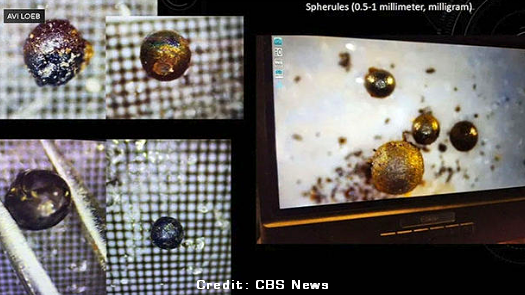
Alien Technology Found, Says Harvard Professor Avi Loeb

Compiled Images of alleged alien spheres found by Harvard Professor Avi Loeb

Harvard professor Avi Loeb believes he may have found fragments of alien technology from a meteor that landed in the waters off of Papua, New Guinea in 2014.

     Loeb and his team just brought the materials back to Harvard for analysis. The U.S. Space Command confirmed with almost near certainty, 99.999%, that the material came from another solar system. The government gave Loeb a 10 km (6.2 mile) radius of where it may have landed.

Wednesday, April 19, 2023

Alleged Alien Probe or Extraterrestrial Artifact To Be Investigated (Video)

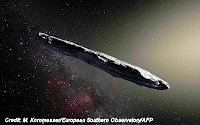
Artwork by www.theufochronicles.com showing Alien Probe or Extraterrestrial Artifact Entering Earth's Atmosphere


A "runaway fireball" that crashed into the water off the coast of Papua New Guinea in 2014 could be an alien probe or extraterrestrial artifact similar to U.S. interstellar probes like NASA's "Voyagers," Harvard professor Dr. Avi Loeb told Fox News Digital.

That would be strong potential evidence of alien life.
     The space object crashed into the Bismarck Sea with a percentage of the energy force of the Hiroshima bomb in 2014 and likely traveled "from the deep interior of a planetary system or a star in the thick disk of the Milky Way galaxy," Loeb said.
By Chris Eberhart
Fox News
4-15-23

Sunday, April 17, 2022

An interstellar object exploded over Earth in 2014, declassified government data reveal

United Nations Takes Aim at Asteroid Threat to Earth

     A fireball that blazed through the skies over Papua New Guinea in 2014 was actually a fast-moving object from another star system, according to a recent memo released by the U.S. Space Command (USSC).

By Brandon Specktor
.livescience.com
4-11-22
The object, a small meteorite measuring just 1.5 feet (0.45 meter) across, slammed into Earth's atmosphere on Jan. 8, 2014, after traveling through space at more than 130,000 mph (210,000 km/h) — a speed that far exceeds the average velocity of meteors that orbit within the solar system, according to a 2019 study of the object published in the preprint database arXiv.