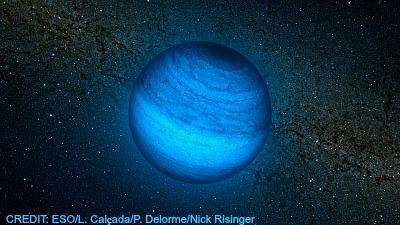
Showing posts with label Rogue Planets. Show all posts

Saturday, March 29, 2014

Could 'Planet X' Still be Lurking Out There?


Bookmark and Share

Could 'Planet X' Still be Lurking Out There?

By Nola Taylor Redd
Space.com
3-28-14

     The hunt for the hypothetical "Planet X" has been fruitless so far, but that doesn't mean astronomers are calling it off.

A new analysis of data collected by NASA's Wide-Field Infrared Survey Explorer (WISE) spacecraft revealed no sign of the mysterious Planet X hypothesized to exist in the outer solar system. But scientists are keeping up the search for a planet or dim star far from the sun.

ANALYSIS: Is 'Planet X 2.0' Lurking Beyond Pluto's Orbit?

"I think astronomers will continue to search for a distant companion to the sun with every new, deeper survey," Kevin Luhman of the University of Pennsylvania told Space.com by email. Luhman, who studies low-mass stars and "failed stars" known as brown dwarfs, recently published the results of his search for Planet X using WISE.

"We have a natural desire to better determine the contents of our solar system," Luhman said. "There's a vast volume of space in the outer solar system, and we would like to know what's out there."

And a recent find may give a boost to the hunt for Planet X. On Wednesday (March 26), researchers announced they had discovered a dwarf planet orbiting the sun in a distant, largely unexplored region known as the inner Oort Cloud. . . .

Tuesday, November 27, 2012

Astronomy Round-Up: Super-Earths, Broken Satellites, and Rogue Planets

Bookmark and Share

Rogue Planet

By Tom Ingram
Tom Ingram
11-26-12

     Astronomers have been doing brisk business over the last few weeks. Recently there have been a number of important discoveries about the nature of our universe. Here’s a roundup of three of them.

Researchers led by Mikko Tuomi of the University of Hertfordshire in the UK have announced the discovery of three new “super-Earth” planets orbiting the star HD 40307 – and one of them is in the star’s habitable zone. The term “super-Earth” is a little misleading, because it implies that the planet is like Earth, only bigger and better. In reality, a super-Earth is just a terrestrial planet that is up to ten times more massive than Earth – in other words, a rocky planet larger than Earth but smaller than Uranus.

HD 40307 was previously known to have three planets in its orbit. These planets, also super-Earths, orbit close to the star, too close to support life. Now the researchers have discovered three additional planets. The outermost of these, a planet seven times the mass of Earth, orbits HD 40307 at a distance similar to the Earth’s from the Sun. It exists in HD 40307’s “Goldilocks zone” (i.e., habitable zone), meaning the planet could support liquid water and a stable atmosphere. It also rotates on its axis in a way similar to Earth, suggesting the possibility of a day-night cycle like our own.

The discovery was made possible by a new technique for analyzing data from the HARPS spectrograph. HARPS senses the changes in the colour of a star’s light due to the gravitational pull of its planets. By filtering out noise from the star itself, the scientists were able to find extremely weak, previously undetectable signals indicating the presence of these three planets. . . .

Tuesday, May 15, 2012

SPACE NEWS | Free Floating Planets Could Harbor Alien Life, New Study Suggests

Bookmark and Share

Free Floating Planets

By Darren Osborne
ABC Science
"If the dust included microbial material that originated on Earth ... this process offers a way by which evolved genes from Earth life could become dispersed through the galaxy,"

     Our galaxy could have as many as a hundred thousand billion life-carrying Earth-sized planets floating between the stars, according to a new study.

An international team of scientists led by Professor Chandra Wickramasinghe, of the University of Buckingham, publish their finding in the journal Astrophysics and Space Science.

Recent estimates have suggested that our galaxy has as many planets as stars - approximately 200 billion - with most of those planets not orbiting a star. But this latest study dramatically increases the number of 'free-floating' planets.

Wickramasinghe and colleagues propose that these planets originated in the early universe a few million years after the Big Bang, and that they make up most of the so-called "missing mass" of galaxies, known as dark matter. . . .