Showing posts with label Astronomy. Show all posts

Monday, September 04, 2017

Mystery of a Star That Vanished After 14 Days

Bookmark and Share
Mystery of a Star That Vanished After 14 Days

     Nearly six centuries ago, Korean astronomers scanning the night sky for omens of the future spotted a new star in the cluster of stars they called Wei, and what today’s star watchers consider the tail of the Scorpius constellation.
By Kenneth Chang
New York Times
8-30-17

Fourteen nights later, it vanished.

Astronomers have now identified the source of that brief brightening — a binary star system a couple of thousand light-years away.

Wednesday, December 31, 2014

Mystery Object Near Milky Way's Monster Black Hole

Bookmark and Share

Mystery Object Near Milky Way's Monster Black Hole
A computer simulation shows the G2 gas cloud's encounter with the supermassive black hole Sagittarius A* at the center of the Milky Way, as well as the paths of the many other objects that orbit the black hole.

By Calla Cofield
Space.com
12-30-14

      A mystery object at the center of the galaxy has astronomers scratching their heads, and a new piece of information won't be solving the case before the New Year.

In yet another twist to a saga of astronomical proportions, astronomers have identified what they say is a gas cloud that made a tight orbit around the supermassive black hole at the center of the Milky Way galaxy 13 years ago. The object could be one in a series of gas clouds, the second of which may soon become a snack for the black hole.

The newly discovered object has been dubbed G1. An object known as G2 has been in the news for more than a year, ever since astronomers at the Max Planck Institute for Extraterrestrial Physics in Germany hypothesized that it was a gas cloud. If that is true, it should lose some of its material to the supermassive black hole at the center of the Milky Way (known as Sagittarius A* or Sgr A*). This giant black hole — its name is pronounced Sagittarius A(star) — doesn't dine on material often, so the event would be a rare chance for astronomers to watch a black hole eat. . . .

Saturday, August 02, 2014

New Scientific Breakthroughs Continue with Hubble Telescope

Hubble Extends Parallax Stellar Distance Measurements

Hubble Space Telescope still pushing the frontiers of astronomy

By William Harwood
CBS News
8-1-14

      Nearly a quarter of a century after its 1990 launch, the Hubble Space Telescope is still pushing the frontiers of observational astronomy, thanks to the sensitivity of its instruments, the ultra precise way the observatory can be controlled and ingenious new techniques that are allowing astronomers to peer deeper into the cosmos than ever before.

"That's why the Hubble is still so exciting," said Matt Mountain, director of the Space Telescope Science Institute at Johns Hopkins University in Baltimore. "We're learning more and more about how to use it even better and better, whether it's looking for exoplanet atmospheres, measuring dark energy to a precision we never thought possible or using gravitational lenses to push Hubble to look even further back in time."

In recent observations, Hubble has been used to search for dim, difficult-to-detect minor planets beyond the orbit of Pluto, possible candidates for a flyby after the New Horizons probe streaks past Pluto in 2015. Hubble has monitored Jupiter's Great Red Spot, which appears to be shrinking, and a comet -- Sliding Spring -- that will make a close flyby of Mars in October.

But it's Hubble's ability to capture light from galaxies shining when the universe was a fraction of its present age that continues to intrigue scientists and the public alike, providing a glimpse into the depths of cosmic history. . . .

Tuesday, November 27, 2012

Astronomy Round-Up: Super-Earths, Broken Satellites, and Rogue Planets

Bookmark and Share

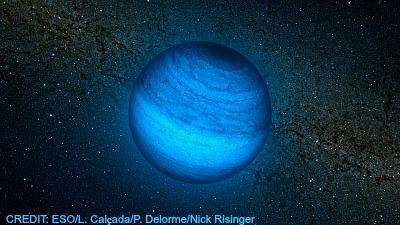
Rogue Planet

By Tom Ingram
Tom Ingram
11-26-12

     Astronomers have been doing brisk business over the last few weeks. Recently there have been a number of important discoveries about the nature of our universe. Here’s a roundup of three of them.

Researchers led by Mikko Tuomi of the University of Hertfordshire in the UK have announced the discovery of three new “super-Earth” planets orbiting the star HD 40307 – and one of them is in the star’s habitable zone. The term “super-Earth” is a little misleading, because it implies that the planet is like Earth, only bigger and better. In reality, a super-Earth is just a terrestrial planet that is up to ten times more massive than Earth – in other words, a rocky planet larger than Earth but smaller than Uranus.

HD 40307 was previously known to have three planets in its orbit. These planets, also super-Earths, orbit close to the star, too close to support life. Now the researchers have discovered three additional planets. The outermost of these, a planet seven times the mass of Earth, orbits HD 40307 at a distance similar to the Earth’s from the Sun. It exists in HD 40307’s “Goldilocks zone” (i.e., habitable zone), meaning the planet could support liquid water and a stable atmosphere. It also rotates on its axis in a way similar to Earth, suggesting the possibility of a day-night cycle like our own.

The discovery was made possible by a new technique for analyzing data from the HARPS spectrograph. HARPS senses the changes in the colour of a star’s light due to the gravitational pull of its planets. By filtering out noise from the star itself, the scientists were able to find extremely weak, previously undetectable signals indicating the presence of these three planets. . . .