Showing posts with label New. Show all posts

Friday, January 11, 2019

New Mysterious Radio Bursts From Deep Space, Is It Aliens?

New Mysterious Radio Bursts From Deep Space, Is It Aliens?

Mysterious fast radio bursts from deep space ‘could be aliens’

     Astronomers have detected mysterious, ultra-brief repeating energy bursts from deep space for only the second time in history, and some experts suggested they could be evidence of advanced alien life.
By Mattha Busby
The Guardian
1-9-19

The origin of fast radio bursts (FRBs), millisecond-long pulses of radio waves, is unknown, but most scientists say they are generated by powerful astrophysical phenomena emanating from billions of light years outside our galaxy, the Milky Way – such as black holes or super-dense neutron stars merging together.

Some, however, including Prof Avi Loeb, from the Harvard-Smithsonian centre for astrophysics, have posited more outlandish theories, suggesting they could be evidence of incredibly advanced alien technology.

Tuesday, April 19, 2016

Earth-Like Planet Found in Nearby Star System?

Earth-Like Planet Found in Nearby Star System?

     (Phys.org)—An Earth-like planet may be lurking in a star system located just 16 light years away, according to a new research. The star, named Gliese 832, was recently investigated by a team of astronomers searching for additional exoplanets that may be residing between the two currently known alien worlds in this system. A paper detailing the finding was published online on Apr. 15 in the arXiv journal.
By Tomasz Nowakowski
phys.org
4-19-16

Gliese 832 is a red dwarf and has just under half the mass and radius of our sun. The star is orbited by a giant Jupiter-like exoplanet designated Gliese 832b and by a super-Earth mass planet Gliese 832c. The gas giant, with a mass of 0.64 Jupiter masses, is orbiting the star at a distance of 3.53 AU, while the other planet is potentially a rocky world, around five times more massive than the Earth, residing very close its host star—about 0.16 AU.

Now, a team of astronomers, led by Suman Satyal of the University of Texas at Arlington, has reanalyzed the available data on this nearby planetary system hoping to find more extrasolar worlds that may be located in a vast space between the two known planets. [...]

Saturday, August 22, 2015

New, Incredible Closeup Images of Saturn’s Moon Dione

Saturn's Moon Dione
This view from NASA's Cassini spacecraft looks toward Saturn's icy moon Dione, with giant Saturn and its rings in the background, just prior to the mission's final close approach to the moon on August 17, 2015.

Cassini's Final Breathtaking Close Views of Dione

By NASA
8-20-15

      A pockmarked, icy landscape looms beneath NASA's Cassini spacecraft in new images of Saturn's moon Dione taken during the mission's last close approach to the small, icy world. Two of the new images show the surface of Dione at the best resolution ever.

Cassini passed 295 miles (474 kilometers) above Dione's surface at 11:33 a.m. PDT (2:33 p.m. EDT) on Aug. 17. This was the fifth close encounter with Dione during Cassini's long tour at Saturn. The mission's closest-ever flyby of Dione was in Dec. 2011, at a distance of 60 miles (100 kilometers).

The full set of images released today is available here.

"I am moved, as I know everyone else is, looking at these exquisite images of Dione's surface and crescent, and knowing that they are the last we will see of this far-off world for a very long time to come," said Carolyn Porco, Cassini imaging team lead at the Space Science Institute, Boulder, Colorado. "Right down to the last, Cassini has faithfully delivered another extraordinary set of riches. How lucky we have been."

Raw, unprocessed images from the flyby are available here.

The main scientific focus of this flyby was gravity science, not imaging. This made capturing the images tricky, as Cassini's camera was not controlling where the spacecraft pointed.

"We had just enough time to snap a few images, giving us nice, high resolution looks at the surface," said Tilmann Denk, a Cassini participating scientist at Freie University in Berlin. "We were able to make use of reflected sunlight from Saturn as an additional light source, which revealed details in the shadows of some of the images."

Cassini scientists will study data from the gravity science experiment and magnetosphere and plasma science instruments over the next few months as they look for clues about Dione's interior structure and processes affecting its surface.

Only a handful of close flybys of Saturn's large, icy moons remain for Cassini. The spacecraft is scheduled to make three approaches to the geologically active moon Enceladus on Oct. 14 and 28, and Dec. 19. During the Oct. 28 flyby, the spacecraft will come dizzyingly close to Enceladus, passing a mere 30 miles (49 kilometers) from the surface. Cassini will make its deepest-ever dive through the moon's plume of icy spray at this time, collecting valuable data about what's going on beneath the surface. The December Enceladus encounter will be Cassini's final close pass by that moon, at an altitude of 3,106 miles (4,999 kilometers).

After December, and through the mission's conclusion in late 2017, there are a handful of distant flybys planned for Saturn's large, icy moons at ranges of less than about 30,000 miles (50,000 kilometers). Cassini will, however, make nearly two dozen passes by a menagerie of Saturn's small, irregularly shaped moons -- including Daphnis, Telesto, Epimetheus and Aegaeon -- at similar distances during this time. These passes will provide some of Cassini's best-ever views of the little moons.

During the mission's final year -- called its Grand Finale -- Cassini will repeatedly dive through the space between Saturn and its rings.

The Cassini-Huygens mission is a cooperative project of NASA, ESA (European Space Agency) and the Italian Space Agency. NASA's Jet Propulsion Laboratory in Pasadena, California, manages the mission for the agency's Science Mission Directorate in Washington. JPL is a division of the California Institute of Technology in Pasadena. The Cassini imaging operations center is based at the Space Science Institute in Boulder, Colo. ...

Wednesday, June 18, 2008

New Fuel Cell System 'Generates Electricity with Only Water, Air'

Water Powered Car
By Kouji Kariatsumari
Nikkei Electronics
6-13-08

     Genepax Co Ltd explained the technologies used in its new fuel cell system "Water Energy System (WES)," which uses water as a fuel and does not emit CO2.

The system can generate power just by supplying water and air to the fuel and air electrodes, respectively, the company said at the press conference, which took place June 12, 2008, at the Osaka Assembly Hall.

The basic power generation mechanism of the new system is similar to that of a normal fuel cell, which uses hydrogen as a fuel. According to Genepax, the main feature of the new system is that it uses the company's membrane electrode assembly (MEA), which contains a material capable of breaking down water into hydrogen and oxygen through a chemical reaction.

Though the company did not reveal the details, it "succeeded in adopting a well-known process to produce hydrogen from water to the MEA," said Hirasawa Kiyoshi, the company's president. This process is allegedly similar to the mechanism that produces hydrogen by a reaction of metal hydride and water. But compared with the existing method, the new process is expected to produce hydrogen from water for longer time, the company said.

With the new process, the cell needs only water and air, eliminating the need for a hydrogen reformer and high-pressure hydrogen tank. Moreover, the MEA requires no special catalysts, and the required amount of rare metals such as platinum is almost the same as that of existing systems, Genepax said.

Unlike the direct methanol fuel cell (DMFC), which uses methanol as a fuel, the new system does not emit CO2. In addition, it is expected to have a longer life because catalyst degradation (poisoning) caused by CO does not occur on the fuel electrode side. As it has only been slightly more than a year since the company completed the prototype, it plans to collect more data on the product life.

At the conference, Genepax unveiled a fuel cell stack with a rated output of 120W and a fuel cell system with a rated output of 300W. In the demonstration, the 120W fuel cell stack was first supplied with water by using a dry-cell battery operated pump. After power was generated, it was operated as a passive system with the pump turned off.

This time, the voltage of the fuel cell stack was 25-30V. Because the stack is composed of 40 cells connected in series, it is expected that the output per cell is 3W or higher, the voltage is about 0.5-0.7V, and the current is about 6-7A. The power density is likely to be not less than 30mW/cm2 because the reaction area of the cell is 10 x 10 cm.

Meanwhile, the 300W fuel cell system is an active system, which supplies water and air with a pump. In the demonstration, Genepax powered the TV and the lighting equipment with a lead-acid battery charged by using the system. In addition, the 300W system was mounted in the luggage room of a compact electric vehicle "Reva" manufactured by Takeoka Mini Car Products Co Ltd, and the vehicle was actually driven by the system.

Genepax initially planned to develop a 500W system, but failed to procure the materials for MEA in time and ended up in making a 300W system.

For the future, the company intends to provide 1kw-class generation systems for use in electric vehicles and houses. Instead of driving electric vehicles with this system alone, the company expects to use it as a generator to charge the secondary battery used in electric vehicles.

Although the production cost is currently about ¥2,000,000 (US$18,522), it can be reduced to ¥500,000 or lower if Genepax succeeds in mass production. The company believes that its fuel cell system can compete with residential solar cell systems if the cost can be reduced to this level.

Monday, May 16, 2005

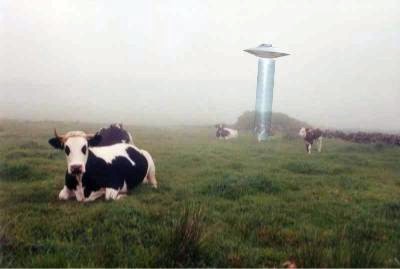
Cow Mutilation Investigator Says Truth Is Out There

Saucer Abducting Cow

www.thenewmexicochannel.com
5-16-05

     ALBUQUERQUE, N.M. -- Human researchers, not Martians, likely mysteriously mutilated cattle in the Southwest during the 1970s and 1980s.

That's what a retired police officer tells Action 7 News.

He would like to say more, but he says the topic is too "sensitive."

"It's solved. I know who did it," said Gabe Valdez, a retired New Mexico State Police officer. "I don't want to go on too much, because it's so sensitive – the research that we're doing."