Showing posts with label Invisible. Show all posts

Thursday, September 11, 2014

'Transparent UFO' Caught On Night Vision, By Military Eyewitness | VIDEO

Bookmark and Share


Military Eyewitness Captures 'Transparent UFO' On Night Vision


Lee Speigel By Lee Speigel
The Huffington Post
9-10-14

     A "low, slow, silent, see-through triangle" was videotaped in the sky above Leland, North Carolina, on the night of May 13, 2014.

The man who taped the event -- an alleged military combat instructor who prefers to remain anonymous -- reported it in August to MUFON, the Mutual UFO Network, where it's listed as case #58923 and is still under investigation.

Here is part of the witness description as reported to MUFON:
I was looking through [night vision] goggles and noticed a 'plane' coming toward me from the north, heading south. It was relatively low, 5,000 feet or a little less. I'm pretty good at estimating distances, I'm an experienced skydiver and long-distance shooter. I thought it was a little weird that I wasn't hearing it coming toward me, so I started recording on the PVS-14 [night vision monocular].

As I'm watching it, I notice that as it's passing stars, I could see stars through the craft! I saw stars through the 'fuselage' of the craft! Later, I confirmed this when I reviewed the video.
Watch the object in night vision:

Sunday, September 07, 2014

Triangular UFO Caught On Night Vision | VIDEO

Bookmark and Share

Triangular UFO Caught On Night Vision Video - May 2014

“See-through” triangle UFO caught on video using night vision


By Alejandro Rojas
openminds.tv
9-5-14

      A military combat instructor says he caught a UFO on video that could not be seen by the naked eye. He described the object as a “Slow flying, low, silent, see-through triangle.”

We recently posted a story about UFO sightings from the North Carolina beaches near the town of Wilmington. We received many responses from others in the area who also had sightings. However, one of the most spectacular cases we received is this one from Leland, North Carolina, which is on the northwest side of Wilmington.

This case was sent to us by a field investigator with the North Carolina chapter of the Mutual UFO Network (MUFON), Kenneth Bates. Bates says he believes the craft caught in this video, “while probably not alien, it is a video of a craft that possesses very advanced technology: (1)the ability to ‘cloak’ itself and (2) a reflective component that gives the illusion of transparency.”

He stresses that he, the director of North Carolina MUFON Lakita Adams, and the witness, all feel that the UFO is most likely some sort of advanced military aircraft with a cloaking device. . . .

Monday, February 04, 2013

Silent, Translucent Craft Sighted Near Brisbane | MY UFO EXPERIENCE


Bookmark and Share

UFO Cloaked

Reader Submitted Report
[Unedited]
1-20-12
     Hello Frank

I would like to relay to you an experience I had last year on the night of 20 April around 8.30pm. I live in a northern suburb of Brisbane , Australia and had just arrived home from an afternoon shift from my workplace at a well known airline company. I had stepped from my car when . being a nice clear night I looked up at the sky as I like to do sometimes when I noticed a clear jelly like craft moving swiftly and silently across the sky about light aircraft height of I suppose 500 meters up. It was totally silent and even though I would say it was invisible I saw it due to it being like a jelly like translucent colour, I would compare it to a cloaked craft like you would see on a Star Trek episode. I tracked the craft for about 10 seconds until it disapeared into the darker night sky. It was very strange and I can attest to the fact I was totally sober and of sound mind when I saw this.

Monday, January 10, 2011

" . . . Physicists Have Built Invisibility Cloaks That Can Shield Large Objects Lying On a Plane"

Cloak Equation


Invisibility cloaks shield the large and visible

By physicsworld.com
1-1-2011

     Two independent groups of physicists have built invisibility cloaks that can shield large objects lying on a plane. These "carpet cloaks" are far closer to the intuitive idea of an invisibility cloak than devices previously built, they argue, because they hide objects that can be seen with the naked eye and do so at visible wavelengths. The cloaks are also relatively cheap and easy to make, being constructed from the natural material calcite.

Carpet cloaks were proposed in 2008 by John Pendry of Imperial College, London as a way of extending the operating range of invisibility cloaks, which were mostly limited to microwave wavelengths. These devices are placed over an object sitting on a reflective plane and alter the path of light bouncing off the object in such a way that the light appears to have bounced straight off the plane.

However, all visible-light carpet cloaks built so far were demonstrated under a microscope, hiding objects no larger than 100 wavelengths across (about 50 μm). In addition, these cloaks were difficult to make, since they consisted of complex, artificially engineered materials. And they were not portable because the cloak, object and surrounding medium all tended to be made from a single structure.

Antistrophic breakthrough

The latest devices follow on from the work of Yu Luo of Zhejiang University in China and colleagues who realized last year that carpet cloaks can be built from homogeneous – rather than more complex inhomogeneous – materials, as long as those materials are anisotropic. Both devices in fact are built from the naturally occurring crystalline material calcite, the refractive index of which depends on the relative orientation of an incoming light wave’s polarization axis and the calcite’s optical axis.

Sunday, January 09, 2011

"British Military Scientists . . . Working To Develop An Army of Invisible Tanks"

Invisible Tanks


By UPI
1-9-2011

     LONDON, Jan. 9 (UPI) -- British military scientists say they're working to develop an army of invisible tanks ready for use on the battlefield within five years.

The armored vehicles will use a technology known as "e-camouflage" that would let images on the vehicle's hull change to match their environment, The Sunday Telegraph reported.

Sophisticated electronic sensors attached the tank's hull would project images of the surrounding environment back on the outside of the vehicle, helping it blend into the landscape and evade attack, the report said.

Army & Air Force Fund Research into 'Invisibility Shields'; Scientists Invent Metamaterial Which Alters How Light Normally Behaves

Army & Air Force Fund Research into 'Invisibility Shields


Invisibility shields one step closer with new metamaterials that bend light backwards

By Sarah Yang
Media Relations
UC Berkeley
8-11-08

     BERKELEY – Scientists at the University of California, Berkeley, have for the first time engineered 3-D materials that can reverse the natural direction of visible and near-infrared light, a development that could help form the basis for higher resolution optical imaging, nanocircuits for high-powered computers, and, to the delight of science-fiction and fantasy buffs, cloaking devices that could render objects invisible to the human eye.

Two breakthroughs in the development of metamaterials - composite materials with extraordinary capabilities to bend electromagnetic waves - are reported separately this week in the Aug. 13 advanced online issue of Nature, and in the Aug. 15 issue of Science.

Applications for a metamaterial entail altering how light normally behaves. In the case of invisibility cloaks or shields, the material would need to curve light waves completely around the object like a river flowing around a rock. For optical microscopes to discern individual, living viruses or DNA molecules, the resolution of the microscope must be smaller than the wavelength of light.

The common thread in such metamaterials is negative refraction. In contrast, all materials found in nature have a positive refractive index, a measure of how much electromagnetic waves are bent when moving from one medium to another.

In a classic illustration of how refraction works, the submerged part of a pole inserted into water will appear as if it is bent up towards the water's surface. If water exhibited negative refraction, the submerged portion of the pole would instead appear to jut out from the water's surface. Or, to give another example, a fish swimming underwater would instead appear to be moving in the air above the water's surface.

Other research teams have previously developed metamaterials that function at optical frequencies, but those 2-D materials have been limited to a single monolayer of artificial atoms whose light-bending properties cannot be defined. Thicker, 3-D metamaterials with negative refraction have only been reported at longer microwave wavelengths.

"What we have done is take two very different approaches to the challenge of creating bulk metamaterials that can exhibit negative refraction in optical frequencies," said Xiang Zhang, professor at UC Berkeley's Nanoscale Science and Engineering Center, funded by the National Science Foundation (NSF), and head of the research teams that developed the two new metamaterials. "Both bring us a major step closer to the development of practical applications for metamaterials."

Zhang is also a faculty scientist in the Material Sciences Division at the Lawrence Berkeley National Laboratory.

Humans view the world through the narrow band of electromagnetic radiation known as visible light, with wavelengths ranging from 400 nanometers (violet and purple light), to 700 nanometers (deep red light). Infrared light wavelengths are longer, measuring from about 750 nanometers to 1 millimeter. (A human hair is about 100,000 nanometers in diameter.)

For a metamaterial to achieve negative refraction, its structural array must be smaller than the electromagnetic wavelength being used. Not surprisingly, there has been more success in manipulating wavelengths in the longer microwave band, which can measure 1 millimeter up to 30 centimeters long.

In the Nature paper, the UC Berkeley researchers stacked together alternating layers of silver and non-conducting magnesium fluoride, and cut nanoscale-sized fishnet patterns into the layers to create a bulk optical metamaterial. At wavelengths as short as 1500 nanometers, the near-infrared light range, researchers measured a negative index of refraction.

Jason Valentine, UC Berkeley graduate student and co-lead author of the Nature paper, explained that each pair of conducting and non-conducting layers forms a circuit, or current loop. Stacking the alternating layers together creates a series of circuits that respond together in opposition to that of the magnetic field from the incoming light.

Valentine also noted that both materials achieve negative refraction while minimizing the amount of energy that is absorbed or "lost" as light passes through them. In the case of the "fishnet" material described in Nature, the strongly interacting nanocircuits allow the light to pass through the material and expend less energy moving through the metal layers.

"Natural materials do not respond to the magnetic field of light, but the metamaterial we created here does," said Valentine. "It is the first bulk material that can be described as having optical magnetism, so both the electrical and magnetic fields in a light wave move backward in the material." The metamaterial described in the Science paper takes another approach to the goal of bending light backwards. It is composed of silver nanowires grown inside porous aluminum oxide. Although the structure is about 10 times thinner than a piece of paper - a wayward sneeze could blow it away - it is considered a bulk metamaterial because it is more than 10 times the size of a wavelength of light.

The authors of the Science paper observed negative refraction from red light wavelengths as short as 660 nanometers. It is the first demonstration of bulk media bending visible light backwards.

"The geometry of the vertical nanowires, which were equidistant and parallel to each other, were designed to only respond to the electrical field in light waves," said Jie Yao, a student in UC Berkeley's Graduate Program in Applied Science and Technology and co-lead author of the study in Science. "The magnetic field, which oscillates at a perpendicular angle to the electrical field in a light wave, is essentially blind to the upright nanowires, a feature which significantly reduces energy loss."

The innovation of this nanowire material, researchers said, is that it finds a new way to bend light backwards without technically achieving a negative index of refraction. For there to be a negative index of refraction in a metamaterial, its values for permittivity - the ability to transmit an electric field - and permeability - how it responds to a magnetic field - must both be negative.

The benefits of having a true negative index of refraction, such as the one achieved by the fishnet metamaterial in the Nature paper, is that it can dramatically improve the performance of antennas by reducing interference. Negative index materials are also able to reverse the Doppler effect - the phenomenon used in police radar guns to monitor the speed of passing vehicles - so that the frequency of waves decreases instead of increases upon approach.

But for most of the applications touted for metamaterials, such as nanoscale optical imaging or cloaking devices, both the nanowire and fishnet metamaterials can potentially play a key role, the researchers said.

"What makes both these materials stand out is that they are able to function in a broad spectrum of optical wavelengths with lower energy loss," said Zhang. "We've also opened up a new approach to developing metamaterials by moving away from previous designs that were based upon the physics of resonance. Previous metamaterials in the optical range would need to vibrate at certain frequencies to achieve negative refraction, leading to strong energy absorption. Resonance is not a factor in both the nanowire and fishnet metamaterials."

While the researchers welcome these new developments in metamaterials at optical wavelengths, they also caution that they are still far off from invisibility cloaks and other applications that may capture the imagination. For instance, unlike the cloak made famous in the Harry Potter novels, the metamaterials described here are made of metal and are fragile. Developing a way to manufacture these materials on a large scale will also be a challenge, they said.

Nevertheless, the researchers said achieving negative refraction in an optical wavelength with bulk metamaterials is an important milestone in the quest for such devices.

Co-lead authors of the Science paper are Zhaowei Liu, postdoctoral researcher; and Yongmin Liu, Ph.D. student, both members of Zhang's Lab at UC Berkeley.

The Nature paper's co-lead authors are Shuang Zhang and Thomas Zentgraf, postdoctoral researchers, who are also members of Zhang's Lab at UC Berkeley.

The NSF helped support research into both metamaterials. Additionally, the U.S. Army Research Office helped support the work reported in Nature, and the U.S. Air Force Office of Scientific Research helped fund the project described in Science.

Saturday, August 02, 2008

Could Terrorists Exploit 'Anti - UFO' Sentiment by Our Government?

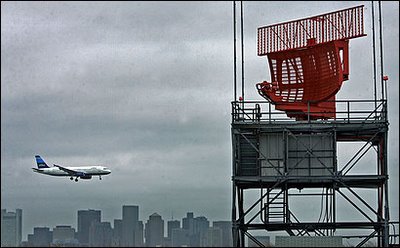
Radar Antenna
Unidentified Flying Threats

By Nick Pope
The New York Times
7-29-08

Nick Pope     ON the afternoon of Nov. 7, 2006, pilots and airport employees at O’Hare International Airport in Chicago saw a disc-like object hovering over the tarmac for several minutes. Because nothing was tracked on radar, the Federal Aviation Administration did not investigate. Yet radar is not a reliable detector of all aircraft. Stealth planes are designed to be invisible to radar, and many radar systems filter out signals not matching the normal characteristics of aircraft. Did it really make sense to entirely ignore the observations of several witnesses?

A healthy skepticism about extraterrestrial space travelers leads people to disregard U.F.O. sightings without a moment’s thought. But in the United States, this translates into overdependence on radar data and indifference to all kinds of unidentified aircraft — a weakness that could be exploited by terrorists or anyone seeking to engage in espionage against the United States.

The American government has not investigated U.F.O. sightings since 1969, when the Air Force ended Project Blue Book, an effort to scientifically analyze all sightings to see if any posed a threat to national security. Britain and France, in contrast, continue to investigate U.F.O. sightings, because of concerns that some sightings might be attributable to foreign military aircraft breaching their airspace, or to foreign space-based systems of interest to the intelligence community.

Most of the incidents investigated in Britain have been easily explained as misidentifications of stars and planets, aircraft lights, satellites and meteors, but some cases have raised national security or air safety issues.

On Dec. 26, 1980, for instance, several witnesses at two American Air Force bases in England reported seeing a U.F.O. land. An examination of the site turned up indentations in the ground and a level of radiation in the area that was significantly higher than ordinary. More witnesses at the same base reported the U.F.O. again on subsequent nights. The deputy base commander reported that the aircraft aimed light beams into the most highly sensitive area of the base — a clear security breach.

On March 30 and 31, 1993, there was a wave of U.F.O. sightings over Britain. One witness described a triangular-shaped craft that flew slowly over an air force base before accelerating away to the horizon in an instant, many times faster than a jet. The British military reported, “There would seem to be some evidence on this occasion that an unidentified object (or objects) of unknown origin was operating over the U.K.”

On April 23, 2007, a commercial airline pilot and some of his passengers reported a huge cigar-shaped U.F.O. — the pilot estimated it to be a mile wide — near the Channel Islands. At the time, air traffic controllers reported to the pilot that radar picked up something, but that it was “unknown traffic.”

In addition, there have been several incidents of near misses between U.F.O.s and known aircraft — enough to prompt the Ministry of Defense and the British Civil Aviation Authority to advise pilots, if they encounter anything, “not to maneuver, other than to place the object astern, if possible.”

The United States is no less vulnerable than Britain and France to threats to security and air safety. The United States Air Force or the National Aeronautics and Space Administration should reopen investigations of U.F.O. phenomena. It would not imply that the country has suddenly started believing in little green men. It would simply recognize the possibility that radar alone cannot always tell us what’s out there.