Excerpt from The Abductionist's Wife: A Memoir
“Extraordinary...beautifully written…with a highly original, almost unbelievable story.”
- Candy Schulman, author of essays and articles, including The New York Times, The Washington Post, McSweeney’s, Newsweek, and the book Lost and Found.
Author’s Note
| It seems timely now, in this era of frighteningly extreme beliefs, to make public my own personal story of how even the unlikeliest person can find herself drawn to enter into an extreme belief system. How she gets caught up in its mythic power, becomes part of the community, and finally, faces the painful fact that she must leave it and people she loves behind. What are the forces that collude to cause a thoroughly modern, educated woman like me to embrace such an unconventional set of beliefs as that of alien abduction and UFOs? It would be easy to explain away by blaming it on my falling in love with and marrying the charismatic leader of this community at the far edges of society. But it’s more than that. There’s a deeper reason, even, than love. | By Carol Rainey
The UFO Trail
2-5-16 |
 |
| Author at work, 1994 |
As I write this unfinished memoir, poking at the past a little every day, it is extraordinarily difficult to tell you – or to understand myself -- what happened to me inside that chaotic, exciting, almost cultish environment for well over a decade. Just as somebody entering thick woods might pick up a sturdy stick, I picked up my video camera to help me understand the beliefs of my husband and the victims who came to him for counsel and hypnosis. Making the film only drew me closer into his investigations, case by case. I saw how a UFO researcher actually did his recovered memory work; not what he said he did. If I questioned his methods or what seemed like a willingness to believe almost anything, that temerity landed me on the enemies list. Days later, we wouldn’t be able to keep our hands off each other. It was the most madly in love, rage-filled, crazy-making, tumultuous relationship of my life.
Some readers may dismiss my story for that very reason.
The angry ex-wife…motives…too close for objectivity. But there is no one else to tell this story. On a day-to-day basis, abduction researchers work alone, with no peer review and no one to double-check their methods and ethics.
i It was only the abductionist’s wife who saw, first-hand, how researchers could and did shape the alien abduction narrative they wanted -- the terrifyingly invisible alien takeover of the planet and the human species. It is my hope that
The Abductionist’s Wife digs far below the surface of the UFO community to reveal the compulsion and complexities of any belief. What I want to offer is a poignant, but clear-eyed story about a great love gone awry in a tangled, emotionally taut search for answers to a human mystery.
****
The events in this excerpt occurred early on in our marriage. “The Singer’s Hybrid Daughter” involved two fragile and volatile people, a case that I found particularly disturbing. Pseudonyms are used for the singer and her daughter, as well as for Linda Cortile. All other events and people are depicted as I remember them, aided by personal journals, correspondence, planning calendars, emails, and extensive audio and video.
Serious inquiries from publishers are welcome.
One late afternoon in the winter of 1997, snow began falling all over Manhattan. Not much at first, barely four or five inches, but rumors of a coming snowstorm cast a spell over the city. I was headed home up Seventh Avenue, arms full of groceries, delighted as a child to be out in the fresh falling snow. For a brief moment in time, New York seemed to have been draped in reams of shimmering white silk. Everything had become equally beautiful, simple and pure – a sculpture in the park, potholes, a bus-stand, gargoyles in the architecture. The surprised city forgot its city-ness. Traffic thinned to almost nothing; yellow taxis crept along. Avenues and streets grew hushed and the trees that lined them made pale, blunt shapes with their boughs. I’d only been living here for two years and had never seen the city like this, so still and quiet. It seemed in a rare mood for listening.
 |
| Blizzard on West Sixteenth Street |
I thought:
This is the kind of enchantment that happens in fairy tales, when the world suddenly turns strange and the girl wandering in the woods somehow knows that her life is about to change. It needed to; it must.
I juggled the bags for balance and twisted to look back through a scrim of falling snow. A single set of footprints trailed behind me. They were dark holes punched in the snow, like bullet holes in a wedding gown. At the sight of those lone footprints, I felt joy begin to leak out of me. It was for the promise of a true partnership that I’d taken the chance of marrying again. But, so far, even as recently as last night, evidence suggested that I might have been an idealistic fool.
A middle-aged broad with a middle-school girl’s swoony notion of a couple’s side-by-side stroll through marriage. Sad, sad, sad.
On West Sixteenth Street, I let myself into the lobby of the modest two-family brownstone that Budd had owned and shared, before me, with two earlier wives and a now-grown daughter. There were signs of these women all through the house. Hanging here in the hallway, for instance, his daughter Grace’s abstract photographs, so like her father’s canvasses – vibrant with color, intentionally flat, and devoid of the human figure. In that same hallway laid a woven wool rug of cerise and green stripes that was made by Wife #1 sometime in the sixties. I thought it looked dated and homely, but Budd liked things to stay as they were. The heavy snow slid down off my hair and coat, forming a dark pool of water on the rug.
And here she stands now, poor thing, hemorrhaging enchantment all over the ugly rug.
I considered my immediate options. If I went downstairs now, we’d probably run into each other – two people who’d barely spoken all day - and I’d know he still hadn’t forgiven me for the question I’d asked last night. The injustice of that would then trigger the anger I’d been so good (so far) at keeping under wraps.
Oh, what a volatile pair, the two of us!
 |
| Rainey and Hopkins Lake Lucerne, Switzerland, 1996 |
But my half-finished video segment about the Brooklyn Bridge abduction was calling. I headed down to my studio, following the twists and turns of the hallway, remembering how well the plan started out. I’d left behind in Boston a long career in producing well-funded films about science so I’d have the freedom to make my own films and to marry Budd. Still blissed-out newly-weds, we’d been so charged by that sense of kinship with the other, we’d work around the clock, seven days a week, on the mysterious phenomenon that Budd had already devoted twenty-five years of his life to investigate.
For reasons I didn’t yet fully understand, the fragmented memories of the people Budd called “abductees” had fascinated me from the start. Most seemed quite sane and sincere - which proved nothing, of course, about the physical reality of their experiences. When someone tells you, however haltingly, that they’ve been snatched from a picnic or a nice warm bed by five or six humanoid creatures, then floated through walls and placed on a table in a round, domed room – it’s not so easy to suspend your disbelief and wait to see how the fuller story unfolds.
 |
| A scar, often called a "scoop mark," photographed on the leg of an alleged alien abductee |
They’d roll up their pants legs and reveal scars that might have been made by scalpels; they’d brought snapshots of a large circular burn in the field next to their house. Innately more skeptical than my husband, I simply couldn’t explain what had happened to the people who were here to consult with Budd. But the abductees saw that my interest in them was genuine and so trusted me to document their stories. It pleased me, too, to watch the way my artist husband worked with them. You might have thought he was a pastor, this silver-haired, attentive man. It was his unusual combination of humor, fatherly compassion, and complete acceptance that provided these baffled and angry people with the safest of places for saying the craziest things.
Our plan had been this: I’d begin the production phase of a documentary about my husband’s strange work, while Budd would carry on as usual, bringing in new individuals for initial interviews and hypnosis sessions. I’d shoot with him every step of the way, knowing that I’d end up not using most of this early footage. I’d bide my time until Budd would zero in on one individual’s story, the way he’d done with Linda Cortile
(Witnessed) and Kathie Davis
(Intruders). Both of these women had complex narratives that Budd had turned into influential and popularly successful books.
But after fourteen months, I was getting concerned. What if we continued like this for another year – even two or three years? There didn’t seem to be any end in sight, no goal we were moving toward. If only I could make out a method or specific process in the way Budd worked with new people! There was rarely, if ever, any second, third or fourth session with the people I had on tape - over forty individual cases, so far. They were all “one-offs,” still at the anecdote level: a first interview, followed by a single hypnosis session. Then goodbye and good luck and we rarely saw a single one of them again. Meanwhile, all production costs were coming out of my own pocket. The nature of the subject matter itself made my movie a funding pariah to foundations and state arts organizations. Add in the sad truth that low-budget indie docs rarely returned a profit and you just might feel my growing panic.
Goodbye, my life-savings! Hello, my dread future as a bag lady.
 |
| Possible new witness to Cortile abduction, 2003 |
Silly me, I’d had visions of shooting fly-on-the-wall, detective-style scenes with Budd as he investigated a particular story. The viewer would be compelled go along with him, following this intelligent man’s obsession to pin down a phenomenon that delighted in thumbing its nose at anyone who tried to do that. But viewers would see that Budd Hopkins was an extraordinary man, one with a reputation of having come closer to touching that mystery than anyone else had. Everybody loved a good story, especially a convincingly scary paranormal tale, and Budd knew how to tell this one with exceptional conviction. The film would build in power and suspense as the investigator explored the where, when, and why of his subject’s reported abductions. He’d draw out family members and friends, each of them shining light on a different facet of the story.
Over dinner last night, I’d explained my production worries to Budd. I was genuinely baffled, I said, puzzled about what he was looking for: “What criteria do you use to select that one person whose abduction experiences you want to investigate?”
I’d been taken aback by his instant reaction. He stopped eating, pushed back from the table and said he wouldn’t sit here pretending to have a nice dinner with his wife, when he was actually being
attacked. He left the apartment so abruptly that I remember my mouth open to respond but he was gone before any words emerged. Later, looking from the kitchen across the rooftop garden, I could see him in his studio writing-loft, banging away on the keyboard. I was sorry to have caused such turmoil and turned the question this way and that in my mind to see what disturbance it held. I couldn’t put my finger on it. The question had been logical; my tone genuinely puzzled.
After a while, I gave up and read myself to sleep. In the morning, a three-page typed letter lay folded on my nightstand. In it, he said I constantly discouraged and disempowered him with my “innocent-seeming” questions. That I clearly knew nothing about research, which
must always begin as an exploration with no known outcome in sight. From here on out, he ordered, it was essential that I not interfere with the exploratory phase of his research.
The letter set me back on my heels. What could a person do with such condescension, bordering on contempt? He knew full well that I’d come to New York, to this house, straight from years of making films with epidemiologists. He knew that the scientists and I had co-written dozens of hefty proposals to the National Institutes of Health – and that we’d been awarded a high percentage of them. If he’d ever read one of the proposals, he’d have seen the way we developed hypotheses and designed the study; reviewed similar research in the field; described the goals of our own project; and wrote protocols for collecting data and protecting our research subjects. The section I most loved was always this one: “Describe how your research [and related film] will advance knowledge in the field.” Imagine actually doing that – or trying to! There was something sacred, really, about a person’s desire to
add even one true thing to the body of human knowledge.
 |
| Hopkins writes in loft during snowstorm, 1997 |
Reading Budd’s letter to me was unsettling, disturbing on several levels. My right to question him was certainly the front and center issue, but was he actually denying that my very recent past life in the academic and scientific worlds had ever happened? Or did he mean that whatever I thought I knew about mainstream research was utterly meaningless when facing a phenomenon this enormous and mysterious and menacing? Or that only a select few investigators like he and David Jacobs knew how to “ask the right questions” about alien abduction? Or that they were “the only two people in the world who really knew what was going on” in this silent, largely unseen invasion of the planet by alien forces? They
did say things like that to each other. Often, in fact. But if that’s what he meant, he should say that, not make seemingly factual statements about the questioner, me, that almost made me doubt my own sanity.
Gaslighting. Such a strange old word to come floating into my head. But I couldn’t recall what it meant.
In the lower studio, I went quickly past the long wooden staircase that led up to Budd’s studio – then turned around, went back and stood at the base.
Okay, I could let the evening drag on with both of us miserable….or I could send out a white dove to test the waters, so to speak. Misery or the dove?
I called out: “The snow’s still falling, Budd! And the city seems so strange. Why don’t we go out for dinner? Make an adventure of it?”
From upstairs, the silence stretched on just long enough to suggest that he was still angry at me. But then my husband, handsome, silver-haired and grave, was standing at the top of stairs. He seemed to be looking down at me from a great distance. “It will have to be inexpensive,” he said.
As if that was news! I said I knew just the place.
Half an hour later, we were slipping and sliding on unshovelled walks toward a Jamaican joint on Greenwich Avenue, a few blocks away. Snow was falling more heavily now. City snowplows were missing in action and most of the shops had closed. It was so hard not to fall that Budd and I were forced to grab onto each other. We stopped to take in the utterly surreal sight of three cross-country skiers in high-end wilderness apparel making their way up a deserted Seventh Avenue. That gave me an idea. I grabbed a garbage can lid, took a running start on a downhill slope and jumped on. The saucer spun me around and around, gaining velocity, before it crashed into a mailbox. Here came Budd on a sheet of cardboard, zipping right past, a big grin on his face. It was this man’s constant buzz of energy that had first drawn me to him, already sixty-five when we met. We shot the avenue’s downhill slope again and again, competing to be the one who’d slide the greatest distance. In the course of all that silliness, breathless action and flirting with danger, the tensions of yesterday’s accusations and hurt fell away. We helped each other struggle through the drifts without falling, which involved a lot of body contact and touching. Any fool who had eyes could see that both of us were relieved to be back in love again. That’s the way it went with us: one day, we’d be in despair, in a fury; and the next, unable to keep our hands off each other.
The “Day-O” was a relic of old Greenwich Village, a downscale ethnic restaurant that featured coconut lampshades, metallic paint, and loud soul music, but the price was right and the food was good. Waiting for our grilled shrimp and coconut rice, Budd sipped his evening Scotch and warmed my frozen hands in his own. He told me he had a promising lead on a new case, a couple from Ohio he’d spoken to today. I told him about the documentary scene I’d just rough-cut. It was barely a fragment of the convoluted Witnessed case, Budd’s latest and most controversial book yet, claiming over twenty witnesses. At conferences and to book reviewers, he consistently referred to it as the “UFO case of the century,” while I carefully refrained from commentary on the uses and abuses of hyperbole.
 |
| Linda Cortile talks of her fear of security agent Dan |
Months earlier, I’d filmed the heroine of the story, Linda “Cortile,” in my studio. I’d seated her in front of a monitor with videotape playing on a loop. Poised and immaculately groomed as usual, Linda hadn’t a shade of reluctance about being on camera. She flipped her heavy brunette tresses back over the right shoulder, turning a now unobstructed face toward me. She explained how she’d come to be screening six hours of recorded television coverage of the 1991 international peace negotiations going on at the United Nations. It was a long shot, but she hoped to spot the two elusive federal agents, known only to Budd (and to readers) as “Richard” and “Dan.” They’d written to him about the early morning events of November 30, 1989, when they said they witnessed Linda’s abduction out of her 12th story apartment and into a glowing red UFO that hovered over her building down near the Brooklyn Bridge. In their car that night, they added, was another witness, an international VIP they were protecting. Budd based much of his book’s narrative on the traumatized men’s letters and Linda’s hypnotic recall of events. Although they refused to ever meet with Budd, the men’s fascination with Linda drove them to repeatedly pursue and abduct her for questioning. If anyone were an ideal candidate to identify the two men, it would be Linda.
The waiter brought our dinners and Budd asked how Linda did on camera. I said she’d been surprisingly capable at re-enacting the emotional, gut response she’d had when her tormentor Dan, against all odds, suddenly appeared on the screen. In fact, like a pro hitting her mark, she’d given me three or four slightly different re-enactments to choose from.
 |
| Linda identifies Dan at the United Nations, 1991 |
Linda’s hand had shot forward, her long fingernail rapping the monitor. “There he is!...There he is, like an eagle. Look at those eyes! He was a very cold, mean person.” She’d pointed out a tall, stern-looking, classically handsome man in a suit, striding quickly along a corridor of the United Nations, alongside Secretary General Javier Perez de Cuellar. The way his eyes darted left and right, non-stop, he certainly seemed to be guarding the VIP.
Budd nodded, pleased. “I’ve always said that making a positive ID like that certainly speaks directly to Linda’s credibility. If somebody was pulling a hoax, they’d never risk pointing at a photograph and saying: ‘That man is definitely Dan, the one I’ve been telling you about.’ Think how easy it would be to prove she was a liar!”
In the interest of sustaining our harmony, I kept my thoughts to myself:
But if these men, “Richard” and “Dan,” really did work for one of the federal intelligence agencies, it was quite likely that their actual names and job titles were fully protected from being disclosed to anyone.
My own research had turned up “The Intelligence Identities Protection Act,” passed by Congress in 1982. It had established criminal penalties for unauthorized disclosure of information that identified U.S. intelligence agents.
1 2 3 Clearly, Budd himself wasn’t familiar with the Act, although he’d discovered that local security agencies played their cards close to the chest. I wondered if Linda, with an ear much more attuned to popular culture, had known that intelligence agents were protected from identity disclosure? Might it have been a plot point in the television programs she watched or in the many mid-list novels she read? If Linda knew that, then she’d know that making a “positive ID” of Dan posed no risk at all to her. Budd could approach a hundred federal agencies, waving “Dan’s” photograph, and never find out a thing.
Dinner and the night out had been an oasis of time for us to purely enjoy each other again. A place apart from a home that sometimes felt to me like Grand Central Station for all of ufology – not only for abductees, but for other researchers, writers, journalists, foreign visitors, and camera crews. By the early 1990s, it was clear that UFOs had captivated the public’s imagination and, right behind them, the media -- and they all came calling on Budd Hopkins, eventually. Reluctantly, I stood to leave while Budd retrieved our coats. Then we heard his name shouted from across the room. A woman’s voice, volume at full throttle. Not your usual restaurant etiquette, even for the Day-O. A stout woman I didn’t know was waving Budd over to her table. She seemed to have materialized straight out of the anti-fashion ‘seventies, liberated from make-up and the tyranny of fitness and style. This woman had a fuzzy ball of big hair topping a plump, bespectacled face. Latching onto Budd’s arm with great affection, the woman was bursting to tell him some news.
“Listen, Budd, there’s been a major development with the kid. Something freaky as hell.”
People at nearby tables glanced over. Budd leaned in closer, a subtle suggestion to hold her voice down. But this woman had no patience for subtleties. Her voice raised a few more decibels.
“I’ve been meaning to call….Budd, you’re the only one who’s really gonna get it!” She drew in a great breath. “Not one of her doctors can explain what’s happening to Julia. They don’t have a friggin’ clue!”
Now diners on the other side of the room were sneaking a discreet look, the way New Yorkers do when they spot a celebrity out in public but would rather die than reveal their uncoolness quotient by staring.
Budd quickly moved to contain the situation. I felt his arm encircle my shoulders, pulling me forward.
The wife in her body-blocking role! Make way for the abductionist’s wife! I was used to it by now. In those first years when we were madly taken with each other, I’d been both pleased and embarrassed at the openness of Budd’s elation. Whether it was at his friend’s book-signing party in George Plimpton’s apartment or at a summer art opening in Provincetown, he always had one arm around my shoulders, steering me from one group of old friends to the next.
He’d say to each of them what he said now: “Arlene, this is my wife, Carol. The one I thought I’d never find. My soul mate.” Each time, he flashed that Hopkins bad boy grin and added: “The third time, we finally got it right!”
Arlene beamed, genuinely happy for us. She struggled to her feet and gave me a hug that was the real thing, a squeezing, rocking big old body hug. I had no idea who she was to Budd. But she wanted me to know that she’d come to see him ten years ago and that he’d helped her “discover some mind-blowing shit.” This husband of mine, she said, had saved her friggin’ life.
Okay, now I understood. One of Budd’s earlier abductees, someone he worked with years before I’d moved to New York in the spring of ‘95.
That evening in the restaurant, I’d seen Arlene as a drama-queen, a cut-up, a fat, foul-mouthed broad. I liked her immediately. I liked anyone who spoke straight from the gut, no filters. She seemed to approve of me, too, saying I had to come meet her daughter. Would I do that? She persisted until I said yes, we’d be glad to come.
“Then get ready to have your hair blown back,” she warned me. Swiveling to Budd, she added: “These are medical records you’re going to want to see, m’dear.”
I saw something flare briefly in his eyes when the woman said “medical records” – and I saw that she glimpsed it, too. Maybe she’d intended this reaction, set him up somehow. I knew nothing of their history together or what the child meant to Budd. Such a great talker and storyteller, my husband had filled me in on the back-stories of literally hundreds of abductees he’d worked with. But there’d never been mention of an “Arlene.” He glanced at his watch, exclaimed it had gotten so late and when he looked up again, the earlier flare of interest had been tamped down into an air of detachment.
“That would be great.” He concentrated on holding my coat for me. “Listen, lady, if we can find a free spot on the calendar, we’ll take a drive over – You could show the records to Carol while we’re there. She’s made quite a few films with scientists and doctors. She understands the lingo.”
You could almost call that an apology….
Out on Sixth Avenue, I asked what that had been all about. We were walking through old Greenwich Village, past the Waverly diner, its iconic red neon sign a bit bedraggled; past the old guys at the West 4th Street subway stop who’d set up folding tables under the shine of street lamps and laid out their used books and music to sell, snow or no snow. The clanking plows were out in force now - bullies and thieves - re-claiming the avenues for vehicles. Sturdy Latino men and boys, the brawn employed by many shop owners, had scooped hobbit-sized pathways through the drifts. It was a sorry business, really, watching how quickly the city gave up the ghost of its fairytale interlude.
Budd said it was his usual Mexican standoff with this woman. Every couple of years or so, Arlene got in touch, promising him the girl’s medical records, but something always came up so she couldn’t hand them over. It made him angry to talk about it. He knocked the still falling snow out of his hair. “Arlene’s a difficult woman, but she’s not stupid. She knows full well that the stakes are huge!”
“Really?” My pulse quickened. The pursuit of a cosmic mystery, I’d discovered, had a familiar addictive quality about it. In recovery from intoxicating substances for many years now, I remembered quite well that heightened sense of being alive, a rush, a buzzing in the blood. You grew convinced that any day now, just around the corner, some experiencer would show up and present us with a piece of material evidence that definitively proved the existence of aliens and their superior aircraft. If it weren’t the person in my viewfinder right now, it would be the one right around the next corner, or the one after that. Any day now, it would happen - if you just kept at it. You felt compelled to break that mystery open, even just a crack. Press your eye to it and you’d get a glimpse of something grand, a sideways slice of the cosmos, an exaltation of patterns that made up our everything.
I asked to be brought up to speed on the significance of Arlene and her daughter.
“You
do know who she is, don’t you? Arlene Love?”
4
“Never heard of her.”
Budd’s bushy dark brows shot up and he peered over to see if I was kidding. “Arlene Love, the star who shot to the top and made the cover of ‘Rolling Stone?’”
I shook my head.
He named a certain song, evidently quite popular, and asked if I knew it. Arlene’s break out song.
 |
| Plymouth Brethren in Illinois, 1952 (Carol’s family) |
I shook my head again. We’d apparently stepped into another one of the many black holes in my knowledge of popular culture. Each time he encountered one, Budd fumed about my Midwestern Plymouth Brethren family, calling them “religious extremists who seal off their kids from the world so they can brainwash them.” Once, I’d have been pleased to beat that drum right alongside him. But over time my feelings about my strict upbringing had grown more nuanced and complex - more aware of my own role in bringing down the curse of banishment and a long exile from family and community. It seemed impossible, though, that I’d ever be able to fill in all that cultural missing time. Cut off from most “worldly people,” television, movies, radio, novels, magazines, parties, dancing, and the aforementioned intoxicating substances, you’d have to concede that I’d missed some rather large chunks of ‘fifties and ‘sixties popular culture.
“Now you’re making me feel all Amish,” I complained.
“Oh, baby,” he said, reaching for my hand, “I can definitely take care of your Amish condition.”
“I’ll bet you can,” I said, flirting right back. He was a big hand-holder, this sweet man who had eighteen years on me. I told him the only way he could redeem himself was to tell me the whole story about this singer.
That was like tossing a Frisbee to a retriever. A born storyteller like Budd didn’t hesitate to seize the invitation. He launched into the dramatic arc of Arlene Love’s tragic rise and fall in the music industry. A singer with almost no formal training, she’d been gifted with an extraordinary vocal range – a contralto with a bluesy growl, capable of sweeping over four octaves. That sound had made her extremely, yet fleetingly famous in the 1970s. She’d been on the cover of Rolling Stone, sang hits with Paul Simon and Linda Ronstadt, appeared on “Saturday Night Live” and was nominated for a Grammy as Best New Artist. Her first album went gold and she’d entertained presidents and kings. Then she gave birth to a severely handicapped daughter and rumor had it that Arlene had gone a little mad. Her career took a steep dive and never recovered. She went from those early glory days to full time caregiver for Julia, a child so profoundly malformed and brain damaged that many people said she should have been institutionalized. The star fell and was lucky these days to get gigs doing commercials. It was during one of the terrible downswings in her life that Arlene had first come to see him.
At home, Budd rummaged in our merged record collection, pulling out one of Arlene’s earliest albums. “There’s a UFO on the cover!” I exclaimed. Budd smiled and dropped the vinyl LP on the turntable. I turned up the volume and we stood there listening, touching, swaying to the rhythm.
It was a lilting, guitar-based song. It was rumored that she’d written it for a married lover. Before we’d met, Budd and I had each endured our own times of love lost, pain and longing. In Arlene’s voice, we felt the authenticity and regret of that bluesy passion in our very bones. It made us wrap our arms around each other and dance the length of the faded Oriental carpet.
2.
Two weeks went by and the brief encounter with Arlene Love had faded into the background of more pressing problems at home. I was only hearing about them now -- the alarming debt Budd had been kicking down the road for years; and the hazardous conditions of the one hundred year old house we lived in. Frazzled wiring cried out for attention by sometimes creating small fires that broke out inside the walls of the house. The insurance company, at one point, refused to renew the building’s policy until the falling down chimney, another fire hazard, was repaired. But nothing was done, so the building went uninsured. On this particular day, I’d just paid a carpenter out of my own account to replace the full set of tall but leaky windows that ran the length of my studio’s rear wall. They let in sunlight and air all year around; in warmer weather, I could step over one windowsill and sit out back in the narrow garden I’d started there. When one of the lower studio’s old floorboards caved in, you could reach down with one finger and touch the rocky earth of old Manhattan. It was the one place in the house where I felt safe – literally grounded.
Overhead, I could hear Budd making end-of-workday sounds. He’d been painting earlier, small collages with paper and acrylics, and now his chair rolled over to the phone machine where he’d listen to his messages. Our studios were separated by only a rough wooden floor and I couldn’t help hearing them too. A man reporting a triangle of lights hovering over his house; he was sending video. A woman anxious for advice - her five-year-old said that little people came through the window at night. People hopeful of booking a hypnosis session with Budd. A plea to hold another abductee support group. The PR woman from Simon & Schuster with more radio programs for him to do.
Then came a very different message, a full-throated voice that soared right out of the phone machine, swelled up into the rafters, and poured down the old wooden stairs into my studio. It was Arlene Love’s rough contralto, belting out: “Hey-hey-hey, Budd, are you and Carol still coming over for drinks this afternoon? Left a coupla messages for you, never heard back. But you’re not going to believe your eyes when you see this fucking kid. I swear, Budd, it has to be something they’re doing to her. Come see for yourself!” She let out a final chord that was a whoop combined with a moan and then wrapped it.
Budd came clattering down the stairs, wild-eyed. “Honey, oh god,” he said. “Can you believe it? Arlene Love just called and wants us to be in Jersey at six, I think it is. Forty minutes from now--” He was jittery and rushed, pulled abruptly out of the day’s dream of color romancing shape.
He forgets to write down some appointments, but never admits it. I sighed, put my arms around him and leaned my head on his chest. “Yeah, I heard her.” His neck still smelled sweet from this morning’s shower, an odor now mixed with acrylic paint and glue-stick. Budd hugged me back, dropped a kiss on the top of my head and was gone, a bird on the wing. Headed up to the second floor apartment. He could sure move fast, for a sixty-seven year old man with a bad leg from childhood polio.
“You better give her a call!” I cried after him, rapidly recalibrating my own plans for the evening. I’d reserved a seat at a screening where a director I admired would speak afterwards. A sharp tang of regret stung my palate. I hated to give up the screening, but Budd had asked me for help with Arlene and the missing medical records. I have to confess that Arlene’s case intrigued me, maybe for the same reason it had kept a grip on Budd’s hopes for so long: the once-famous singer and her damaged child would make one hell of a story!
I would go with him tonight and ask for more consideration, please, in giving me advance notice of such events. Three years in, I still hadn’t gained the art of living gracefully in the middle of a whirlwind. On any given day or night, you couldn’t predict who might turn up on the doorstep: a camera crew, a sheriff’s deputy, or a prince from a far-away land. It was a way of being that Budd seemed to thrive on. I definitely did not thrive on this level of anxiety or the sudden reversal of all your plans. Evidently, if you were the abductionist’s wife, you shouldn’t expect to have any plans at all, other than being a happy camper on the support team for “the most important discovery in human history.”
 |
| Speakers from 1999 UFO conference in New York |
3.
An hour late, we pulled up to Arlene’s building in a New Jersey city across the river from Manhattan - one of those many bland, nondescript high-rises built in the ‘fifties. As the elevator rose, Budd squeezed my hand, always pleased to be able to introduce me to somebody whose art I respected. “I’m going to get the daughter’s medical records from Arlene tonight,” he assured me. “For ten years, she’s been promising to give them to me…”
“What if she doesn’t?”
He let go of my hand. “Then there’s nothing else I can do with her case! I’m not going out on a limb if she’s not willing to back me up with proof.”
“Sounds reasonable. But I’m not certain what you want to prove.”
“It’s not the time to get into that.” Budd didn’t feel like talking about it anymore. A bell clanged, the door slid open directly into Arlene’s apartment, and he grinned, back to his old genial self. “Here we are!” He pulled me forward quickly.
And there was Arlene, beaming and moon-faced. She hugged us each in turn against her belly, sloshy as the waterbeds so loved by her fans back in the day. Her cloud of curly dark hair brushed my face like steel wool. Dark moles spotted her face, magnified under those unfashionably large spectacles. I’d forgotten just how loud and brash her normal speaking voice was.
“I swear, Hopkins, you’d stand up the goddamn Pope.”
“No, no, I didn’t forget, did I, honey?” He pulled me in close to be his false witness. “It was a hectic day, one thing after another, and I lost track of time.”
 |
| Hopkins working on Witnessed |
Arlene jabbed me with an elbow. “Next thing you know, this guy’ll be handing us some bullshit about ‘missing time.’”
We all laughed. Arlene clearly felt affection for Budd, as most of the abductees did. I teased him that it was because he reminded people of their fathers, or of fathers they wished they’d had. A silver-haired, generally sweet-tempered father, a natural-born raconteur, an intelligent man who loved the arts, and leaned left in all the right ways. An aging father, but one whose energy rarely flagged and who would sit down, give you his undivided attention for two hours, and seriously consider any crazy-sounding, illogical thing you’d come to tell him.
“Come in. Entrée, entrée! Missing time or not, I'm just friggin’ glad you're here to share her with me!”
Arlene led us into a modest-sized living room that was plumply filled with round-edged, overstuffed furniture, all in beiges and browns. It was like a rabbit’s nest, one lined by the doe with fur plucked from her own belly. A place to fall down in and not get hurt. It was as utilitarian and unpretentious as Arlene herself.
Budd placed both hands on Arlene’s shoulders and stooped a bit to look directly into her eyes. He said he worried when he hadn’t heard from her for a long time.
“We have been away, my friend. I found two really fabulous doctors in this Mexican alternative clinic. Great big promises, right? They did alternative this and alternative that with Julia. They tested her up the wazoo, but medically? They did jackshit. Still, that kid kept amazing them. Things that are friggin’ impossible, scientifically! The medical team couldn’t believe it. I’ll show you their reports.”
Budd said yes, he wanted to see them. “But I’m not one whit surprised that you’re still Julia’s greatest advocate.”
“I'm in love with this child,” Arlene said, shrugging, with a big grin. “As simple as that.”
Budd glanced up, catching movement in the dimly lit hall coming from the bedrooms. Arlene turned, saw what Budd saw. And her normally loud voice grew louder, almost heraldic. This mother’s voice, announcing the coming of her damaged child, carried an undertone of golden trumpets and strings.
“Here she comes! Isn’t she beautiful?”
I turned around, a little too fast for polite. Unexpectedly, I was terribly afraid to meet this eighteen-year-old girl. There’d been so much hushed talk about multiple deformities and extreme brain damage, that I dreaded seeing an unbearably grotesque version of a human youngster. One whose own mother had hinted that the girl was only partly human. I wasn’t entirely clear where Budd stood on that question.
The girl wobbling down the hall toward us was small, her frail body topped with a head that seemed disproportionately large. Her spine curved sideways, turning her chest into a shallow bowl. Her pale face was strikingly triangular, with large dark eyes set so far apart they seemed mounted on the sides of her head. A small, flat nose made barely a bump above a long upper lip. Her ears were so low-set, I half-expected them to pivot backwards like a dog’s. Everything about Julia seemed crooked, out of sync, like she'd been cut out of the same basic material as other people, but the parts had been glued together wrong. She didn’t look like any human being I’d ever seen.
Budd and I were both stunned into silence. He’d only met Arlene’s daughter briefly, years earlier. The girl’s jolting gait came to a stop in front of us, her head low and swaying. “Say hello to our friends, sweetheart,” Arlene said.
Julia fell against me. I felt her skeletal arms surround me and her head wedged itself under my chin. Ashamed I wasn’t ready for this closeness, I gave her an awkward hug back. She didn’t quite see me, or maybe she saw two of me. One eye pointed east, the other tugged west. The movement of her eyeballs was not a smooth, continuous turning. Sunk in large, dark sockets, her hazel eyes jerked past me like digital video, in tiny mechanical jolts.
She wavered over to bump her dark, curly head against Budd’s chest. Arlene was quite pleased. "She remembers you, Budd, you see that?" Budd looked uncertain about that. This girl with low-slung ears that could not hear, who had only learned to walk at sixteen, and had never spoken a word – who could say what she remembered?
Budd seemed so oddly disconcerted that my heart went out to him. In his last two books,
Intruders and
Witnessed, he’d written about people with abduction experiences who, under hypnosis, recalled how the “beings from elsewhere” had presented them with their hybrid, half-alien children aboard a craft. These recollections emerged damply out of hypnotic regression, wet with tears. The experiencers had to leave the hybrid children behind. I’d always mentally filed these reports in my “Maybe/Maybe Not” box. It held all things that were
hypothetically possible, but that lacked any material evidence. Now one of Budd’s abductees had presented him with an actual child-in-the-flesh instead of the theoretical ones he wrote about and he was clearly having a hard time taking it in. I slipped a hand into his elbow as we sat down.
Arlene thumped a thick album of photographs on the coffee table. Julia sat slumped sideways next to her mother. For the next hour, she was silent and immobile, except for two fingers that listlessly picked, picked, picked away at invisible lint.
“I want you to see what a goddam weird kid she was right from the start.”
Budd and I sat forward, fascinated at first, but with a growing sense of horror and sadness. In the first pages, Arlene showed off images of a newborn that could have sprung full-blown from the mind of David Lynch. This might be Eraserhead’s mewling child. Arlene’s insistence was that we look, not back off from what we were seeing. Her doughy body stretched, reached, and spread across the tabletop, never letting up. She kept doling out photos of a big-headed, listless baby with a face as flat as a dinner plate and nearly as featureless.
“Look, no lips to speak of…A little splat of a nose, almost not there. Like you-know-who, the little grey guys….And here, at fifteen months, see the long smooth upper lip, the turndown? That’s called a ‘fish mouth.’”
Arlene sorted quickly through a number of shots and then triumphantly produced the one she wanted. "Here's the neck webbing she was born with. Like a little rhino or baby lizard. That really spooked people. You were just Momma's little freak show, right, Stinky?”
Budd’s eyes met mine briefly. The whole scene made us both very uncomfortable. For one thing, Julia was sitting right there and her mother was going on as if she didn’t exist. When we’d first arrived, Arlene had let me know that she believed the girl was secretly and profoundly wise, preternaturally gifted even. I glanced over at Julia. The lint-picking mission was ongoing.
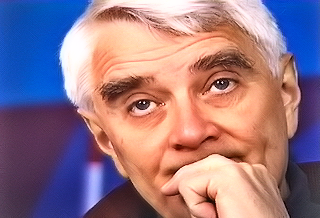 |
| Hopkins talking with Rainey during production, 1995 |
For one moment, I wondered and allowed the thought to grow: what if Julia was a genius, a super-being trapped inside that frail, droopy body? But something didn’t add up here. If Arlene really believed that her daughter was an über-genius, she’d hardly be making such brutally frank comments about her grotesqueness right in front of her. And if she had proof of something so extraordinary—in the form of medical records, say—then why hadn’t she long ago shown that evidence to Budd?
He was now shooting me a meaningful look. It was time for me to give it a try. But, without warning, everything in me resisted. Now that I was here, at the very center of the life these two were forced to share, all my desire to “investigate” Arlene’s abduction story had vanished. Like her, I’d been the single mother of a young daughter for many years. And for me, too, there had been those times when a pit yawns open in front of you and says:
All is not right with your beloved girl. Our maternal experiences were similar – yet utterly different by orders of magnitude.
Stalling, my eyes followed the photographs that Arlene was slapping down in front of us like an expert blackjack dealer. One showed a young-ish man with big hair and bellbottoms, awkwardly holding the infant Julia. The camera’s flash had captured a glint of shamed panic in his eyes. With a red marker, someone, presumably Arlene, had scrawled a caption across the bottom: “O, Happy Man!”
I could feel Budd’s eyes on me. His leg was doing an anxious jig-jig-jig. Finally I managed a question: “Arlene, I’m sure you’ve taken Julia to a clinical geneticist or two. What was the diagnosis?”
“From the time this kid was born until just last year--” Arlene pounded the sofa for emphasis. “Nobody’s come up with a diagnosis. She’s been in and out of every hospital, every specialist’s office on the Eastern seaboard. Nobody in medicine has ever seen anything like the number of defects that Julia has. Twenty-one dysmorphologies! It’s one for the record books….But they can’t explain them. She doesn’t have Down syndrome, she doesn’t have Turner’s; she doesn’t have the usual ‘syndromes’—a fancy word for some kid that’s been born with a wackadoodle shit-load of major physical defects.”
“And none of those specialists could come up with a diagnosis?” Budd asked the question kindly, but I was surprised to hear a hint of doubt in his voice. Arlene picked up on it, too.
Her voice rose sharply: “Julia’s no textbook genetic fuck-up, Budd! That’s the whole point of you coming here to see her.”
From the moment we’d walked in the door, I’d sensed that Arlene had an agenda for the evening. It was as if she had seized an audience and intended to hold us hostage until she’d delivered herself of a shameless bid for…what, exactly?
“I’m sorry I don’t know the full story,” I said. “What do you mean? What’s ‘the whole point’?”
Arlene sat forward, focused and intense. “So you’ve got this kid who’s a complete mystery to the medical profession. But it gets wilder still. Fast forward to the present--to the insanely wonderful part of it. You listening, Budd?” Arlene was pleased to see that she had our full attention. “This kid’s genetic defects are being reversed! Yeah, I said ‘Reversed.’ Neuromuscular defects—she can walk now, she can hold up her own big head. Chronic edema of the hands and feet—gone. Bladder and bowel constrictions—greatly improved.” She turned to me. “You know it’s medically impossible to reverse shit like this, right?” I nodded. “They don’t have a clue how it’s happening.”
She closed the album with a thump and swung back to Budd. Her smile was broad and beatific, triumphant in its certainty. “But we know. We know why and we know how it’s happening, don’t we, Budd?”
My husband’s own smile was constrained, his voice quiet. I was relieved to see that he’d regained his footing. “Well, it’s something we can only speculate about….”
Arlene stared at him. Behind the thick glasses, her eyes seemed to bulge. “‘Speculate?’ Fuck that!” Her good humor suddenly went on the fritz. She glared at him, genuinely shocked. “You were right there with me the whole way! During those friggin’ long hypnosis sessions. On that puke green living room couch of yours. Bawling like a baby. ‘Waa-waa. Is she a bug? Oh, god, she’s one of them!’
Speculate?”
Budd was kind, but firm. He reached over and covered both her hands with his own. “We can be fairly certain that the aliens—whatever, whoever they are--they were involved with you, Arlene. With you, from childhood on. But nobody can say for sure that they had anything to do with Julia.”
She glared at him again. “What the fuck? You said they did, Budd! I’m not making this stuff up.”
I was puzzled, my unease deepening by the minute. Somebody’s memory was terribly skewed. Whose? My aging husband completed the Times crossword puzzle every morning before getting out of bed. His memory, long-term and short-term, was extraordinary.
Budd stood his ground. “We only explored your early childhood experiences, Arlene. We didn’t get much further than that.”
“Bullshit. I must be losing my mind.” Arlene stared at him, then whirled and confronted me. “What, am I nuts, Carol? Do you think I’m a wack job?”
“No, I don’t.”
“Thank you very much! Because this is all that keeps me going.” She jabbed a forefinger skyward like a preacher implicating God. “What I found out with Budd about their intervention. I’ve been caring for this kid for so long, I got nothin’ left….The career, the man—long gone. It’s no picnic, I can tell you.”
“I can certainly understand that,” I said, trying to rally. “But Budd’s right—he needs you to provide him with documentation. Nobody’s going on record about genetic defects being reversed unless there’s solid, gold-star medical evidence for it. That would be a major scientific discovery!”
“Let Carol take the records home,” Budd urged. “Maybe there’s something the doctors overlooked.”
Arlene flipped back around to Budd. “Now you’re changing the subject. I guess there’s all kinds of games going on around here.” She stared at him in furious disbelief. “I’m really pissed off at you, Budd Hopkins. Unfuckingbelievable.”
His smile was sad, gentle, and charming all at once. “Arlene, I’m very sorry you’re angry. I just want to be straight with you about what happened.”
“Bullshit! That’s not being straight with me!
It’s not what happened. For some reason, Hopkins, you want me to think I’m nuts! Making up stuff…” Arlene was struggling to get to her feet from the soft depths of the sofa. Her face was red and congested. Dislodged, Julia fell onto her side and began to squeal. Budd jumped up to help them, but Arlene waved him away.
“…That I’m nuts and don’t remember what happened. But I know this for a fact, Budd: This kid is proof positive that the grey guys make mistakes in this genetic game they’re playing with our silly little species. And she’s also proof positive that they can and will fix whatever they screw up. Do you read me loud and clear, Hopkins? They can fix her.”
Panting, Arlene planted her feet and glared at him one final time. Her daughter’s sounds of distress escalated and her hands flapped like the wings of a downed bird. Arlene bent down and lifted the girl up against her sturdy body, held her until the panic eased.
“Momma’s girl,” she crooned into the cap of curly dark hair so like her own. “Momma’s little freak show.”
4.
Everyone had been relieved when the evening had come to a rapid close. We’d left Arlene’s apartment shortly after Julia went into a second meltdown and needed to be taken to bed. On the way out, Budd had asked Arlene, one more time, if she’d mail us the medical records. She’d handed us our coats, yessed him, and said that she would. I was certain that she wouldn’t. The woman’s sense of betrayal was palpable.
It clung to us like a bitter odor on the trip back to the city. We were both quiet, each of us caught up in our own thoughts and turbulent emotions. Behind the wheel, Budd’s face was grim. I wished that I could offer sympathy for my husband’s discomfort—a touch or a word--but I suddenly dreaded finding out that some part of what Arlene accused him of might be true. If it was, if Budd had led this volatile woman to believe otherworldly beings were the cause of her child’s deformities and brain damage, he’d made a terribly self-serving call.
If he had – he surely intended to push the envelope on what he believed was an historic discovery about alien intervention in the human gene pool. But in medical terms, Budd Hopkins was not qualified to diagnose even a case of measles in a child!
But there in Arlene’s apartment, Budd had been adamant: he denied and denied again that he’d ever made such a claim to Arlene.
Our silence lasted across the George Washington Bridge, with its elevated and northernmost view of Manhattan stretching to the right. The old blue Toyota shifted into the right lane and curved around and down, merging onto the Hudson River Parkway. With the roar of bridge traffic left behind, I broke the silence.
“I don’t understand what happened back there.”
Budd said ‘nothing happened.’ It was just Arlene being Arlene. She was a very difficult woman. He’d researched her case the way he did every other one: somebody has an experience, it disturbs their life, they come to him, and together they start to explore it through hypnotic regression. Perfectly routine. But, I countered, nothing about Arlene’s case seemed routine. I hesitated to say directly what it was that I most wanted him to explain away, but there was no way around it.
“She said you led her to believe that her daughter’s deformed because she’s a hybrid, a half-alien kid.”
“If there’s one thing you know, it’s that
I do not lead people!” Now he was angry. The Toyota drifted into another lane. A horn blared. Budd jerked the wheel to the right and a red BMW shot past us on the left, doing ninety. Budd swore.
“Don’t get mad at me, please,” I said. “You asked me to be part of this and I’m trying to understand how the abduction investigation might have influenced Arlene’s care of her child. Maybe she ran wild with the idea of a cure all on her own. I don’t know. I wasn’t there. I’m asking you.”
He didn’t seem inclined to answer. He stared ahead at the winding parkway.
“Budd, after the first half hour in that apartment, I felt sick about even being there…. Like we were a MUFON delegation on a field trip to a children’s cancer ward.”
“Oh, great. First, my work’s an abomination. Now it’s all a big joke.”
“Not at all. Hardly! Budd, you know I’ve always defended your right to work with abductees. But when people are as vulnerable as Arlene and Julia… Isn’t there a possibility for real damage? Please help me understand one thing – something so important to Arlene that she said it two or three times. She said you told her Julia’s condition was caused by alien intervention.”
He slapped the steering wheel. “I did no such thing! What is this third degree I’m getting from you?”
I looked out my passenger window at the silver river unfurling on the right, bearing along the gleaming facets of stars. After a moment, I said quietly: “Any time you don’t like the questions I ask, I always know that something’s wrong.”
 |
| Hudson River at dusk |
Blogger's Note
The work presented in both parts one and two of this post, including all written content and photos, is credited to Carol Rainey. I am pleased to provide a venue for it. - Jack Brewer
Endnotes:
i I do not count the small coterie of psychologists and academics who were groomed by the researcher to help him counter critics’ claims that he wasn’t qualified to do this work. These people were happy to be invited to the house once or twice a year and sit in on several hypnosis sessions with the researcher and one or two abductees he had pre-selected. He’d worked with them before; he knew how they’d respond. The credentialed observers had no knowledge about possible previous telephone or in-person contact between the two. Neither did they seem familiar with the substantial body of academic research regarding “the suggestive environment” and the influence of “context” on the creation of recalled memories. They left after this limited and staged presentation, believing they had witnessed the great man at work. They reported that they had observed no leading of subjects. There was nothing wrong with the researcher’s methodology.
1 NYTimes, June 11, 1982, “Bill to Penalize Uncovering of Agents Passed by Senate.”
2 https://en.wikipedia.org/wiki/Intelligence_Identities_Protection_Act: The Intelligence Identities Protection Act of 1982 (Pub.L. 97–200, 50 U.S.C. §§ 421–426) is a United States federal law that makes it a federal crime for those with access to classified information, or those who systematically seek to identify and expose covert agents and have reason to believe that it will harm the foreign intelligence activities of the U.S.,[1] to intentionally reveal the identity of an agent whom one knows to be in or recently in certain covert roles with a U.S. intelligence agency, unless the United States has publicly acknowledged or revealed the relationship.[2]
3 CRS Report for Congress, Intelligence Identities Protection Act, Jennifer K. Elsea, Legislative Attorney, 7-5700, April 10, 2013. wwww.crs.gov. RS21636
4 Pseudonyms are used for both Arlene and her daughter Julia.
Acknowledgements
A deeply felt thank you to the following people for ongoing friendship, their trust in me to get it right, and intelligent feedback on this part of the memoir:
Jeremy Vaeni
Jeff Ritzmann
Jack Brewer
Tyler Kokjohn
Peter Brookesmith
Penelope Franklin | Ryan Harbage
Fred Thompson
Lynda Cooper
George Hansen
Marianne Macy
S.G. Collins
|


.jpg "Jack Brewer")


