Showing posts with label ESA. Show all posts

Thursday, October 15, 2020

Scientists Call For Serious Study of UFOs / UAP


You don't have to be an alien truther to be curious about recent UAP events


[...]

     The recently observed UAPs purportedly have accelerations that range from almost 100 Gs to thousands of Gs — far higher than a human pilot could survive. There's no air disturbance visible. They don't produce sonic booms. These and other
By Leonard David
www.space.com
10-12-20
oddities have captured the attention of "I told you so, they're here" UFO believers.

But there's also a rising call for this phenomenon to be studied scientifically — even using satellites to be on the lookout for possible future UAP events.

Monday, July 10, 2017

Oxygen Producing Comet Found in Deep Space

Bookmark and Share

Rosetta Navigation Camera Image of Comet 67P
The finding shows that oxygen can be generated in space without the need for life, and could influence how researchers search for signs of life on exoplanets.

     In 2015, scientists announced the detection molecular oxygen at Comet 67P/Churyumov-Gerasimenko, which was studied by the Rosetta spacecraft. It was the “biggest surprise of the mission,” they said — a discovery that could change our understanding of how the solar system formed.
By Nancy Atkinson
Seeker.com
5-10-17

Thursday, July 06, 2017

New Search for Alien Life with Deep-Space Observatory

New Search for Exoplanets and Alien Life with Deep-Space Observatory

     The European Space Agency’s Science Programme Committee has approved the Planetary Transits and Oscillations of stars (PLATO) mission to move into the construction phase. They aim to launch this deep-space observatory in 2026 with the goal of “discovering and
By Tom Ward
futurism.com
7-4-17
characterizing Earth-sized planets and super-Earths orbiting Sun-like stars in the habitable zone” — although it “could eventually lead to the detection of extraterrestrial life,” according to a University of Warwick press release.

The observatory will have 26 telescopes on board and will be launched 1.5 million km (932,000 miles) into space, where, according to a mission summary, it will conduct “Ultra-high precision, long (up to several years), uninterrupted photometric monitoring in the visible band of very large samples of bright (mV ≤11) stars.” This will provide unprecedented data on distant planets.

Wednesday, October 12, 2016

Digital Message Sent to Possible Extraterrestrial Civilization

Digital Message Sent to Possible Extraterrestrial Civilization
A 14-minute digital transmission of 3,000 messages beamed toward Polaris, the North Star, by the European Space Agency’s Cebreros deep-space tracking station in Spain.


     Today’s 14-minute digital transmission of 3,000 messages beamed toward Polaris, the North Star, by the European Space Agency’s Cebreros deep-space tracking station in Spain ends a year-long effort
By The Daily Galaxy
10-11-16
known as “A Simple Response to an Elemental Message,” spearheaded by Irish-born artist Paul Quast, who solicited 3,775 text-only messages from around the world in response to this question: "How will our present environmental interactions shape the future?"

"The challenge of constructing any interstellar message is trying to anticipate what you and your recipient have in common," said psychologist Douglas Vakoch, president of METI International, an organization dedicated to detecting alien intelligence.
"One thing we can guarantee is they won't be native speakers of English or Swahili or Chinese." And the same problem applies to any incoming message to Earth.

"It's very reasonable to think that we will know there's an extraterrestrial out there, that we will have a message that is distinctly artificial, but that we won't be able to decipher it," Vakoch added.

Friday, September 16, 2016

Most Detailed 3D Atlas of a Billion Stars Released by ESA | VIDEO

Most Detailed 3D Atlas of a Billion Stars Released by ESA

• Satellite is now just over half-way through its five-year mission and the first batch of data has been released

• The one billion stars it has located are still only one per cent of the Milky Way's estimated stellar population

Abigail Beall
Mailonline
9-14-16
• Gaia's mapping effort is already unprecedented in scale, but the satellite still has several years left to run

• In the future Gaia will collect data about each star's temperature, luminosity and chemical composition


Esa has unveiled a stunning 3D map of a billion stars in our galaxy that is 1,000 times more complete than anything that previously existed.

The data for the map was collected by a space-based probe called Gaia, which has been circling the sun nearly a million miles beyond Earth's orbit since its launch in December 2013.

On its journey, the satellite has been discreetly snapping pictures of the Milky Way.

Now the European Space Agency has released the first batch of data collected by Gaia, which includes information on the brightness and position of over a billion stars. ...

Wednesday, September 07, 2016

Missing Spacecraft Found on Comet

Missing Spacecraft Found on Comet 9-2-16

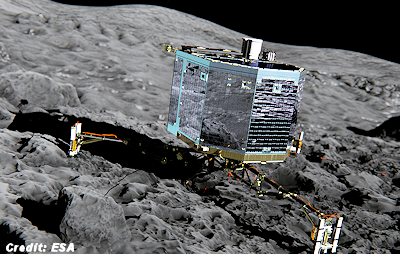
      The final resting place of the European comet lander Philae is a mystery no more. After nearly two years of searching, the lander's shadowy grave on Comet 67P/Churyumov–Gerasimenko has been found in images from its mothership Rosetta.
Elizabeth Howell
Space.com
9-2-16

The European Space Agency's Philae lander touched down on Comet 67P (as scientists call it) in Nov. 12, 2014, but its final location was uncertain due to the probe's rough, bouncy landing. News of Philae's discovery comes just weeks before Rosetta — low on solar power as the comet moves away from the sun — is set for a dramatic touchdown itself on 67P's surface to end the mission. In a statement today (Sept. 5), ESA officials expressed marvel that they found Philae at almost the last minute.

"With only a month left of the Rosetta mission, we are so happy to have finally imaged Philae, and to see it in such amazing detail," said Cecilia Tubiana of the OSIRIS narrow-angle camera team, in a statement. She was the first person to see the images when they were downlinked from Rosetta yesterday. ...

Friday, July 01, 2016

Wild Light Show, Strange Sounds Coming From Jupiter | VIDEO

Wild Light Show, Strange Sounds Coming From Jupiter

     Jupiter is putting on quite a show — with both sound and light.

A new Hubble image shows a stunning light show, capturing an aurora display on the largest planet in our solar system (see above).
By Ed Mazza
The Huffington Post
7-1-16

Jupiter’s auroras cover areas bigger than the entire Earth, are hundreds of times more energetic and never cease, the European Space Agency said in a news release.

Unlike auroras here, which are caused by solar storms, Jupiter pulls charged particles from its surroundings, including solar winds and even the volcanos on Io, one of its moons and the most volcanically active world in the solar system.

In addition to stunning images, NASA also released unusual “sounds” from Jupiter captured by the Juno spacecraft, which will enter orbit around the planet on July 4.

Saturday, January 02, 2016

Quest in Discovering Alien Life Includes New Moon Base

Bookmark and Share

New Moon Base

By The Sun
1-2-16


A MANNED base on the moon should become reality
by 2030, according to the European Space Agency.

     ESA chiefs say the planned “Moon Village”, which would be built by 3D printers, could help mankind explore the galaxy.

The plans say robots will land on the Moon and prepare the surface for human life, and come complete with a series of stunning concepts showing what the Moon base could look like.

Astronauts could then use the Moon as a space base to push on and explore more celestial bodies, such as Mars, NASA’s top priority target destination.

With water found by NASA on Mars, speculation about alien life is rife as the ESA confirmed their Moon colony dreams at a two-day conference entitled Moon 2020-2030 – A New Era of Coordinated Human and Robotic Exploration. [...]

Wednesday, October 14, 2015

Amazing Close-Up of Mars' Mysterious South Pole

Bookmark and Share

Amazing Close-Up of Mars' Mysterious South Pole 2015
The icy south pole of Mars takes center stage in this amazing close up from a larger photo of the Martian south pole and cratered Hellas Basin region captured by the European Space Agency's Mars Express orbiter.

By Kasandra Brabaw
Space.com
10-13-15

      A newly released photo provides a great look at Mars' seldom-seen South Pole.

The swirling white dot toward the bottom of the photo, which was taken by the European Space Agency's Mars Express spacecraft, is the Red Planet’s south polar ice cap. The cap is composed of both frozen water and frozen carbon dioxide, and it changes shape with Mars' seasons.

In 2004, Mars Express confirmed that the south polar cap contains water ice, according to the European Space Agency (ESA). [...]

Wednesday, July 08, 2015

Claim of Alien Life on Comet Blows Up

Claim of Alien Life on Comet Blows Up

Scientists Shoot Down Claim That Alien Life May Be on Comet

By Justin Worland
time.com
7-7-15


The findings did not hold up to scientific scrutiny

      Scientists have picked holes in a widely-reported presentation by researchers claiming microbial life may exist on the comet now home to the Philae lander.

The claim originated in a presentation before the Royal Astronomical Society, in which researchers said the makeup of the comet, 67/P Churyumov-Gerasimenko, suggested the presence of living organisms. The scientists argued that data from Rosetta, the European Space Agency probe orbiting the comet, showed the capacity for micro-organisms to eke out life beneath the comet’s black crust.

But the findings did not hold up to scientific scrutiny. . . .

Tuesday, July 07, 2015

Philae Comet Could Be Home to Microbial Alien Life

Philae Comet Could Be Home to Microbial Alien Life

By www.theguardian.com
7-5-15
Astronomers say features of comet landed on by spacecraft in November, such as black crust and icy lakes, suggest living micro-organisms beneath surface
     The comet landed on by the spacecraft Philae could well be home to an abundance of alien microbial life, according to leading astronomers.

Features of the comet, named 67P/Churyumov-Gerasimenko, such as its organic-rich black crust, are most likely explained by the presence of living organisms beneath an icy surface, the scientists have said.

Rosetta, the European spacecraft orbiting the comet, is also said to have picked up strange clusters of organic material that resemble viral particles. . . .

Monday, June 15, 2015

It's Alive! Comet Lander Philae Phones Home After Months of Silence

 
Bookmark and Share

It's Alive! Comet Lander Philae Phones Home After Months of Silence
The European Space Agency's Philae comet lander is seen by the Rosetta spacecraft in this image captured on Nov. 12, 2014 as Philae headed for its landing on Comet 67P/Churyumov-Gerasimenko. The probe went silent 60 hours later and reawakened on June 13, 2015.

By Tariq Malik
Space.com
6-14-15

     A European probe that made a bouncy landing on a comet last year, and then slipped into a silent hibernation, is alive again and phoning home.

The European Space Agency's Philae comet lander, which dropped onto Comet 67P/Churyumov-Gerasimenko from the Rosetta spacecraft last November, beamed an 85-second wake-up message to Earth via Rosetta yesterday (June 13), ESA officials announced today. It was the first signal from Philae in seven months since the probe fell silent on Nov. 15 after its historic comet landing. . . .

Friday, February 20, 2015

Monster Black Hole Could Transform Entire Galaxy

Monster Black Hole Could Transform Entire Galaxy

By Calla Cofield
space.com
2-19-15

      A ravenous, giant black hole has belched up a bubble of cosmic wind so powerful that it could change the fate of an entire galaxy, according to new observations.

Researchers using two X-ray telescopes have identified a cosmic wind blowing outward from the supermassive black hole at the center of galaxy PDS 456. Astronomers have seen these winds before, but the authors of the new research say this is the first observation of a wind moving away from the center in every direction, creating a spherical shape.

The wind could have big implications for the future of the galaxy: It will cut down on the black hole's food supply, and slow star formation in the rest of the galaxy, the researchers said. And it's possible that strong cosmic winds are a common part of galaxy evolution — they could be responsible for turning galaxies from bright, active youngsters to quiet middle-agers. . . .

Thursday, November 20, 2014

Are Organic Molecules Found on Philae Comet Ingredients for Life? | VIDEO

Bookmark and Share

Are Organic Molecules Found on Philae Comet Ingredients for Life?

Philae Lander 'Sniffed' Organic Molecules on Comet's Surface

By www.nbcnews.com
11-18-14

     BERLIN — The European Space Agency's Philae comet lander "sniffed" organic molecules before its primary battery ran out and it shut down, German scientists said. They said it was not yet clear whether the molecules included the complex compounds that make up proteins. One of the key aims of the mission is to discover whether carbon-based compounds, the basis of life as we know it, were brought to early Earth by comets.

Philae landed on Comet 67P/Churyumov–Gerasimenko after a 10-year journey through space aboard the Rosetta spacecraft, on a mission to unlock details about how planets and perhaps even how life evolved. It wrapped up a 57-hour marathon of scientific experiments on the comet's surface on Saturday as its batteries ran out. Philae's COSAC gas-analyzing instrument was able to sniff the comet's ultra-thin atmosphere and detect the first organic molecules after landing, the DLR German Aerospace Center said. The lander also drilled into the comet's surface, although it is still unclear whether Philae managed to deliver a sample to COSAC for analysis. . . .

Friday, November 14, 2014

Mysterious Radio Signals Coming from Rosetta Comet | VIDEO

Bookmark and Share

Mysterious Radio Signals cComing from Rosetta Comet

By Stephen Morgan
www.digitaljournal.com
11-12-14

     The European Space Agency (ESA) has released a tape of mysterious radio signals coming from the “Rosetta comet” . . ..

The ESA has dubbed 67P/Churyumov-Gerasimenko as the “singing comet.” The Agency's blog quotes Karl-Heinz, from Rosetta Plasma Consortium, as saying, “This is exciting because it is completely new to us. We did not expect this and we are still working to understand the physics of what is happening.”

The explanation they are currently giving has to do with geophysics of the object. The blog says the discovery “has taken the RPC scientists somewhat by surprise. The comet seems to be emitting a ‘song’ in the form of oscillations in the magnetic field in the comet’s environment. It is being sung at 40-50 millihertz, far below human hearing, which typically picks up sound between 20 Hz and 20 kHz. To make the music audible to the human ear, the frequencies have been increased by a factor of about 10,000.”

It continues, “The music was heard clearly by the magnetometer experiment (RPC-Mag) for the first time in August, when Rosetta drew to within 100 km of 67P/C-G. The scientists think it must be produced in some way by the activity of the comet, as it releases neutral particles into space where they become electrically charged due to a process called ionization. . . .

Rosetta Mission Comet 'is ALIEN craft?

Bookmark and Share

Comet 67P-Churyumov–Gerasimenko

UFOs: Rosetta mission comet 'is ALIEN craft attempting to make contact with humans'

By Chris Richards
www.mirror.co.uk
11-14-14


Ufologists claim the celestial body contains "alien structures" and that its "mystery song" is an attempt to make communicate with Earth

      Space probe Philae is actually a UFO attempting to make contact with humans, conspiracy theorists are claiming.

Ufologists claim the European Space Agency's (ESA) craft, which on Wednesday completed the extraordinary feat of landing on a speeding comet, is of alien origin

An email published ... claimed the agency had joined forces with NASA to "cover-up" the celestial body's true extra-terrestrial nature.

The email, purportedly written by a secret whistle-blowing ESA employee of the ESA, reads: “Do not think for ONE MOMENT that a space agency would suddenly decide to spend billions of dollars to build and send a spacecraft on a 12-year journey to simply take some close-up images of a randomly picked out comet floating in space.”

“Comet 67P is NOT a comet.

“Some 20 years ago Nasa began detecting radio bursts from an unknown origin out in space.

"It would later be known that these had likely come from the direction of the now named comet 67P.

"It does show signs on its outside of machine like parts and unnatural terrain.” . . .

Tuesday, September 16, 2014

Comet Probe Finds Elements of Life

Bookmark and Share

Comet 67P-C-G (400 px)

Comet Probe Finds Elements of Life


By Paul Rodgers
www.forbes.com
9-14-14

    The Rosetta spacecraft has discovered all the elements of life in the gases jetting from a comet as it approaches the Sun.

The ingredients that make up amino acids, life’s building blocks, are all contained in the tail of the comet 67P/Churyumov-Gerasimenko (67P/C-G). Among them are methane, methanol, CO2, ammonia and water. All proteins are made of amino acids.

If Rosetta’s lander, Philae, discovers complete amino acids when it reaches the comet’s surface in November, it would support the hypothesis that life on Earth was seeded by comets with complex organic molecules as well as water. . . .

Saturday, February 22, 2014

The Real Threats From Asteroids Impacting Earth | VIDEO


Bookmark and Share

The Real Threats From Asteroids Impacting Earth

Accidents and Asteroids

By European Space Agency, ESA
YouTube
2-21-14

     How real is the threat of an asteroid hitting Earth, and is there anything we can do to prevent it from happening? Asteroid impacts are nothing new. Only last year, one exploded over the city of Chelyabinsk in Russia injuring 1500 people and damaging some 7,000 buildings.

"It was a pretty nasty event, luckily nobody was killed, but it just shows the sort of force that these things have," says Alan Harris, Senior Scientist, DLR Institute of Planetary Research Berlin.

While there was surprise nobody saw it coming, the asteroid itself wasn't that big, measuring no more than 20 metres across. It was tricky to spot, arriving into Earth's atmosphere backlit by the Sun.

In fact, much bigger threats lurk out in space. Just a few days ago another asteroid 270 metres wide passed near Earth. That kind of object could cause much more damage.

"Something with the size of a hundred metres for instance, which still isn't very big, you're talking about something that would fit into a football field, and that could actually completely destroy an urban area in the worst case. So those are the things that we're really looking out for, and that we're trying to find ways to tackle," says Harris.

Action to address the asteroid threat is already underway. Earlier in February, space scientists and policy experts from all the major space-faring nations held talks to create a framework for action. . . .

Friday, February 21, 2014

Alien-Seeking Space Observatory to Hover Between Earth and Sun

Bookmark and Share

Alien-Seeking Space Observatory to Hover Between Earth and Sun

By Fabien Tepper
www.csmonitor.com
2-20-14

The European Space Agency is set to build a space-based observatory to scan the cosmos for habitable worlds outside our solar system.

     The search for alien worlds has received an unprecedented burst of energy, with the European Space Agency's (ESA) vote this week to fund a 34-telescope observatory that will scan the sky for habitable planets, from a fixed spot between Earth and the sun.

The new PLATO mission (Planetary Transits and Oscillations of Stars) projects a 2024 launch of the observatory, which will seek out the Earth-like planets believed to orbit neighboring stars, as part of ESA's Cosmic Vision program.

“PLATO will begin a completely new chapter in the exploration of extrasolar planets” said Heike Rauer, an astrophysicist with the German Aerospace Center, who leads the PLATO mission. “We will find planets that orbit their star in the life-sustaining ‘habitable’ zone: planets where liquid water is expected, and where life as we know it can be maintained.” . . .

Saturday, January 11, 2014

Rosetta Spacecraft's Planned Orbit Around Comet | VIDEO

Rosetta Spacecraft's Planned Orbit Around Comet

By European Space Agency (ESA)
1-10-14

     Rosetta's journey from launch in March 2004 to comet 67P/Churyumov-Gerasimenko in August 2014, including 3 flybys of Earth and 1 of Mars. By January 2014 Rosetta is about 9 million kilometres from comet 67P/CG.

By early May, Rosetta will be 2 million kilometres from the comet and at the end of May the spacecraft will execute a major rendezvous manoeuvre to line it up for orbit insertion at the start of August. . . .