Showing posts with label Cassini. Show all posts

Saturday, August 22, 2015

New, Incredible Closeup Images of Saturn’s Moon Dione

Saturn's Moon Dione
This view from NASA's Cassini spacecraft looks toward Saturn's icy moon Dione, with giant Saturn and its rings in the background, just prior to the mission's final close approach to the moon on August 17, 2015.

Cassini's Final Breathtaking Close Views of Dione

By NASA
8-20-15

      A pockmarked, icy landscape looms beneath NASA's Cassini spacecraft in new images of Saturn's moon Dione taken during the mission's last close approach to the small, icy world. Two of the new images show the surface of Dione at the best resolution ever.

Cassini passed 295 miles (474 kilometers) above Dione's surface at 11:33 a.m. PDT (2:33 p.m. EDT) on Aug. 17. This was the fifth close encounter with Dione during Cassini's long tour at Saturn. The mission's closest-ever flyby of Dione was in Dec. 2011, at a distance of 60 miles (100 kilometers).

The full set of images released today is available here.

"I am moved, as I know everyone else is, looking at these exquisite images of Dione's surface and crescent, and knowing that they are the last we will see of this far-off world for a very long time to come," said Carolyn Porco, Cassini imaging team lead at the Space Science Institute, Boulder, Colorado. "Right down to the last, Cassini has faithfully delivered another extraordinary set of riches. How lucky we have been."

Raw, unprocessed images from the flyby are available here.

The main scientific focus of this flyby was gravity science, not imaging. This made capturing the images tricky, as Cassini's camera was not controlling where the spacecraft pointed.

"We had just enough time to snap a few images, giving us nice, high resolution looks at the surface," said Tilmann Denk, a Cassini participating scientist at Freie University in Berlin. "We were able to make use of reflected sunlight from Saturn as an additional light source, which revealed details in the shadows of some of the images."

Cassini scientists will study data from the gravity science experiment and magnetosphere and plasma science instruments over the next few months as they look for clues about Dione's interior structure and processes affecting its surface.

Only a handful of close flybys of Saturn's large, icy moons remain for Cassini. The spacecraft is scheduled to make three approaches to the geologically active moon Enceladus on Oct. 14 and 28, and Dec. 19. During the Oct. 28 flyby, the spacecraft will come dizzyingly close to Enceladus, passing a mere 30 miles (49 kilometers) from the surface. Cassini will make its deepest-ever dive through the moon's plume of icy spray at this time, collecting valuable data about what's going on beneath the surface. The December Enceladus encounter will be Cassini's final close pass by that moon, at an altitude of 3,106 miles (4,999 kilometers).

After December, and through the mission's conclusion in late 2017, there are a handful of distant flybys planned for Saturn's large, icy moons at ranges of less than about 30,000 miles (50,000 kilometers). Cassini will, however, make nearly two dozen passes by a menagerie of Saturn's small, irregularly shaped moons -- including Daphnis, Telesto, Epimetheus and Aegaeon -- at similar distances during this time. These passes will provide some of Cassini's best-ever views of the little moons.

During the mission's final year -- called its Grand Finale -- Cassini will repeatedly dive through the space between Saturn and its rings.

The Cassini-Huygens mission is a cooperative project of NASA, ESA (European Space Agency) and the Italian Space Agency. NASA's Jet Propulsion Laboratory in Pasadena, California, manages the mission for the agency's Science Mission Directorate in Washington. JPL is a division of the California Institute of Technology in Pasadena. The Cassini imaging operations center is based at the Space Science Institute in Boulder, Colo. ...

Wednesday, October 01, 2014

Mysterious 'Island' on Saturn Moon Puzzles Scientists | VIDEO

Mysterious 'Island' on Saturn Moon Puzzles Scientists - July 2013

Mysterious 'Island' on Saturn Moon Puzzles Scientists


By Mike Wall
space.com
9-30-14

      Saturn's huge moon Titan just got a little more mysterious.

NASA's Cassini spacecraft has spotted an odd islandlike feature in Ligeia Mare, one of Titan's largest hydrocarbon seas. Scientists don't know what to make of the feature, which has apparently doubled in size over the past year or so, from about 30 square miles to 60 square miles (78 to 155 square kilometers).

"Science loves a mystery, and with this enigmatic feature, we have a thrilling example of ongoing change on Titan," Cassini radar team deputy leader Stephen Wall, of NASA's Jet Propulsion Laboratory in Pasadena, California, said in a statement. "We're hopeful that we'll be able to continue watching the changes unfold and gain insights about what's going on in that alien sea." . . .

Monday, June 23, 2014

Mystery Object in Lake on Saturn's Moon Titan | PHOTOs

Mystery Object in Lake on Saturn's Moon Titan
The mystery object, described as a 'magic island' appeared out of nowhere in radar images of a hydrocarbon sea on Saturn's giant moon, Titan. (Credit: NASA)

By Ian Sample
www.theguardian.com
6-22-14
Nasa's Cassini probe took image last year as it passed by planet's largest moon – nothing seen when other images taken

     Scientists are investigating a mystery object that appeared for a moment and then vanished again from a giant lake on Titan, the largest moon of Saturn.

They spotted the object in an image taken by Nasa's Cassini probe as it swung around the alien moon last year more than a billion kilometres from Earth. Pictures taken of the same spot saw nothing before or some days later.

Little more than a white blob on a grainy image of Titan's northern hemisphere, the sighting may be a huge iceberg that broke free of the shoreline, an effect of rising bubbles, or waves rolling across the normally placid lake's surface, scientists say.

Astronomers have named the blob the "magic island" until they have a better idea what they are looking at. "We can't be sure what it is yet because we only have the one image, but it's not something you would normally see on Titan," said Jason Hofgartner, a planetary scientist at Cornell University in New York. "It is not something that has been there permanently." . . .

Saturday, December 15, 2012

NASA Finds River On Saturn's Largest Moon, Titan | SPACE NEWS | VIDEO


Bookmark and Share

River on Saturn’s Moon Titan, As Captured By Cassini


By SPACE.com
12-12-12

      NASA's Cassini spacecraft has captured a crisp image of a long river cutting across Saturn's huge moon Titan.

The hydrocarbon-filled river stretches more than 250 miles (400 kilometers) from its source to a large sea near frigid Titan's north pole. Cassini's radar image is the first high-resolution shot ever taken of such a vast river system on a world beyond Earth, researchers said, and scientists are comparing it to Earth's Nile River in Egypt.

"Though there are some short, local meanders, the relative straightness of the river valley suggests it follows the trace of at least one fault, similar to other large rivers running into the southern margin of this same Titan sea," Jani Radebaugh, a Cassini radar team associate at Brigham Young University, said in a statement.

Thursday, June 14, 2012

Cassini Spacecraft Finds 'Tropical' Lakes on Saturn Moon Titan


Bookmark and Share

Methane Lakes On Titan

By Thomas H. Maugh II
The LA Times
6-14-12

     Infrared imaging by JPL's Cassini spacecraft has shown the existence of large methane lakes near the equator of Saturn's moon Titan. One of them is about the size of Utah's Great Salt Lake at its lowest recorded level and is at least three feet deep. The spacecraft also discovered smaller, shallower "ponds" nearby similar to marshes on Earth, with knee- to ankle-level depths.

Astronomers have previously observed large methane lakes near Titan's poles, but the discovery of the "tropical" lakes is a surprise because it was generally assumed that this region was too warm to allow such lakes to exist for any length of time. Titan's weather system is similar to Earth's in one respect, but with liquid methane instead of water. The methane near the equator evaporates and is transported by winds to the poles, where it condenses back into a liquid. On Earth, the water is carried back to the equator by ocean currents, but there is no comparable mechanism on Titan, so researchers have assumed there could be no large bodies of methane near the equator. . . .

Thursday, May 03, 2012

VIDEO | NASA's Cassini Orbiter Has Spotted Strange Objects Punching Holes in Saturn's Outermost Ring


Bookmark and Share

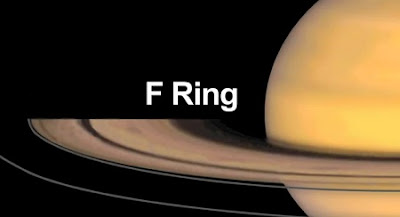
Saturn's F Ring


By ESA
4-25-12

     New images from the Cassini spacecraft reveal rogue kilometre-sized objects punching through Saturn's F-ring as the source of 'mini-jets' seen emanating from the ring.

Saturn's narrow F-ring is already known to host a variety of dynamic features including channels, ripples and 'snowballs' that are created by the gravitational influence of nearby moon Prometheus. While some snowballs are likely broken up by collisions and tidal forces, the new images reveal five hundred separate cases where small surviving fragments punch through the F-ring, dragging icy ring particles with them.

The objects collide with the ring at low speeds of around two metres per second, resulting in 'mini-jets' that extend between 40 and 180 kilometres from the ring. In some cases the snowball impacts occur in groups, creating exotic patterns as they drag through the ring. . . .

Wednesday, March 28, 2007

SATURN: Artifact or Natural Anomaly?

Saturn Hexagon (A)
Image above: This nighttime view of Saturn's north pole shows a bizarre six-sided hexagon feature encircling the entire north pole. The red color indicates the amount of 5-micron wavelength radiation, or heat, generated in the warm interior of Saturn that escapes the planet. Image credit: NASA/JPL/University of Arizona

Cassini Images Bizarre Hexagon on Saturn

By NASA
3-27-07

     Pasadena, Calif. -- An odd, six-sided, honeycomb-shaped feature circling the entire north pole of Saturn has captured the interest of scientists with NASA's Cassini mission.

NASA's Voyager 1 and 2 spacecraft imaged the feature over two decades ago. The fact that it has appeared in Cassini images indicates that it is a long-lived feature. A second hexagon, significantly darker than the brighter historical feature, is also visible in the Cassini pictures. The spacecraft's visual and infrared mapping spectrometer is the first instrument to capture the entire hexagon feature in one image.

"This is a very strange feature, lying in a precise geometric fashion with six nearly equally straight sides," said Kevin Baines, atmospheric expert and member of Cassini's visual and infrared mapping spectrometer team at NASA's Jet Propulsion Laboratory, Pasadena, Calif. "We've never seen anything like this on any other planet. Indeed, Saturn's thick atmosphere where circularly-shaped waves and convective cells dominate is perhaps the last place you'd expect to see such a six-sided geometric figure, yet there it is."

The hexagon is similar to Earth's polar vortex, which has winds blowing in a circular pattern around the polar region. On Saturn, the vortex has a hexagonal rather than circular shape. The hexagon is nearly 25,000 kilometers (15,000 miles) across. Nearly four Earths could fit inside it.

The new images taken in thermal-infrared light show the hexagon extends much deeper down into the atmosphere than previously expected, some 100 kilometers (60 miles) below the cloud tops. A system of clouds lies within the hexagon. The clouds appear to be whipping around the hexagon like cars on a racetrack.

"It's amazing to see such striking differences on opposite ends of Saturn's poles," said Bob Brown, team leader of the Cassini visual and infrared mapping spectrometer, University of Arizona, Tucson. "At the south pole we have what appears to be a hurricane with a giant eye, and at the north pole of Saturn we have this geometric feature, which is completely different."

The Saturn north pole hexagon has not been visible to Cassini's visual cameras, because it's winter in that area, so the hexagon is under the cover of the long polar night, which lasts about 15 years. The infrared mapping spectrometer can image Saturn in both daytime and nighttime conditions and see deep inside. It imaged the feature with thermal wavelengths near 5 microns (seven times the wavelength visible to the human eye) during a 12-day period beginning on Oct. 30, 2006. As winter wanes over the next two years, the feature may become visible to the visual cameras.

Based on the new images and more information on the depth of the feature, scientists think it is not linked to Saturn's radio emissions or to auroral activity, as once contemplated, even though Saturn's northern aurora lies nearly overhead.

The hexagon appears to have remained fixed with Saturn's rotation rate and axis since first glimpsed by Voyager 26 years ago. The actual rotation rate of Saturn is still uncertain.

"Once we understand its dynamical nature, this long-lived, deep-seated polar hexagon may give us a clue to the true rotation rate of the deep atmosphere and perhaps the interior," added Baines.

The hexagon images and movie, including the north polar auroras are available at: http://www.nasa.gov/cassini and http://saturn.jpl.nasa.gov and http://wwwvims.lpl.arizona.edu .

The Cassini-Huygens mission is a cooperative project of NASA, the European Space Agency and the Italian Space Agency. The Jet Propulsion Laboratory, a division of the California Institute of Technology in Pasadena, manages the Cassini-Huygens mission for NASA's Science Mission Directorate, Washington. The Cassini orbiter was designed, developed and assembled at JPL. The Visual and Infrared Mapping Spectrometer team is based at the University of Arizona.