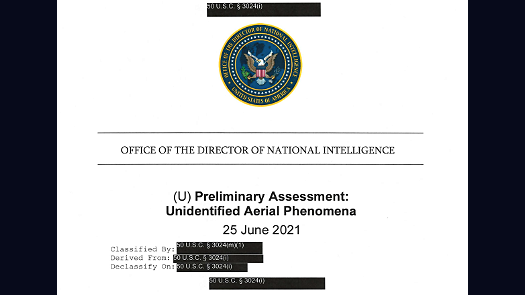
| On June 25, 2021, the US Department of Defense released a 9-page “Preliminary
Assessment: Unidentified Aerial Phenomena.”1,2 It was a public version of a longer
classified report prepared for US Congress. Thanks to the good efforts of John
Greenewald (The Black Vault), this complementary, 17-page report has been released
under the Freedom of Information Act (FOIA).3 The UAP report is sanitized, that is, certain
words, lines and entire sentences have been redacted by being blacked out to hide
information such as military systems and operational details. By comparing both
documents chapter by chapter, a number of inferences may be made, both |
By V.J. Ballester-Olmos
The UFO Chronicles
4-4-22
|
about the
document itself and about the differences between the two versions. That is the purpose
of this article.
Firstly, we must emphasize that the aim of the original report was “to provide an overview
for policymakers of the challenges associated with characterizing the potential threat
posed by the UAP.” For me, this is a misguided objective from the very beginning. The
association of materiality is a preconceived notion that adds unnecessary dramatism and
fantasy to the subject. Obviously, this has happened because of the active pressure of
lobbying ufologists and promoters of alien ideas, mainly from the political and intelligence
sectors. Therefore, I will be collating the public, unclassified report with the classified
version (eight pages longer), to see what observations may arise.
Christopher Mellon is the primary architect of the push for this legislation, with the
assistance of Luis Elizondo. The justification for the Pentagon’s Advanced Aerospace
Weapon System Applications Program (AAWSAP) and its successor, the Advanced
Aerospace Threat Identification Program (AATIP) was allegedly: “The objective of this
program is to understand the physics and engineering of these applications as they apply
to the foreign threat out to the far-term, i.e., from now through the year 2050.” Portraying
UFOs as a national security issue is the only way to get the military interested, and was
the motivation for the US Air Force investigating flying saucers from the 1940s to the
1960s.
On page 2, the input organizations for the report are described. In the third paragraph, a
3-letter word is redacted. Can it be CIA? But if FBI, DIA or NSA are already cited in the
open, why hide the Central Intelligence Agency?
To calm overexcited UFO enthusiasts, let me highlight this statement from the
“Assumptions” sentence: “…some UAP may be attributable to sensor anomalies.”
We read on page 3: “As a result, the UAPTF concentrated its review on [missing space
for 12 letters] describing incidents that occurred between 2004 and 2021.” The redaction
could correspond to XXX reports, for instance. As the number of handled reports is
estimated further down in the report as 144, the question arises whether the actual figure
is different. But why censor this? Perhaps because the source is other than human
testimony, obtained by space monitoring systems?
Then the report mentions that “In a limited number of incidents, UAP reportedly appeared
(two cautious weasel words–from now on, added emphasis to several quotes is
represented in italics) to exhibit unusual flight characteristics.” The classified version
expands on this writing and adds: “…including several in which the [65 mm redacted]
involving [123 mm redacted].” The censored words probably refer to certain aircraft,
vessels and/or sensitive operations. To me, the important thing is what both texts say
next: These observations could be the result of sensor errors, spoofing, or observer
misperceptions and require additional rigorous analysis. I could not agree more. I hope
they are starting to learn, although their reinvention of the wheel will cost a lot of money
defrayed by US taxpayers.
AVAILABLE REPORTING LARGELY INCONCLUSIVE
This chapter title on page 4 is most educational and, taking into account that it is the first
UAPTF report, it states, “Limited Data Leaves Most UAP Unexplained,” which further
suggests the authors believe that better information would lead to more identifications of
the objects reported. Larger portions of sanitization commence here. In the second
paragraph, the public report reads: “…the UAPTF focused on reports that involved
UAP…witnessed…by military aviators,” while the classified text writes “…the UAP
focused on a dataset of [redacted] probably describing [redacted] that involved
UAP…witnessed…by military aviators.” It seems they do not wish us to know the exact
number of UAP cases under study. Also, the original, unabstracted version labels as
“probably describing” when referring to the UAP.
Next, the public report says that “144 reports originated from USG sources. Of these, 80 reports involved observation with multiple sensors. Most reports described UAP as
objects that interrupted pre-planned training or other military activity.” The copy to the
Congress has a 7-character blank space before the figure of 144. I am inclined to think it
says something like Of XXX, actually giving the total number of incidents collected.
Following “multiple sensors” it adds “including [71 mm redacted] and [27 mm redacted].
The remaining [18 mm redacted] observed incidents were captured by [28 mm redacted].
(See Tables 1 and 2.)” Obviously, the type of used sensors is secret information. It also
confirms that another set of reports is not included in the count of 144, those that were
probably captured from orbiting satellites and/or foreign intel devices that DoD is not
reasonably willing to disclose to those who do not have a need to know. The classified
report includes four new lines, mostly readable, plus three footnotes (6 more lines)
indicating a significant number of reports were from military operations and exercises. “Of
the 144 USG reports, [number redacted] originated from Navy ‘Range Fouler’ reports...”
(“U.S. Navy aviators define a ‘range fouler’ as an activity or object that interrupts pre-
planned training or other in a military operating area or restricted airspace.”) It is followed
by nine new lines, largely blacked out where supposedly “the description of unknown
targets” was discussed. Tables 1 and 2 appear at page 12, to be commented on later.
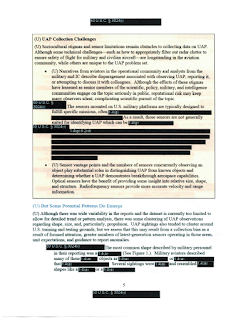
On page 5 there is an inset for “UAP Collection Challenges.” The public version has three
bullet points, while the classified one has four. One contains 145 mm of censored space
on the topic of “sensors mounted on military platforms” where specific purposes or
functions are probably named. Interestingly, the report says:
As a result, those sensors
are not generally suited for identifying UAP and it is followed by this brief new text “which
can be [38 mm redacted],” where some class of identification might appear. The fourth
bullet point has five and a half lines completely censored.
The section below, “But Some Potential Patterns Do Emerge,” contains two more
paragraphs in the classified version. One (five lines) establishes “The most common
shape described by military personnel…” but all descriptions of the shapes are redacted.
Another (five more lines) describes the altitudes at which “Observed UAP usually
traveled,” as well as some other dynamics, but every detail is censored.

The section that follows on page 6 is important as far as new input in the declassified
document. Titled “And a Handful of UAP Appear to Demonstrate Advanced Technology”
(let me affix here a great sic because of its likely inaccuracy), the public release hardly
had 10 lines, while the Congressional version has 34 lines. What are their contents?
There are many portions redacted but it suggests that it covers “UAP behavior,” “radio
frequency (RF) energy associated,” and “radar displays.” Three specific Navy UAP
sightings are also depicted but precise details are lacking. Later, when the report refers
to a “small amount of data that appears to show UAP…acceleration…or signature
management,” a continuing, redacted line in the full report starts with “However, this…,”
with the qualifying dubitative verb “appears” and the adverb “however.” Clearly, the report at this stage says that “Additional rigorous analyses is necessary…to determine the
nature and validity of these data.” Then, 15 new lines follow on page 7 of the declassified
report, describing three UAP incidents not included in the public version: one airborne
observation, another from 2004 that “reportedly demonstrated” something censored, and
a Navy report involving “a helicopter pilot and two weapon systems officers (WSOs)
visually observed several [redacted] objects moving approximately [redacted] five
[redacted] objects, which [redacted]. The WSO reported he [redacted] but [redacted] the
pilot and the other WSO [redacted] the [redacted] objects.” Time, date, location and
situation data have been blacked out here. This missing information evidently prevents
an external case study.
UAP PROBABLY LACK A SINGLE EXPLANATION
The report’s chapter headings are conveying outstanding clues for non-mentally-blind readers. They are far from subtle. Skeptical UFO researchers maintain that there is not a unique UFO phenomenon, but a sizeable list of causes that explain all reported sightings. Mostly being misidentifications. The UAPTF is starting to face this reality as well, if we have to understand what the chapter titles indicate. This chapter (pages 7 and 8) lists a
number of possible classes of UAP identifications. After one introductory sentence, the
report includes five paragraphs: “airborne clutter,” “natural atmospheric phenomena,”
“industry developmental programs,” “foreign adversary systems,” and “Other.” The
classified report contains eight additional paragraphs, most of whose lines are blacked
out. Only one sentence is not redacted, and its content is rather significant. In the
“atmospheric phenomena” class of events, it appends this phrase: “Although we cannot
definitively classify any UAP occurrences in our dataset as caused by atmospheric
phenomena,
we also cannot rule out the possibility that these factors may account for
some of what pilots have observed.”
UAP THREATEN FLIGHT SECURITY SAFETY AND, POSSIBLY, NATIONAL
SECURITY
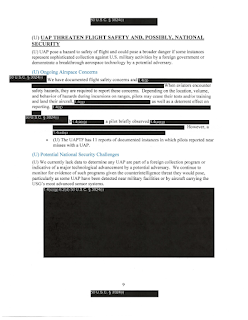
This chapter fills in page 9 of the report. My immediate reflection is: how many commercial
or military accidents have involved encounters with unidentifiable flying objects in the
history of aviation? From 1903 to date, hundreds of millions of flights have been in
operation. Is it rational that today any government questions itself whether UFOs/UAP
constitute a risk to flight safety? If true, wouldn't it have been proven many years ago with
extensive evidence? As for the second part of the title, it is even less logical, when numerous governments around the world have closed their UFO desks, and released and declassified their UFO archives on the conviction that during all these years (1947 to thepresent day) UFO sightings have posed no risk to national security. Reinventing the wheel
again?
This classified chapter has twice the length of the public copy, but most of the new text is
redacted. In the “Ongoing Airspace Concerns” section, the only words that are released
say: “We have documented flight safety concerns and…” followed by a mostly censored
3-line sentence on a (date missing) sighting where “a pilot briefly observed [redacted].
However, a [redacted].” Again, the adverb with the adversative sense. The public
assessment establishes: “The UAPTF has 11 reports of documented instances in which
pilots reported near misses with a UAP.” In this respect, excuse me if I express my
particular doubts about the accuracy of such close, near-miss incidents.
But it is in the “Potential National Security Challenges” section here that a complete 15-
line added paragraph is censored. It is after writing that “We currently lack data to
determine any UAP are part of a foreign collection program or indicative of a major
technological advancement by a potential adversary.” I am at loss to know what this new
text may voice, but I cannot imagine that the United States needs the UAPTF to determine
what its adversaries do or don’t do in terms of intelligence collection.
EXPLAINING UAP WILL REQUIRE ANALYTIC,
COLLECTION AND RESOURCE INVESTMENT
In the initial section of this chapter on pages 10-11, “Standardize the Reporting,
Consolidate the Data, and Deepen the Analysis,” five lines are added, almost complete:
“Given the [120 mm redacted] the UAPTF also plans to explore how best to leverage the
capabilities of non-DoD departments and agencies to enable effective and efficient
transfer of data and [redacted] among the DoD [redacted] and the law enforcement
community.” Good if they are thinking of consulting with NASA, NOAA, etc. on UFO
sightings. The section headed as “Expand Collection” shows a censored 11-line
paragraph as well. Towards what lines the data collection will expand is only subject to
speculation.
Page 12 of the declassified report covers “Table 1. USG UAP Reports by [redacted] (144
total),” and “Table 2. UAP Detected by [redacted].” These two tables are fully censored,
except for these few words in Table 2: “In over half of the 144 reports from USG observers
[redacted]…” I would bet that part of (and/or in addition to) the 144 standard UFO
sightings, the UAPTF has collected data from signal intelligence sources.
Page 13 of the report to Congress is “Figure 1,” a full-page tabulation for UAP “Common
Shapes” and “Less Common/Irregular Shapes.” However, all data and illustrations are
redacted. I hope they will soon find out that there are as many shapes and colors and
dimensions and dynamics as observers themselves.
In page 14, “The sections below provide a brief summary of contributions by intelligence
discipline,” with censored data contributed by the four types already listed in the public
report’s Appendix B, as follows: “Geospatial Intelligence (GEOINT)…The images and
videos captured…”; “Signals Intelligence (SIGINT)”; “Human Intelligence (HUMINT)”; and
“Measurement and Signature Intelligence (MASINT).” A last line adds: “The UAPTF had
no MASINT reporting on the events considered in this dataset.”
Page 15 is for the “Federal Bureau of Investigation Support of Attribution Efforts.” After
the sentence “Given the national security implications associated with potential threats
posed by UAP operating in close proximity to sensitive military activities, installations,
critical infrastructure, or other national security sites, the FBI is positioned to use its
investigative capabilities to support deliberate DoD and interagency efforts to determine
attribution,” 25 new lines with details are blacked out.
Once more, national security seems to be at stake. Listen, we have had flying saucer and UFO sightings for 75 years, seen from the air and from the ground. Even alleged humanoids beside their touched-down spacecrafts. Observations by civilians and military
personnel. Even people who reported being kidnapped by aliens. Everything that might happen has already happened. Or so they say. What are the national security implications? None. Now they appeal to national security concerns because most of the report’s sightings occurred during military operations, in protected areas, and from highly sophisticated aircraft or vessels. So, the concern is not by the target itself but because of the situational environment.
I also doubt the practical help local FBI agents can provide when a UAP has been
recorded close to a missile silo, from a Stealth aircraft or a Navy ship, or during a secret
military exercise. It will be extremely limited.
Page 16 repeats the contents of what was listed as Appendix A in the public document:
“Definition of Key Terms,” i.e., UAP, UAP Event, UAP Incident, and UAP Report. Four
censored lines appear in the classified version of the report to Congress.
Page 17. It is identical to the public version’s Appendix B, and it enumerates the eight
intelligence information requirements dictated from the Senate in line with the Intelligence
Authorization Act for Fiscal Year 2021.
Speaking in general, the major flaw of this report (both in the full and the summarized
forms) is the confession that out of (at least) 144 sightings examined, occurred between
2004 and 2021, with the majority coming in the last two years, “in only one instance, the
UAPTF was able to identify the reported UAP with high confidence” (it was a large,
deflating balloon). This inability to discover the real nature of things flying in the sky is
amazing. I just keep my fingers crossed that Vladimir Putin or Kim Jong-un do not decide
to attack the United States with drones or similar unconventional weapons, otherwise,
America, you are lost!
For further insight into the UAPTF report, I recommend seeing the files presented at the
US Navy’s FOIA Reading Room, “Case-Files: UFO Info,” which contains some of the files
that went into the UAPTF’s evaluation.4 One particular file is of interest, a UAP reported
in a “Range Fouler Debrief Form.” While not explicitly labelled, it seems to be the UAPTF’s
lone object that was able to be identified with “high confidence.”5
Additionally, the form may give insight to redacted information from the UAPTF report
concerning “Common Shapes” for UAP. On the form, there’s the section, “Please check
all that apply,” which gives twelve check boxes for shapes and characteristics, as follows:
Round
Square
Balloon-shaped
Wings/Airframe
Other Shape
Apparent Propulsion
Moving Parts
Metallic
Markings
Translucent
Opaque
Reflective
Lastly, it would be most convenient to briefly discuss the US military’s usage of UFO
terminology. A good source is US Navy spokesman Joseph Gradisher’s interview
published back in 2019 by The Washington Post.6 To summarize, Gradisher explained
that “The ‘Unidentified Aerial Phenomena’ terminology is used because it provides the
basic descriptor for the sightings/observations of unauthorized/unidentified
aircraft/objects that have been observed entering/operating in the airspace of various
military-controlled training ranges.” Gradisher told The Post, that UAP was not a new
term, that Navy preferred to eliminate the cultural stigma that might discourage pilots from
reporting “UFO” incidents for fear of being labeled “kooky.” “Gradisher said one possible
explanation could be the rise of unmanned aerial systems… such as quadrocopters, a
kind of drone easily available to the public.” When the Navy says UAP, they essentially
mean unidentified aircraft, but the public hears UFO.
The Navy is no longer in charge of the investigation and “UAP” was removed from the
name of the new organization. On November 23, 2021, the U.S. Department of Defense
announced the establishment of “the Airborne Object Identification and Management
Synchronization Group (AOIMSG) as the successor to the U.S. Navy’s Unidentified Aerial
Phenomena Task Force.” 7 The announcement stated the “preliminary assessment report
submitted to Congress in June 2021… identified the need to make improvements in
processes, policies, technologies, and training to improve our ability to understand UAP.”
The further details promised about the office have yet to be announced.
The author wishes to express his gratitude to Curt Collins for input and advice, and to Richard W. Heiden for editing.
(1) Preliminary Assessment: Unidentified Aerial Phenomena
(2) V.J. Ballester-Olmos, “The UAP Pentagon Report - Commented Abstract” (June 26,
2021), fotocat.blogspot.com
(3) FOIA Request response to John Greenewald/The Black Vault, FOIA Request response to John Greenewald/The Black Vault (see Enclosure 2).
(4) UFO Info: UAP DOCUMENTS
(5) File name: “RANGEFOULERDeflatedBalloon”:
(6) Kayla Epstein, “Those UFO videos are real, the Navy says, but please stop saying UFO,’” The Washington Post online, September 18, 2019, Those UFO videos are real, the Navy says, but please stop saying ‘UFO’
(7) DoD Announces the Establishment of the Airborne Object Identification and Management Synchronization Group (AOIMSG)
*Vicente-Juan Ballester Olmos—has been involved in UFO research since 1966; he is an advocate of science based investigation/analysis. His achievements are voluminous and he has worked in conjunction with the most esteemed Ufologists of the last 50 years.