Showing posts with label Hanford. Show all posts

Monday, June 07, 2021

UFO Over Hanford Atomic Plant – Fighter Jets Scrambled! | UFO CHRONICLE – 1949

UFO Over Hanford Atomic Plant – Fighter Jets Scrambled!


     At 1330 a call was received from Hanford Area (Concrete) that a Flying Saucer was over the East 200 area approximately 4 (four) miles east of the Hanford Atomic Plant, Washington. The operator at Hanford stated that the Disk was standing still and then took off in a south-easterly direction at a speed greater than that of a jet fighter. The available aircraft was
By Air Force
637th Aircraft Control & Warning Squadron
5-23-1949
called for by the Hanford operator and the aircraft was scrambled. The Hanford operator cleared the aircraft into their prohibited area (authorization coming from the Assistant Chief of Security Section at Hanford).

Friday, February 08, 2019

Flying Saucer Hovers Over Hanford Atomic Plant, Say Veteran Pilots


Flying Saucer Hovers Over Hanford Atomic Plant – United Press 7-5-1952

     Four Florida pilots, three of them Second World War veterans, told today of seeing a "Flying Saucer" hovering over the Hanford Atomic Plant at Richland, Washington.
By United Press
7-5-1952

Capt. John Baldwin of Coral Gables, Florida, and Air Force pilot in the Pacific in the Second World War, who has 7000 hours of airlione-pilot experience, said the object he and his companions saw early today was a "perfectly round disc, white in color and almost transparent with small vapor trails off it like tenacles of an octopus.

[...]

"The object seemed to back away from us and change shape. It was perfectly round and still at first. Then it seemed to back away from us and change shape. It became flat, gained speed and disappeared quickly."

Monday, October 05, 2015

Reports Confirm UFO Activity at A-Bomb Plant in 1945 (Redux)

Reports Confirm UFO Activity at A-Bomb Plant

By Robert Hastings
The UFO Chronicles
8-4-15

     UFO incursions at U.S. atomic/thermonuclear weapons sites, extending from the 1940s to nearly the present day, are well-established. Hundreds of U.S. military veterans and thousands of declassified Army, Air Force, Navy, FBI, and CIA documents make reference to these incidents. In fact, it can now be said that UFOs apparently monitored our atomic weapons program even before Hiroshima and Nagasaki were bombed in August 1945.

During the war, Clarence R. “Bud” Clem was a Lieutenant Junior Grade in the U.S. Naval Reserves, serving as an F6F Hellcat fighter pilot assigned to Air Group 50 aboard the U.S.S. Cowpens CVL-25. In an April 2, 2009 email, Clem told me:
Our group was deployed to NAS (Naval Air Station) Pasco, Washington for ground support training in March 1945. The Hanford Ordnance Works was just across the Columbia River from Pasco and designated Top Secret. We experienced an unknown object over the Hanford site in March/April, 1945. I did not fly after the object, as two members of our squadron did, but I did assist in trying to determine what was going on. I am 84 and I do not know if any other members of our squadron are still alive [who] could add more information. If you have any information about our experience, I would like to see what the official report stated.
The Hanford site was the plutonium-production plant that manufactured the fissile material used in the first atomic bomb—exploded on July 16, 1945, near Alamogordo, New Mexico—as well as in the bomb dropped on Nagasaki, Japan three weeks later, on August 9th. I wrote back to Clem, saying that I didn’t have any official reports relating to the incident at Hanford and asked for more details. He responded:
One night, shortly after the evening meal, the officers were gathered at the Officers Club for relaxation when the duty officer at the tower called our commander with a request. Lt. Commander Richard Brown took the call, as the Captain was in conference. Ensign C.T. Neal and I were with Brown and he asked us if we would volunteer to go with him to the flight line for possible duty. We both agreed and a jeep was waiting at the door to take us to the flight line. We learned that an unknown ‘bogey’ was over the Hanford Ordnance Works, according to the radar operator located at an auxiliary field just across the Columbia River from Hanford reservation.

We had been instructed upon arrival that the Hanford Ordnance Works was Top Secret and no flights over any part were permitted...We did not know about the radar, but the duty officer stated that something was in the sky over the area and wanted someone to investigate. A plane was [already] armed and warmed-up on the tarmac. Brown stated he would go and Neal was to stand-by in another plane, in case of trouble. I was to join the [controller] in the tower and communicate info from radar to the pilots.

Brown quickly found the object, a bright ball of fire, and took chase. But he could not close [on it], even with water injection that gave a quick boost in speed. The object headed out NW towards Seattle and was quickly lost by radar. Brown returned to base and we three retired to the club, still shaking and wondering what we had encountered. Memory does not recall details of two similar experiences—I think Neal was to take the next chase—but the object disappeared before he got airborne. I was assigned to fly the entire [Hanford] reservation at low altitude (200 feet or so) to give the radar operator the blind spots [caused by the terrain]…

I do not know if any other incidents occurred after we left Washington. None of the above information was mentioned in the ‘history’ of our squadron but I wonder what is on record at NAS Pasco.
I asked Clem, “During the first incident, how long did it take for the aircraft to get to Hanford?” He replied, “Not long. An aircraft was always ready to fly on short notice to intercept the Japanese incendiary balloons. If you’ve read the history of that project, and the concern the balloons caused, it would have been logical to intercept them before they could reach Hanford.”

I asked Clem if the pilot on the first night, Lt. Commander Brown, had described the object in detail, either over the radio or back at the Officers Club. Clem replied, “He just said it was so bright that you could hardly look directly at it. As he closed on it, it took off to the northwest at a high rate of speed. No maneuvers really, just a straight-line course.”

Other questions to Clem added few details. He later sent me his military records which revealed that his fighter squadron was actually at Pasco from January 9 to February 15, 1945, not during March and April, as he had first indicated. This fact is important in light of subsequent developments.

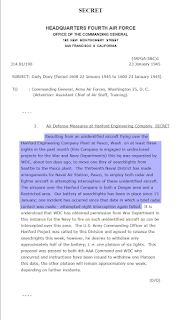
On July 6, 2014, UFO historian Jan Aldrich wrote to me saying that his research group, Project 1947, had secured documents from Headquarters Fourth Air Force, written during the war, which referred to overflights of the Hanford site by “unidentified aircraft”. One of them, dated January 23, 1945, and directed to the Commanding General of the Army Air Forces and the Assistant Chief of Air Staff, Training, states:
Daily Diary (Period 1600 22 January 1945 to 1600 23 January 1945)
- Click on image(s) to enlarge -
Courtesy of Jan Aldrich / Project 1947

Resulting from an unidentified aircraft flying over the Hanford Engineering Company Plant at Pasco, Wash. on at least three nights in the past month (this Company is engaged in undisclosed projects for the War and Navy Departments) this HQ was requested by [Western Defense Command], about ten days ago, to move one [battery] of searchlights from Seattle to the Pasco plant. The Thirteenth Naval District has made arrangements for Naval Air Station, Pasco, to employ both radar and fighter aircraft in attempting interception of these unidentified aircraft. The airspace over the Hanford Company is both a Danger area and a Restricted area. Our battery of searchlights has been in place since 15 January; one incident has occurred since that date in which a brief radar contact was made—attempted night interception again failed.
So here we have an official document referring to one or more unidentified aircraft flying over the Top Secret Hanford atomic materials production plant on three occasions between late December 1944 and late January 1945. At least one of those “aircraft” was tracked on radar and successfully eluded the U.S. Navy fighter sent up to intercept it.

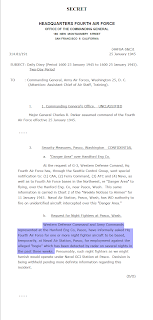
A second record, dated January 25, 1945, states:
Daily Diary (Period 1600 23 January 1945 to 1600 25 January 1945) (Emphasis Added)
Click on image(s) to enlarge -
Courtesy of Jan Aldrich / Project 1947
Western Defense Command and Army Commands represented at the Hanford Engineering Co, Pasco, have informally asked HQ Fourth Air Force for one or more night fighter aircraft to be based, temporarily, at Naval Air Station, Pasco, for employment against the alleged "bogie" which has been detected by radar on several nights in the past three weeks.
Here we learn that the radar trackings of the unidentified aircraft occurred more than once. No known records exist which confirm that any Japanese fixed-winged aircraft ever overflew the Hanford site. Regarding the balloon bombs, on March 10, 1945, one of them descended near the facility, resulting in a short circuit in the power lines supplying electricity for the nuclear reactor’s cooling pumps, but power was quickly restored.

In any case, given Bud Clem’s description of the object that outran Lt. Commander Brown, it seems highly unlikely that it was Japanese in origin. Once again, Clem told me, “[Brown] just said it was so bright that you could hardly look directly at it. As he closed on it, it took off to the northwest at a high rate of speed. No maneuvers really, just a straight-line course.”

Given the available data, it appears that bona fide UFOs were in fact operating near the Hanford site in early 1945, only months prior to the attacks on Hiroshima and Nagasaki. If this was the case, one might ask if the unknown craft—whether piloted or remote-controlled—were also monitoring other operations associated with the U.S. atomic weapons program.

Indeed, one might wonder whether UFOs were present during the atomic attacks themselves! It must be stressed that no credible evidence is available which would substantiate this possibility, however, military records confirming sightings of the orb-like “Foo Fighters” by U.S. Army Air Force bomber crews on missions over Japan, during the early months of 1945, are a matter-of-record.

Monday, August 10, 2015

Reports Confirm UFO Activity at the Hanford Nuclear Weapons Plant During World War II


Bookmark and Share


By Robert Hastings
The UFO Chronicles
8-4-15

     UFO incursions at U.S. atomic/thermonuclear weapons sites, extending from the 1940s to nearly the present day, are well-established. Hundreds of U.S. military veterans and thousands of declassified Army, Air Force, Navy, FBI, and CIA documents make reference to these incidents. In fact, it can now be said that UFOs apparently monitored our atomic weapons program even before Hiroshima and Nagasaki were bombed in August 1945.

During the war, Clarence R. “Bud” Clem was a Lieutenant Junior Grade in the U.S. Naval Reserves, serving as an F6F Hellcat fighter pilot assigned to Air Group 50 aboard the U.S.S. Cowpens CVL-25. In an April 2, 2009 email, Clem told me:
Our group was deployed to NAS (Naval Air Station) Pasco, Washington for ground support training in March 1945. The Hanford Ordnance Works was just across the Columbia River from Pasco and designated Top Secret. We experienced an unknown object over the Hanford site in March/April, 1945. I did not fly after the object, as two members of our squadron did, but I did assist in trying to determine what was going on. I am 84 and I do not know if any other members of our squadron are still alive [who] could add more information. If you have any information about our experience, I would like to see what the official report stated.
The Hanford site was the plutonium-production plant that manufactured the fissile material used in the first atomic bomb—exploded on July 16, 1945, near Alamogordo, New Mexico—as well as in the bomb dropped on Nagasaki, Japan three weeks later, on August 9th. I wrote back to Clem, saying that I didn’t have any official reports relating to the incident at Hanford and asked for more details. He responded:
One night, shortly after the evening meal, the officers were gathered at the Officers Club for relaxation when the duty officer at the tower called our commander with a request. Lt. Commander Richard Brown took the call, as the Captain was in conference. Ensign C.T. Neal and I were with Brown and he asked us if we would volunteer to go with him to the flight line for possible duty. We both agreed and a jeep was waiting at the door to take us to the flight line. We learned that an unknown ‘bogey’ was over the Hanford Ordnance Works, according to the radar operator located at an auxiliary field just across the Columbia River from Hanford reservation.

We had been instructed upon arrival that the Hanford Ordnance Works was Top Secret and no flights over any part were permitted...We did not know about the radar, but the duty officer stated that something was in the sky over the area and wanted someone to investigate. A plane was [already] armed and warmed-up on the tarmac. Brown stated he would go and Neal was to stand-by in another plane, in case of trouble. I was to join the [controller] in the tower and communicate info from radar to the pilots.

Brown quickly found the object, a bright ball of fire, and took chase. But he could not close [on it], even with water injection that gave a quick boost in speed. The object headed out NW towards Seattle and was quickly lost by radar. Brown returned to base and we three retired to the club, still shaking and wondering what we had encountered. Memory does not recall details of two similar experiences—I think Neal was to take the next chase—but the object disappeared before he got airborne. I was assigned to fly the entire [Hanford] reservation at low altitude (200 feet or so) to give the radar operator the blind spots [caused by the terrain]…

I do not know if any other incidents occurred after we left Washington. None of the above information was mentioned in the ‘history’ of our squadron but I wonder what is on record at NAS Pasco.
I asked Clem, “During the first incident, how long did it take for the aircraft to get to Hanford?” He replied, “Not long. An aircraft was always ready to fly on short notice to intercept the Japanese incendiary balloons. If you’ve read the history of that project, and the concern the balloons caused, it would have been logical to intercept them before they could reach Hanford.”

I asked Clem if the pilot on the first night, Lt. Commander Brown, had described the object in detail, either over the radio or back at the Officers Club. Clem replied, “He just said it was so bright that you could hardly look directly at it. As he closed on it, it took off to the northwest at a high rate of speed. No maneuvers really, just a straight-line course.”

Other questions to Clem added few details. He later sent me his military records which revealed that his fighter squadron was actually at Pasco from January 9 to February 15, 1945, not during March and April, as he had first indicated. This fact is important in light of subsequent developments.

On July 6, 2014, UFO historian Jan Aldrich wrote to me saying that his research group, Project 1947, had secured documents from Headquarters Fourth Air Force, written during the war, which referred to overflights of the Hanford site by “unidentified aircraft”. One of them, dated January 23, 1945, and directed to the Commanding General of the Army Air Forces and the Assistant Chief of Air Staff, Training, states:
Daily Diary (Period 1600 22 January 1945 to 1600 23 January 1945)
- Click on image(s) to enlarge -
Courtesy of Jan Aldrich / Project 1947

Resulting from an unidentified aircraft flying over the Hanford Engineering Company Plant at Pasco, Wash. on at least three nights in the past month (this Company is engaged in undisclosed projects for the War and Navy Departments) this HQ was requested by [Western Defense Command], about ten days ago, to move one [battery] of searchlights from Seattle to the Pasco plant. The Thirteenth Naval District has made arrangements for Naval Air Station, Pasco, to employ both radar and fighter aircraft in attempting interception of these unidentified aircraft. The airspace over the Hanford Company is both a Danger area and a Restricted area. Our battery of searchlights has been in place since 15 January; one incident has occurred since that date in which a brief radar contact was made—attempted night interception again failed.
So here we have an official document referring to one or more unidentified aircraft flying over the Top Secret Hanford atomic materials production plant on three occasions between late December 1944 and late January 1945. At least one of those “aircraft” was tracked on radar and successfully eluded the U.S. Navy fighter sent up to intercept it.

A second record, dated January 25, 1945, states:
Daily Diary (Period 1600 23 January 1945 to 1600 25 January 1945) (Emphasis Added)
Click on image(s) to enlarge -
Courtesy of Jan Aldrich / Project 1947
Western Defense Command and Army Commands represented at the Hanford Engineering Co, Pasco, have informally asked HQ Fourth Air Force for one or more night fighter aircraft to be based, temporarily, at Naval Air Station, Pasco, for employment against the alleged "bogie" which has been detected by radar on several nights in the past three weeks.
Here we learn that the radar trackings of the unidentified aircraft occurred more than once. No known records exist which confirm that any Japanese fixed-winged aircraft ever overflew the Hanford site. Regarding the balloon bombs, on March 10, 1945, one of them descended near the facility, resulting in a short circuit in the power lines supplying electricity for the nuclear reactor’s cooling pumps, but power was quickly restored.

In any case, given Bud Clem’s description of the object that outran Lt. Commander Brown, it seems highly unlikely that it was Japanese in origin. Once again, Clem told me, “[Brown] just said it was so bright that you could hardly look directly at it. As he closed on it, it took off to the northwest at a high rate of speed. No maneuvers really, just a straight-line course.”

Given the available data, it appears that bona fide UFOs were in fact operating near the Hanford site in early 1945, only months prior to the attacks on Hiroshima and Nagasaki. If this was the case, one might ask if the unknown craft—whether piloted or remote-controlled—were also monitoring other operations associated with the U.S. atomic weapons program.

Indeed, one might wonder whether UFOs were present during the atomic attacks themselves! It must be stressed that no credible evidence is available which would substantiate this possibility, however, military records confirming sightings of the orb-like “Foo Fighters” by U.S. Army Air Force bomber crews on missions over Japan, during the early months of 1945, are a matter-of-record.

Monday, February 18, 2013

Tank Leaking High-Level Radioactive Waste at Hanford | NUCLEAR RADIATION NEWS | VIDEO

Bookmark and Share

Tank Leaking High-Level Radioactive Waste at Hanford


By MIKE BAKER
Associated Press / www.komonews.com
2015-13
      OLYMPIA, Wash. (AP) - A tank that holds radioactive liquids is leaking at the nation's most contaminated nuclear site, Washington Gov. Jay Inslee said Friday, raising concerns about the integrity of other storage facilities at the Hanford Nuclear Reservation.

The U.S. Department of Energy said liquid levels are decreasing in one of 177 underground tanks at the nuclear reservation. Monitoring wells near the tank have not detected higher radiation levels, but Inslee said the leak could be in the range of 150 gallons to 300 gallons over the course of a year and creates a long-term threat that could impact groundwater or rivers.

"I am alarmed about this on many levels," Inslee said at a Friday afternoon news conference. "This raises concerns, not only about the existing leak ... but also concerning the integrity of the other single shell tanks of this age." . . .

The tanks hold millions of gallons of a highly radioactive stew left from decades of plutonium production for nuclear weapons.

Tuesday, December 04, 2012

1949 Nuclear Experiment is an Ugly Legacy of Hanford: "Hanford Nuclear Reservation in Southeastern Washington Deliberately Experimented on Residents in the Area"

Bookmark and Share

1949 Nuclear Experiment is an Ugly Legacy of Hanford:

By Susan Cundiff and Patricia Hoover
www.registerguard.com
12-2-12

     Many of us in the timber-rich Northwest are familiar with such terms as “pulling the green chain” and fresh-cut “green” wood. But how many know the term “Green Run?” Never heard of it? That’s because it was a secret.

On Dec. 2, 1949, officials at the Hanford Nuclear Reservation in southeastern Washington deliberately experimented on residents in the area by releasing raw, irradiated uranium fuel. It was the largest known single incident of intentional radioactive contamination ever. It’s come to be known as the Green Run; in this case “green” meant “uncured.”

Normally, radiated fuel would be cooled for 83 to 101 days to allow some of the short-lived radioactive materials to decay before releasing those materials into the environment. For this test, officials waited a mere 16 days and did not filter the exhaust.

Over a seven-hour period, 7,780 curies of iodine-131 and 20,000 curies of xenon-133 were released. To put these numbers in perspective, the Three Mile Island accident released between 15 and 24 curies of radioactive iodine. Women and children were evacuated, and milk was impounded.

During the Green Run, Air Force planes measured the deposits of iodine-131 on ground vegetation within a 200- by 40-mile plume that stretched from The Dalles to Spokane. Vegetation samples taken in Kennewick, Wash., revealed nearly 1,000 times the acceptable daily limit of iodine-131.

Citizens in the area routinely accepted unusual practices devised by Hanford officials as natural and patriotic: urine samples were left on porches for pick-up, schoolchildren went through whole-body counter scans, and men in white coats palpated students’ throats around the thyroid gland.

As thyroid disease and cancer rates rose among the populations of Richland, Wash., The Dalles, Hermiston and the surrounding countryside, the public began to question the safety of Hanford’s practices. They were assured that “not one atom” had ever escaped from Hanford and that it was as “safe as mother’s milk.” Of course, if mother is contaminated, her breast milk is, too — as is the milk from dairy cattle in the area, the salmon in the river, and vegetables and fruit from the farms and ranches nearby.

With all their collected data, officials had to know the health consequences. And still the deception continued. . . .

Monday, October 31, 2011

Two Former World War II Fighter Pilots Report UFO Experiences at the Hanford Plutonium Production Plant in 1945

Bookmark and Share


By Robert Hastings
www.ufohastings.com
10-31-11

     When World War II ended, in September 1945, Clarence R. “Bud” Clem was a Lieutenant Junior Grade (Lt. jg) in the U.S. Naval Reserves, serving as an F6F Hellcat fighter pilot assigned to Air Group 50 aboard the U.S.S. Cowpens CVL-25. In an email, Clem told me, “[After the Japanese surrendered,] the Cowpens was the first aircraft carrier to arrive in Tokyo Bay and I was with the first flight to land at Yokasuka Naval Air Station (NAS) that day.”

However, nearly a year earlier, the Hellcat squadron had been based at NAS Klamath Falls, Oregon. “[During that same period] our group was deployed to NAS Pasco, Washington for ground support training in March 1945.” Clem wrote, “The Hanford Ordnance Works was just across the Columbia River from Pasco and designated TOP SECRET. We experienced an unknown object over the Hanford site in March/April, 1945. I did not fly after the object, as two members of our squadron did, but I did assist in trying to determine what was going on. I am 84 [years-old] and I do not know if any other members of our squadron are still alive who could add more information. If you have any information about our experience, I would like to see what the official report stated.”

The plutonium produced by Hanford was used in the first atomic bomb test, conducted in the New Mexico desert on July 16, 1945, as well as in the bomb dropped on Nagasaki, on August 9, 1945.

I wrote to Clem, saying that I didn’t have any official reports relating to the incident. I then asked for more details. Clem responded:
One night, shortly after the evening meal, the officers were gathered at the Officers Club for relaxation when the duty officer at the tower called our commander with a request. Lt. Commander Richard Brown took the call, as the Captain was in conference. Ensign C.T. Neal and I were with Brown and he asked us if we would volunteer to go with him to the flight line for possible duty. We both agreed and a jeep was waiting at the door to take us to the flight line. We learned that an unknown ‘bogey’ was over the Hanford Ordnance Works, according to the radar operator located on an auxiliary field just across the Columbia River from Hanford reservation.

We had been instructed upon arrival that the Hanford Ordnance Works was Top Secret and NO flights over any part were permitted...We did not know about the radar, but the duty officer stated that something was in the sky over the area and wanted someone to investigate. A plane was [already] armed and warmed-up on the tarmac. Brown stated he would go and Neal was to stand-by in another plane, in case of trouble. I was to join the [controller] in the tower and communicate info from radar to the pilots.

Brown quickly found the object, a bright ball of fire, and took chase. But he could not close, even with water injection that gave a quick boost in speed. The object headed out NW towards Seattle and was quickly lost by radar. Brown returned to base and we three retired to the club, still shaking and wondering what we had encountered.

Memory does not recall details of two similar experiences—I think Neal was to take the next chase—but the object disappeared before he got airborne. I was assigned to fly the entire [Hanford] reservation at low altitude (200 feet or so) to give the radar operator the blind spots [caused by the terrain]…

The third, and last attempt on our part to ‘catch’ and identify the object came just shortly before we returned to Klamath Falls, and then on to California and Hawaii, before joining the 7th Fleet in combat. I do not know if any other incidents occurred after we left Washington. None of the above information was mentioned in the ‘history’ of our squadron but I wonder what is on record at NAS Pasco.1
I asked Clem, “During the first incident, how long did it take for the aircraft to get to Hanford?” He replied, “Not long. An aircraft was always ready to fly on short notice to intercept the Japanese incendiary balloons. If you’ve read the history of that project, and the concern the balloons caused, it would have been logical to intercept them before they could reach Hanford.”

I asked Clem if the pilot on the first night, Lt. Commander Brown, had described the object in detail, either over the radio or back at the Officers Club. Clem replied, “He just said it was so bright that you could hardly look directly at it. As he closed on it, it took off to the northwest at a high rate of speed. No maneuvers really, just a straight-line course.”

Other questions to Clem added few details. He later sent me his military records which revealed that the fighter squadron was actually at Pasco from January 9 to February 15, 1945, not during March and April, as he had first indicated.

But Bud Clem’s account is not unique. Another former World War II fighter pilot, Rolan D. Powell, states that he too was involved in a UFO intercept attempt at the Hanford plant, possibly in July 1945. That incident was first mentioned in a self-published book by Byron D. Varner, an aviation cadet during World War II whose naval career included a 13-year stint as a Navy Public Affairs Officer.

Upon learning of Powell’s report, Walt Andrus, former International Director of the Mutual UFO Network (MUFON), located and interviewed him. According to a short article available at nicap.org, Powell told Andrus that while he was unaware of the whereabouts of the other five aviators who had been involved in the action, and did not even remember their full names, they had nevertheless belonged to a squadron of 12 veteran fighter pilots who had survived combat in the Pacific as members of Air Group 3, while assigned to the U.S.S. Yorktown CV-10.

According to the article:
Powell estimated that the event took place six weeks before the Japanese surrendered on September 2, 1945, which puts the sighting in the middle of July 1945.
Powell told Andrus that six F6F [aircraft] made visual contact with the object, [which was] described as the size of three aircraft carriers side-by-side, oval shaped, very streamlined, like a stretched-out egg, and pinkish in color. Powell reported that some kind of vapor was being emitted around the outside edges from portholes or vents. He speculated that the vapor was being discharged to form a cloud for disguise. The object was observed at noon in a clear sky at an estimated altitude of 65,000 feet.

The F6Fs went up as high as 42,000 feet, well above their rated ceiling of 37,000 feet, but could not reach the large object, which hovered above the Hanford nuclear reactor for an additional 20 minutes, before going straight up as the six Hellcats gave up the intercept.2
A rather dramatic account, to say the least! Hopefully, at least some of the other members of Powell’s squadron who participated in this action can be located and interviewed. Efforts are currently underway to do just that.

In any case, given Bud Clem’s recent report to me, it now appears likely that UFO surveillance at America’s nuclear weapons sites began at least several months prior to the successful test of the first atomic bomb, in the New Mexico desert, on July 16, 1945. Moreover, if Rolan Powell’s estimate of the date of his encounter at Hanford is reasonably accurate, the event he describes would have occurred around the time of the test. (That said, Bud Clem’s initial estimate of his squadron’s presence at the Pasco NAS was off by some two months, perhaps not unreasonably, given that the reported incident occurred over 60 years ago. Similarly, Powell’s estimate of the time-frame for his own experience may be somewhat inaccurate as well.)

References
1. Bud Clem to Robert Hastings, personal communication, April 2, 2009

2. http://www.nicap.org/ncp/ncp-hanford45.htm

Thursday, September 23, 2010

MY UFO EXPERIENCE: "UFO's Were Hovering Over the Hanford Atomic Energy Facility . . ." F 94 Starfire Jets Were Scrambled!

Hanford Plutonium Plant
Reader Submitted Report
[Unedited]
9-22-10

     I was stationed at the 636th AC&W Radar site, Condon,Oregon in the 1950's in the capacity of Air Policeman base security.

On one very clear day my phone rang at the gatehouse, It was Major Arnold asking me to go outside and look straight up and tell him what I saw. It appeared to be a disc shaped object very bright and shiny.

Everybody that wanted to or could leave his post or duties was invited to look and or take photos It.appeared as a bright and shiny dime. I don't know if our height finder was installed at that time.

On one such incident some UFO's were hovering over the Hanford Atomic Energy facility and supposedly six F 94 Starfire jets were dispatched from McCord air force base to chase away the UFO's.

Four aircraft never returned as reported by the press.

Our radar site was about thirty miles south of the Columbia River, The Hanford works was about fifty miles north of the river. I never could understand why the cover up unless it was of our own technology.

Sunday, August 09, 2009

Former World War II Fighter Pilot Bud Clem’s 1945 UFO Experience at the Hanford Plutonium Production Plant

Hanford Plutonium Plant Aerial View

On the Anniversary of the Destruction of Nagasaki:

By Robert Hastings
ufohastings.com
© 8-8-09

     When World War II ended, in September 1945, Clarence R. “Bud” Clem was a Lieutenant Junior Grade (Lt. jg) in the U.S. Naval Reserves, serving as an F6F Hellcat fighter pilot assigned to Air Group 50 aboard the U.S.S. Cowpens CVL25. In an email, Clem told me, “[After the Japanese surrendered,] the Cowpens was the first aircraft carrier to arrive in Tokyo Bay and I was with the first flight to land at Yokasuka Naval Air Station (NAS) that day.”

However, almost a year earlier, the Hellcat squadron had been based at NAS Klamath Falls, Oregon. “Our group was deployed to NAS Pasco, Washington for ground support training in March 1945.” Clem wrote, “The Hanford Ordnance Works was just across the Columbia River from Pasco and designated TOP SECRET. We experienced an unknown object over the Hanford site in March/April, 1945. I did not fly after the object, as two members of our squadron did, but I did assist in trying to determine what was going on. I am 84 and I do not know if any other members of our squadron are still alive [who] could add more information. If you have any information about our experience, I would like to see what the official report stated.”

I wrote to Clem, saying that I didn’t have any official reports relating to the incident. I then asked for more details. Clem responded:
One night, shortly after the evening meal, the officers were gathered at the Officers Club for relaxation when the duty officer at the tower called our commander with a request. Lt. Commander Richard Brown took the call, as the Captain was in conference. Ensign C.T. Neal and I were with Brown and he asked us if we would volunteer to go with him to the flight line for possible duty. We both agreed and a jeep was waiting at the door to take us to the flight line. We learned that an unknown ‘bogy’ was over the Hanford Ordnance Works, according to the radar operator located on an auxiliary field just across the Columbia River from Hanford reservation.

We had been instructed upon arrival that the Hanford Ordnance Works was Top Secret and NO flights over any part were permitted...We did not know about the radar, but the duty officer stated that something was in the sky over the area and wanted someone to investigate. A plane was [already] armed and warmed-up on the tarmac. Brown stated he would go and Neal was to stand-by in another plane, in case of trouble. I was to join the [controller] in the tower and communicate info from radar to the pilots.

Brown quickly found the object, a bright ball of fire, and took chase. But he could not close, even with water injection that gave a quick boost in speed. The object headed out NW towards Seattle and was quickly lost by radar. Brown returned to base and we three retired to the club, still shaking and wondering what we had encountered.

Memory does not recall details of two similar experiences—I think Neal was to take the next chase—but the object disappeared before he got airborne. I was assigned to fly the entire [Hanford] reservation at low altitude (200 feet or so) to give the radar operator the blind spots [caused by the terrain]…

The third, and last attempt on our part to ‘catch’ and identify the object came just shortly before we returned to Klamath Falls, and then on to California and Hawaii, before joining the 7th Fleet in combat. I do not know if any other incidents occurred after we left Washington. None of the above information was mentioned in the ‘history’ of our squadron but I wonder what is on record at NAS Pasco.1
I asked Clem, “During the first incident, how long did it take for the aircraft to get to Hanford?” He replied, “Not long. An aircraft was always ready to fly on short notice to intercept the Japanese incendiary balloons. If you’ve read the history of that project, and the concern the balloons caused, it would have been logical to intercept them before they could reach Hanford.”

I asked Clem if the pilot on the first night, Lt. Commander Brown, had described the object in detail, either over the radio or back at the Officers Club. Clem replied, “He just said it was so bright that you could hardly look directly at it. As he closed on it, it took off to the northwest at a high rate of speed. No maneuvers really, just a straight-line course.”

Other questions to Clem added few details. He later sent me his military records which revealed that the fighter squadron was actually at Pasco from January 9 to February 15, 1945, not during March and April, as he had first indicated. Perhaps significantly, Hanford began plutonium-separation processing on January 20, 1945. Some of that material was used in the “Fat Man” bomb that was dropped on Nagasaki, on August 9, 1945.

But Bud Clem’s account is not unique. Another former World War II fighter pilot, Rolan D. Powell, has revealed that he too had been involved in a UFO intercept attempt at the Hanford plant, possibly in July 1945. That incident was first mentioned in a self-published book by Byron D. Varner: an aviation cadet during World War II, whose naval career included a 13-year stint as a Navy Public Affairs Officer.

Upon learning of Powell’s report, Walt Andrus, former International Director of the Mutual UFO Network (MUFON), located and interviewed him. According to a short article available at nicap.org, Powell told Andrus that while he was unaware of the whereabouts of the other five aviators who had been involved in the action, and did not even remember their full names, they had nevertheless belonged to a squadron of 12 veteran fighter pilots who had survived combat in the Pacific as members of Air Group 3, while assigned to the U.S.S. Yorktown [CV-10].

According to the article:
Powell estimated that the event took place six weeks before the Japanese surrendered on September 2, 1945, which puts the sighting in the middle of July 1945.

Powell told Andrus that six F6F [aircraft] made visual contact with the object, [which was] described as the size of three aircraft carriers side-by-side, oval shaped, very streamlined, like a stretched-out egg, and pinkish in color. Powell reported that some kind of vapor was being emitted around the outside edges from portholes or vents. He speculated that the vapor was being discharged to form a cloud for disguise. The object was observed at noon in a clear sky at an estimated altitude of 65,000 feet.

The F6Fs went up as high as 42,000 feet, well above their rated ceiling of 37,000 feet, but could not reach the large object, which hovered above the Hanford nuclear reactor for an additional 20 minutes, before going straight up as the six Hellcats gave up the intercept.2
A rather dramatic account, to say the least! Hopefully, at least some of the other members of Powell’s squadron who participated in this action can be located and interviewed. Efforts are currently underway to do just that.

In any case, given Bud Clem’s recent report to me, it now appears likely that UFO surveillance at America’s nuclear weapons sites began at least several months prior to the successful test of the first atomic bomb, in the New Mexico desert, on July 16, 1945. Moreover, if Rolan Powell’s estimate of the date of his encounter at Hanford is reasonably accurate, the event he describes would have occurred around the time of the test. (That said, Bud Clem’s initial estimate of his squadron’s presence at the Pasco NAS was off by some two months, perhaps not unreasonably, given that the reported event occurred over 60 years ago. Similarly, Powell’s estimate of the time-frame for his own experience may be somewhat inaccurate as well.)