 Pentagon Has Far-Reaching Defense Spacecraft in WorksBush Administration Looking to Space to Fight Threats
By Walter Pincus
Washington Post Staff Writer
3-16-05
The Pentagon is working to develop a suborbital space capsule within the next five years that would be launched from the United States and could deliver conventional weapons anywhere in the world within two hours, defense officials said.
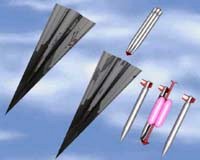
This year, the Falcon program will test a launcher for its Common Aero Vehicle (CAV), an unmanned maneuverable spacecraft that would travel at five times the speed of sound and could carry 1,000 pounds of munitions, intelligence sensors or other payloads. Among the system's strengths is that commanders could order a CAV -- an unpowered glide vehicle -- not to release its payload if they decided not to follow through with an attack.
The first-generation CAV, expected to be ready by 2010, will have "an incredible capability to provide the warfighter with a global reach capability against high payoff targets," Gen. Lance W. Lord, commander of Air Force Space Command, told the House Armed Services Committee last Wednesday.
Within the next three years, the Falcon program hopes to enter a second stage of the effort: flight-testing two versions of a reusable hypersonic cruise vehicle, sometimes referred to as a space plane, that could travel a suborbital path, about 100,000 feet high, carrying a CAV anywhere in the world. Unlike a missile, the vehicle could return to its base after releasing the CAV to deliver bombs or intelligence sensors.
The Falcon program vehicles "will improve the military's ability to quickly position intelligence, surveillance and reconnaissance payloads, while reducing its reliance on forward and foreign basing," Anthony J. "Tony" Tether, director of the Defense Advanced Research Projects Agency (DARPA), told a Senate Armed Services subcommittee last week.
While most public attention today focuses on meeting threats abroad with traditional land, sea and air forces, the Falcon program reflects how the Bush administration is increasingly looking to space to meet dangers it anticipates.
The use of space "enables us to project power anywhere in the world from secure bases of operation," says the Pentagon's national defense strategy, which Defense Secretary Donald H. Rumsfeld signed on March 1. Among the key goals in the strategy paper are "to ensure our access to and use of space and to deny hostile exploitation of space to adversaries." The strategy paper, done every four years, provides the policy basis on which the armed services plan their research, development and acquisitions of weapons systems. This year's strategy, Rumsfeld wrote, "emphasizes the importance of influencing events before challenges become more dangerous and less manageable."
In congressional appearances over two weeks, Lord, Tether and other senior Pentagon officials have described a variety of new space initiatives for meeting challenges such as updating intelligence and communications satellite programs and even fielding systems that would allow the United States to temporarily silence enemy satellites if the need arose.
Space communications have already become important to U.S. warfighting. As Lord put it, "Our most recent operations in Afghanistan and Iraq prove our nation relies on capabilities coming from and through space more than ever before." For example, more than 60 percent of all communications at the height of Operation Iraqi Freedom came through satellites, which also guided munitions to targets and today transmit intelligence from the United States directly to troops fighting in the field.
Looking to the future, the defense strategy calls for the use of space vehicles that provide capabilities beyond the current intercontinental missiles to thwart any future adversaries that move to prevent U.S. use of land or sea bases.
Such abilities, Lord told the House members, are dubbed "prompt global strike" and represent "a top priority for our space and missile forces." Because CAVs, unlike missiles, can be recalled, they could be launched toward a potential target even before a final decision was made to attack. The system could, Lord said, "deliver a conventional payload precisely on target within minutes of a valid command and control release order."
The capability offered by CAV would also reduce the need for overseas bases and enable the United States "to react promptly and decisively to destabilizing or threatening actions by hostile countries and terrorist organizations," according to DARPA's early solicitation for bids put out in mid-2003.
John E. Pike, director of GlobalSecurity.org, a nongovernmental defense think tank, said yesterday that the Falcon and CAV programs will allow the United States "to crush someone anywhere in world on 30 minutes' notice with no need for a nearby air base."
In addition to creating attack weapons, the Pentagon is working on new defense systems to protect the ever-more-important satellites the United States has in space.
"I think everybody that I know in the United States military and the Department of Defense understands the important role that our space assets play in our national security," Gen. Richard B. Myers, chairman of the Joint Chiefs of Staff, told the House Armed Services Committee last Thursday.
Last October, the Pentagon announced deployment of its first mobile ground-based system that could temporarily disrupt satellite-based communications from an enemy satellite. The counter-communications system uses powerful electromagnetic radio frequency energy to silence transmissions from a satellite in a way that is reversible if the need passes. Two more units are due later this year.


