Showing posts with label Giza. Show all posts

Tuesday, September 25, 2012

Mini-Great Pyramid of Giza on Mars Intrigues Curiosity Rover Team


Bookmark and Share

Pyramid Shaped Rock On Mars

By Pete Spotts
www.csmonitor.com
9-19-12

     NASA's Mars rover Curiosity is eying a target for the first tandem test of two instruments crucial to the rover's mission of determining whether its new home, Gale Crater, as well as the crater's central Mt. Sharp, could have hosted life early in the planet's history.

At 16 inches wide and about 10 inches tall, the target rock looks like a miniature Great Pyramid of Giza, with one face artisans neglected to maintain.

But it's just the ticket for testing the rover's ChemCam and and Alpha Particle X-Ray Spectrometer (APXS), a complementary set of tools for determining the composition of the rocks and soils the rover will encounter during its two-year prime mission on Mars. . . .

Thursday, March 01, 2012

Unraveling the Age of the Pyramids and Sphinx on the Giza Plateau


Bookmark and Share

The Sphinx

By Dennis G. Balthaser
www.truthseekeratroswell.com
3-1-12
     After all these years of doing research by many scholars about the pyramids of Giza and the Sphinx, a definitive time line is yet to be confirmed establishing when they were built, who built them or for what purpose the were built. Unlike many other ancient structures in the world, no records have been found thus far to resolve these lingering questions.

Map
We do know that global weather has had a big part on where various civilizations lived or moved to because of such things as prolonged drought, extreme periods of moisture, etc. Egypt is of course no exception to that, since thousands of years ago Egypt for the most part was a tropical area, unlike the harsh desert terrain of today. (Ice Age map, left)

Around 12,000 BC, Earth’s sea level rose suddenly more than 60 feet in less than 200 years, a direct result of extreme glacial melting, which was the beginning of an eight-thousand-year period scientists call the end of the last Ice Age, when sea levels rose nearly 400 feet to the level they are today. About 9000 BC monsoon rains invaded Egypt, which lasted until about 3500 BC when they abruptly stopped.

A few of the theories I’ve become aware of include the most obvious one we hear about today, that the Pyramids of Giza were built for Egyptian Pharaohs, primarily of the 4th dynasty (2500 BC). The Great Pyramid was supposedly the burial tomb for Kufu to enter the afterlife, yet nothing has ever been found inside the Great Pyramid to verify that.

Sphinx water deterioration

As I’ve mentioned in previous editorials, the Sphinx has water deteriation on the back of the lion’s body, and we know there hasn’t been that amount of rainfall to cause it in Egypt for some 7000 years.

Some have said the Pyramids of Giza were built by the Israelites while in captivity in Egypt, while others refer to the great flood mentioned in the Bible, however it’s believed the deteriation would have been caused by large volumes of rainfall, not flooding. Many of the Arabs of the ninth century AD appear to have had sources of information, which led them to believe that the Great Pyramid was built before the flood, as a repository for scientific knowledge.

Still another theory was that a civilization in North Africa known as Khemtians some 10,000 years ago had contact with star people that may have been involved in the construction, or at least the method of doing the construction. For me with a civil engineering background, it’s hard to envision how the construction could have been accomplished with the tools we believe were available to them at the time, and the technology that would have been involved.

Today with the use of computers and soft ware it’s possible to track the stars of the heavens back thousands of years to determine there location on particular ancient dates. Many of those locations do in fact align with certain structures in Egypt, such as the three Pyramids of Giza being in the same alignment as the 3 stars of Orion’s belt, the fact that the Sphinx faces exactly toward the eastern sunrise at certain times of the year, and that the shafts of the Kings and Queens chamber align perfectly with certain stars, and other astronomical occurrences in the sky. As an example, during the summer solstice, (the longest day of the year), and the winter solstice, (the shortest day of the year), at Giza the sun rises about 28 degrees south of due east and 28 degrees north during those two times of the year, thus being an equinoctial marker when the Sphinx faces perfectly to the east at sunrise during the spring equinox.

Pyramid with casing stones

The technology side of how the Pyramids were built is to me, some of the most amazing information to come forward thus far. Fourteenth century Arab commentators tell us the Great Pyramid and the second one were both covered with smoothly-polished Tura limestone that glowed in the Egyptian sun, and were shaken loose by an earth quake in 1301 AD, and most then used to build mosques and temples. Only the second Pyramid still has any of the limestone casing stones at the top. Those casing stones consisted of an estimated 22 acres of 8-foot thick blocks, each weighing about 16 tons, and so closely joined that they appeared to be a single slab from top to bottom. As determined in 1881 by Sir W. M. Flinders Petrie, the mean thickness of the joints is 0.020 of an inch giving a variation of the cutting of the stone from a straight line and a true square but 0.01 of an inch on a length of 75 inches up the face.

The mathematical value of pi (3.14), was supposedly discovered by the Greeks in the 3rd century BC, however when one takes the designed height of the Great Pyramid (481.3949 feet), it bears the same relationship to its base perimeter (3023.16 feet), as does the circumference of a circle to its radius. That relationship is:

2 pi (481.3949 feet) x 2 x 3.14 = 3023.16 feet

There is also a direct relationship between the dimension of the Pyramid and the dimension of the earth using a scale of 1 : 43,200. These relationships are not speculation, but rather measurable facts.

The accuracy of the Pyramid’s base between the longest and shortest side is less than 8 inches, considering each side is 755 feet.
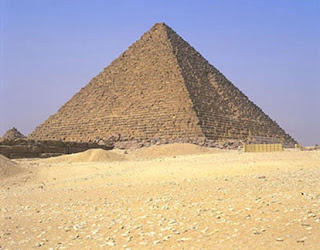
The Great Pyramid
The Great Pyramid

I have for years wondered about the stability of the Pyramid with the massive weight of the stones not causing it to recede into the sand. In Graham Hancock and Robert Bauval’s book, “The Message of the Sphinx”, they point out that it was not built on perfectly flat ground, as might be expected by the accuracy of the dimensions revealed, but with a massive natural mound, or hill, left exactly in the middle of the site on which the Great Pyramid was erected. The mound is estimated to be almost 30 feet high, and located dead center over the base, which probably accounts for its stability over thousands of years.

It’s now believed that the Sphinx is much older than the 4500-year age assigned to it by Egyptologists, some thinking as far back as the last Ice Age in a range of 15,000 BC and 5000 BC.

Have the Pyramids of Giza and the Sphinx given us some message about a past civilization that we don’t yet understand, not unlike the possibility of a message from extraterrestrials would or have given us perhaps about the future. Both seem to be a possibility. Perhaps there is a common language that all technical civilizations, no matter how old or futuristic use. That common language is science and mathematics, since the laws of nature are the same everywhere based on our limited knowledge today.

It appears the 3 Pyramids of Giza and the Sphinx, as well as some other monuments located on the Giza Plateau are giving us a view of the sky as much as 10,500 years ago. Carbon dating of mortar from the Great Pyramid with organic fiber obtained in 1986 was tested at Southern Methodist University, and others at laboratories in Zurich, Switzerland, revealing dates of 3809 BC to 2869 BC, some 400 years prior to the Fourth Dynasty.

Can we draw any conclusions today? Various theories must continue to be pursued and some day, hopefully the truth will be known.

Wednesday, February 02, 2011

More Theories About The Sphinx and Pyramids of Giza

Sphinx


By Dennis Balthaser
www.truthseekeratroswell.com
2-1-11

Dennis Balthaser     During my 33 years of civil engineering work with the Texas Department of Transportation, I was fortunate enough to have been involved with quality control and quality assurance of materials used to build several massive bridge structures in Texas. That background tends to be the reason I became interested in researching Underground Bases and Tunnels, and more recently the Pyramids of Giza. Area 51 and the 1947 Roswell Incident were two areas of research I had an interest in before retiring from the Texas DOT in 1996, and it’s been sometime since I addressed one of my favorite areas of research, “the pyramids of Giza.” My views about who built them haven’t changed over the years, still believing that the three pyramids of Giza and the Sphinx are much older than the Egyptian civilization, as we’re led to believe today by many Egyptologists and others.

If in fact The great pyramid of Giza was built for Khufu, a Pharaoh of the 4th dynasty about 2600 BC, why was nothing ever found inside the pyramid to indicate that he was prepared for the afterlife, as was the custom with other Pharaoh’s tombs uncovered over the years? To this date the only artifact found referring to Khufu is a 3” statute, now in the Cairo museum, that was originally found a great distance away from the pyramids in 1903. Unless some great discovery is still to be revealed inside the great pyramid referring to Khufu, I will continue to question if in fact the great pyramid was ever built for him.

I have recently come upon several new theories about how the pyramids of Giza were built, indicating that after all these years and all the research that has been done, we still don’t have any factual information on how they were built, who built them or for what purpose. Unlike everything else the Egyptian civilization did accomplish, no records have been discovered on how or who built the 3 pyramids of Giza or the Sphinx. Theories are described as, “Proposed explanations whose status is still conjectural, in contrast to well-established propositions that are regarded as reporting matters of actual facts.” Many I suppose would place UFO research into that same category as only being theories, since some have suggested that alien technology was involved in the building of the pyramids.

Researcher Stephen Mehler offers scientific evidence in his book, “The Land of Osiris”, about an advanced civilization that lived in Northern Africa some 10,000 years ago known as Khemitians. One of his sources of information came from a local known as a “keeper of wisdom”, who presented evidence that he believed the ancient Khemitians had contact, and that the existence of life on other planets and in other dimensions is a distinct reality, being part of the indigenous tradition of the Khemitian wisdom keepers. Were the pyramids of Giza and the Sphinx built with technology the Khemitians received from star people, prior to the Egyptian civilization?

The great pyramid of Giza stands over 450’ tall and contains some 2 ½ million stones weighing between 2 and 70 tons each. That does not include the polished limestone casing stones that originally covered the stones seen today. Only one of the three great pyramids of Giza still has any casing stones in place near the top, due to the Arabs removing them to build mosques and temples.

The most frequently mentioned method of building the pyramids is the use of a ramp to drag the stones to their final location, requiring 20-30 years and 20-30,000 workers to accomplish. Considering the stones had to be quarried, cut, transported up the Nile river, moved across the Giza Plateau and set, using the above information, a stone would have had to been placed every 90 seconds.

ramp to drag the stones
Another mathematical problem is the ramp itself. Knowing the height of the pyramid (450 feet) and assuming an angle of 20 degrees for the ramp, which would be a fairly steep angle, the length of a ramp would calculate to more than 1316 feet long. Additionally, assuming a conservative width of 20 feet for the ramp, and knowing the length and height, the volume of material required for such a ramp would be more than 7,000,000 cubic feet. These numbers seem like astronomical figures, since as the pyramid grew taller, the ramp would have to be lengthened and the base widened to keep it from collapsing. Since there are over 200 lifts, or steps to the top of the great pyramid, considerable time would have been lost in maintaining the ramp size for each lift. Other ramp methods have also been theorized, using internal, zigzag, or spiraling ramps. Levitation of the stones has also been mentioned.

Other ramp methods
More recently, Steven Myers, author of the book, “Lost Technologies of the Great Pyramid” has suggested that the stones were transported up the Nile on barges utilizing a series of water locks across the Giza plateau, similar to what was used to build the Erie canal in the 1800’s, due to the increase in elevation from the Nile River to the Giza plateau pyramid site. Upon arrival at the site, each layer of the pyramid was sealed and flooded, enabling the stones to be floated into position by lifting the stones on barges in switchback water locks up along the face of the emerging pyramid. Railroads today use a similar switchback concept to travel up steep grades.

When the three pyramids of Giza were built remains as much a mystery as how they were built and/or who build them. Many believe they were build before the great flood mentioned in the Bible, as one researcher has found evidence of fossils in some of the stones. I would raise the question of whether those fossils were in the stones cut from the quarries, or were they embedded after the pyramid was built due to a massive flood? In either case unlike today, Egypt was apparently subjected to a large amount of water at one time, 5-10 thousand years ago. I’m also convinced that the Sphinx shows evidence on the back portion of the lion’s body of water damage, not deteriation by wind and sand as many propose, having been covered with sand up to the neck until the 1800’s.

Although I’ve not found any direct references to the pyramids of Giza in the Bible, Biblical scholars have made other comments such as found in Isaiah 19:19-20; Joshua 22:26, Ephesians 2:20-21

The purpose of the great pyramid has been discussed by many over the years indicating it was designed as an energy machine, while others contend it was a water pump of sort. Today there is no doubt that it is a money-making generator based on the tourism industry in Egypt.

A few of the lesser-known facts about the three pyramids of Giza that I find interesting are the following:
The alignment of the three pyramids of Giza coincides with the 3 stars of Orion’s belt in the Orion Constellation.

There is believed to be a large rock outcropping directly below the pyramids which might explain why the massive weight of the pyramids has not recessed much in height over thousands of years.

The great pyramid was placed in the exact center of all the land area of the world. Lines drawn through the north-south and east-west axis of the pyramid divide equally all the earth’s terrain.

The empty coffer found in the great pyramid by the Arabs about 850 AD has the exact same inside dimensions as the “Ark of the Covenant” mentioned in the Bible. Coincidence?
Egyptologists continue to take credit for building the three pyramids of Giza and the Sphinx, however these theories and others not mentioned here need to be considered. For me the research of the pyramids and Sphinx are more important than as a tourist industry.

Friday, May 07, 2010

Building the Pyramids of Giza

Pyramids of Giza
By Dennis Balthaser
www.truthseekeratroswell.com
© 5-1-10

Dennis Balthaser     Over the years many theories have been proposed about how the three Pyramids of Giza were constructed, however I know of no records having ever been found explaining how they were in fact built, or by whom. Some of the theories proposed have merit; while others are questionable, and I’ll try to explain a few that I’m familiar with in this article.

Khafu StatueNot only is the construction of the pyramids a mystery, but their age is as well. Most Egyptologists refer to a period of time about 2600 BC during the reign of the 4th Dynasty Pharaoh Khufu. The problem with that however is the fact that nothing has ever been discovered inside the great pyramid, other than an empty lidless box (coffer) to indicate a Pharaoh was ever buried there, as no artifacts for the afterlife were present when the Arabs first entered the pyramid about 820AD. The only reference to Khufu found was a 3”statue, located miles from the pyramids which is today on display in the Cairo museum. (Not much of a legacy for a Pharaoh supposedly buried in a pyramid built for him.)

Researcher Ken Kline has stated that he found evidence of salt water deposits on the inside of the great pyramid, which would predate the age mentioned above, since that area of the world has not had significant rainfall for 5-10,000 years. Kline goes as far as stating perhaps the salt-water deposits he mentions are indicative of the great flood mentioned in the Bible, which would predate the Egyptian civilization. Many structures in Egypt including the Sphinx, also contain seashells and marine fossils fully intact and preserved in the stones used to construct those edifices.

Bosnian PyramidIn recent years several pyramid shaped structures have been discovered in Bosnia, in a town near Sarajevo and Herzegovina, by Bosnian-American archaeologist Semir (Sam) Osmanagich, which are believed to be even older and larger than the those on the Giza Plateau, containing a paved entrance and underground tunnel system, when the woodland covering them is removed. As with the many ancient structures still covered by sand in Egypt, much more research will be required to validate this recent discovery. For more information on the Bosnian pyramids go to http://www.bosnianpyramids.org

Top of PyramidA Franco-American study first made in the 1970’s by French chemist Joseph Davidovits, claimed the pyramids of Giza were built by pouring a form of concrete into blocks on the site rather than cutting and transporting large stones from a quarry, at least on the upper portion of the pyramids, since it is apparent that two types of stones were used, (one from the quarries and one man-made.) According to an article published in the Journal of American Ceramic Society, “the chemistry is well and truly different.” The concrete theorists also point out differences in the density of the pyramid stones, which have a higher mass near the bottom and bubbles near the top, like old-style concrete blocks. The 2.5 million blocks used to build the great pyramid were originally covered with polished limestone casing stones. When the great pyramid is viewed from above, one clearly sees that the horizontal surfaces of the uppermost blocks are flat, unlike the rougher appearing surfaces of blocks toward the bottom of the pyramid. The work force required for casting the blocks at the top of the structure would have been greatly reduced also, versus pulling gigantic stone blocks up ramps to place them in their proper position.

The use of ramps with 20-30,000 workers over a 25-30 year period seems to be the most popular theory presented thus far for explaining how the 3 pyramids of Giza were constructed. I have some problems with that theory which I’ll explain.

Considering the fact that the great pyramid, (Khufu’s), contains 2 ½ million stones weighing between 2 and 70 tons each, and that each stone had to be quarried and shaped away from the site, transported by barge up the Nile River and then set in place, (some at a height of over 400 feet), doesn’t fit the time schedule referred to. To accomplish this, a stone would have had to be set in place every 90 seconds, 24 hours a day, 7 days a week, for 30 years. Prior to the Aswan Dam being completed in 1970 on the Nile, the river flooded annually, which seems to me would have created problems for transporting the massive stones from the quarry to the site, and not allowed for the continuous placement of each stone.

Khafre pyramidTwo methods of dragging these stones on wooden sleds to their final location has also been proposed. Using one continuous ramp would have required an extremely long ramp to reach to the upper portions of the pyramid, requiring the ramp to be lengthened every few increases in elevation of the pyramid, and there are over 200 steps or tiers to the summit. Another ramp proposal utilized a spiral ramp on all 4 sides of the pyramid, going upward as each lift or step was completed. The casing stones, which eventually covered the pyramids, were probably started at the top working downward. Today the only remaining casing stones on the pyramids of Giza are at the top of the Khafre pyramid, (Khufu’s son), adjacent to, and slightly shorter than the great pyramid. The Arabs removed most of the casing stones during the 14th century to build their own temples and Mosques.

Another theory I have heard mentioned, but have found little documentation on is the possibility of levitation to lift the gigantic stones into place.

Researcher Stephen Mehler, in his book “The Land Of Osiris” refers to a civilization in North Africa some 10,000 years ago known as “Khemitians”. According to Mehler this civilization, supposedly had contact with star people. This would of course predate the Egyptian civilization, and as many believe, the pyramids of Giza and the Sphinx are much older than the Egyptian civilization. As an example, it’s a well-accepted fact that the deteriation on the Sphinx was caused by water, not by wind and sand.

Using Mehler’s information I’m not proposing that star people (aliens) built the pyramids, but perhaps furnished the technology to build them. Of the 100+ other pyramids in Egypt, none compare with the 3 of Giza, which all appear to be poor replicas built by the Egyptians, of the 3 on the Giza Plateau.

Considering the tools the Egyptian’s had available to themselves, the different theories proposed over the years for how the pyramids were constructed, and the technology required, I continue to question some of the information that has been presented about who built the 3 pyramids of Giza and the Sphinx, and how it was accomplished. Perhaps validated information will be forthcoming in the future, but for the present time some of us will continue to doubt and question what we’re being told. The physical evidence is there today for all to see. The only questions remaining are how did they get there, for what purpose were they built, and who built them?

Wednesday, January 02, 2008

Another Look at the Pyramids of Giza

Great Pyramids of Giza
By Dennis Balthaser
© 1-1-08

     For the past six years I have thoroughly enjoyed my association with the Great Pyramids of Giza Research Association Advisory board, www.gizapyramid.com following the research of such well known researchers as Stephen Mehler, Joe Parr, Chris Dunn and others under the Directorship of John DeSalvo, PhD.

Land of OsirisThe research of Stephen Mehler, http://www.gizapyramid.com/BIO-Mehler.htm has been of particular interest to me as a Ufolgist, and caught my attention with the knowledge he has obtained and shared in his book, “The Land of Osiris”, that a civilization known as Khemitians existed in North Africa before the Egyptian civilization, which supposedly had contact with “star people”. It appears to be a well-accepted fact by many of us that the Sphinx and three pyramids of Giza are by factual information much older than the Egyptian civilization. The truth about these structures is well protected however, by Dr. Hawass of the Egyptian Department of Antiquities, and in many of the books and documentaries that have surfaced by “other researchers” and Egyptologists, containing dubious information about the history of the pyramids. It appears that the bureaucracy within the Department of Antiquities and Dr. Hawass is extensive, and suppressive in finding factual information.

Great PyramidThe Great PyramidI recently became aware of another researcher Ken Klein www.kenkleinproductions.net who has produced two extraordinary DVD documentaries (“The Great Pyramid: Lost Legend of Enoch” and “The Great Pyramid: Message from the Stars”) that shed new light on the truth behind the pyramids of Giza, and in my view, help factually prove that the pyramids of Giza could not have been built by the Egyptians. Were other pyramids in Egypt build by Egyptians? Yes, but not the three on the Giza plateau.

Pyramid InnardsAs we are constantly told, the 30-year time frame to build the pyramids of Giza is totally inaccurate and not even possible when the calculations are done. 2.4 million blocks of stone weighing between 3 and 5 tons each were quarried at the Aswan quarry, which would have been an achievement in itself with the tools available to the Egyptians. It’s also known that 3 different types of stones were utilized to build the great pyramid; the inner core blocks which are visible today were limestone, the Kings chamber and other inner chambers were very hard red granite, and the polished casing stones (removed years ago to build mosques and other buildings), were white limestone. It’s interesting to note that some of the red granite stones used for the King’s chamber ceiling joists were 5’ wide, 7’ thick and 32’ long, weighing up to 80 tons each. They would have had to been cut, lifted and transported to the Nile river, floated by barge, of which there are no records anywhere in Egypt indicating such tools or equipment would have been available.

Pyramid ShotFinally the 80-ton red granite stones would have had to be lifted 150 feet up, to place them where the Kings chamber and anti-chambers are located in the great pyramid. Transporting such massive stones on barges would have also been a problem, since the Nile River annually flooded before the Aswan High Dam was completed in 1970. Work could have only been accomplished about 9 months out of the year, however using the 30-year time frame we’re supposed to accept, it would have been necessary to quarry, transport and set a stone every 90 seconds, 24-7, 365 days a year, to fit the 30-year time frame. As a matter of note, the144, 000 polished casing stones, weighing 15 tons each, that once covered the pyramid, would have also had to have been quarried, polished, transported and placed with a space tolerance of 1/50th of an inch between them utilizing mortar joints. Were the casing stones with mortar joints on the outer surface used to keep water out of the pyramid? I’ll address that with Mr. Klein’s theory later.

The above-mentioned technology and workmanship are not evident in any other pyramids in Egypt or anywhere else in the world. Two examples are the “Bent pyramid” and the “Red pyramid”, also supposedly constructed during Egypt’s 4th Dynasty.

We’re told the great pyramid was built for the pharaoh Khufu, and the only statue ever found of Khufu (several hundred miles from the Giza plateau where the pyramids are located), is on display in the Cairo Museum and is an astonishing 3”tall. Not much glory for a pharaoh who supposedly was buried in the great pyramid. When the Arabs first entered the great pyramid about 890 AD, the only thing found was an empty coffer, nothing for the afterlife of a pharaoh, no hieroglyphics, inscriptions or paintings.

The Kings chamber in the great pyramid has two shafts extending upward from the north and south walls of the chamber some 200’ toward the outside of the pyramid, and are referred to as ventilation shafts. Mummies don’t breath, and the outside air would have accelerated the deterioration of a mummy. Of course no mummy was ever found in the great pyramid or any other pyramid in Egypt, making that a moot point. The shafts do however point to heavenly locations, which it is believed the builders of the pyramids had great knowledge of.

The Madonna
"The Madonna with Saint Giovannino",
15th century by Domenico Ghirlandaio (1449-1494),
Loeser collection at the Palazzo Vecchio.

Many 13th and 14th century art works and tapestries show what appears to be a UFO in the paintings of Mary with the Christ child, John the Baptist, and other Christians. What were these artists depicting? From the time of Christ, there are records of earthly visitations by heavenly celestial vehicles, now frequently referred to as UFOs --- not angelic. Mr. Klein’s research indicates the pyramids could have been build as far back as in Enoch’s time (several generations removed from Adam and Eve), and that the salt water deposits he located inside the pyramid could have been caused by the flood described in the Bible in Noah’s time, answering the question raised earlier about the casing stones with mortar joints.

In another Biblical reference (Isaiah 19:19) Mr. Klein refers to the verse, “In that day there will be an altar to the Lord in the heart of Egypt, and a monument to the Lord at its border”. The location of the pyramids of Giza seems to fit that location.

I personally put more credibility into the research of Ken Klein with his Biblical approach and Stephen Mehler in his pre-Egyptian civilization than I do in Dr. Hawass and the Egyptian Department of Antiquities, for determining that the pyramids of Giza were NOT build by the Egyptian civilization. Whether you agree or not with either of these two researchers, I believe the truth about the pyramids of Giza is a step closer, thanks to their research.

Saturday, October 20, 2007

Who Built The Pyramids?

Flying Saucer Over The Pyramids
© Frank Warren
10-20-07

     Regular guest “Dennis Balthaser” rides into the “Paracast Show” on a horse with different colors as demonstrated by his latest gig with co-hosts Gene Steinberg & David Biedny.

Most familiar with Dennis, or for that matter the Paracast show, are aware of the formers’ dedication and years of research regarding the field of Ufology, and the “Roswell Incident” in particular.

This week however, the topic of conversation isn’t about UFO’s and or their occupants, it’s about the pyramids in Egypt, and the mysteries behind them.

Friends and colleagues, as well as frequent visitors to his “award winning web-site,” are mindful of Dennis’ curio with the pyramids as well as his relationship with the “Great Pyramid of Giza Research Association”; however, listeners will certainly come to realize that Dennis has more then a passing interest in the subject.

Most would agree that the pyramids are certainly a fascinating topic of conversation; conversely the 60 minutes devoted to the matter will no doubt captivate the listener, and leave he or she scratching their respective heads.

Gene & David’s “to the point” inquiries elicited answers from Dennis that in the very least give the listener “pause” in regards to how history was written about the origins of the pyramids.

Most importantly, Dennis calls into question the date of construct of the pyramids and in particular the “Sphinx.” He talks about the scientific evidence that supports the construction of the Sphinx, which predates Egyptian society. The very idea that mainstream historians could be off by over 5000 years is mind-boggling!

Dennis’ career as a civil engineer comes into play in regards to his research, and he points out the ideologies offered by present day Egyptologists just don’t add up! He cites the flaws in the time allotted to construct the pyramids with a multitude of slave labor, and sheds light for the lay person with basics math skills, that what has been posed “just ain’t so!”

I found this latest dialogue stimulating, informative, enlightening and instilling a need to “know more,” however, there was one item I took issue with—it just wasn’t long enough!