Showing posts with label Energy. Show all posts

Thursday, September 22, 2016

Electricity and Hydrogen Produced By Cells in Spinach

Electricity and Hydrogen Produced By Cells in Spinach

     Using a simple membrane extract from spinach leaves, researchers from the Technion-Israel Institute of Technology have developed a bio-photo-electro-chemical (BPEC) cell that produces electricity and
phys.org
9-22-16
hydrogen from water using sunlight. The raw material of the device is water, and its products are electric current, hydrogen and oxygen. The findings were published in the August 23 online issue of Nature Communications. ...

Sunday, November 30, 2014

Florida Disc UFO ‘Gives Off Energy’

Bookmark and Share

Florida Disc UFO ‘Giving Off Energy’

By Roger Marsh
OpenMinds.tv
11-25-14

     A Florida witness at Lake Mary recounts a close encounter with a disc-shaped UFO that moved overhead, according to testimony in Case 61661 from the Mutual UFO Network (MUFON) witness reporting database.

The witness was working a night shift as a waiter in Lake Mary and had stepped outside just after sunset with a co-worker about 7:45 p.m. on September 1, 2011, when the object was first seen.

“I noticed a luminous flying saucer coming from the east right over the tree line,” the witness stated.”I was absolutely positive that I was seeing something I have never seen before. It flew directly (90-degrees) over our heads and appeared to be pretty high up, but not at airplane level – traveling west-northwest in a steady line going relatively slow (in my opinion).”

The witness described the object.

“It appeared to be the size of an aspirin (if held up to compare). The light that it was giving off was more like energy than something being emitted from a bulb or beam or something like that. It was a brilliant display of comforting green and silver light, to say the least. There were patterns on the surface, the underside) that looked to be details of its construction. From the time we saw it to the time it flew out of our vision, approximately 3-4 minutes went by.”

Sunday, March 24, 2013

Multi-Purpose Wonder Can Generate Hydrogen, Produce Clean Water and Even Provide Energy | SCIENCE NEWS

Bookmark and Share

Assoc Prof Darren Sun holding the patented Titanium dioxide nanofibre

By www.sciencedaily.com
3-23-13

A new wonder material can generate hydrogen, produce clean water and even create energy.

      Science fiction? Hardly, and there's more -- It can also desalinate water, be used as flexible water filtration membranes, help recover energy from desalination waste brine, be made into flexible solar cells and can also double the lifespan of lithium ion batteries. With its superior bacteria-killing capabilities, it can also be used to develop a new type of antibacterial bandage.

Scientists at Nanyang Technological University (NTU) in Singapore, led by Associate Professor Darren Sun have succeeded in developing a single, revolutionary nanomaterial that can do all the above and at very low cost compared to existing technology.

This breakthrough which has taken Prof Sun five years to develop is dubbed the Multi-use Titanium Dioxide (TiO2). It is formed by turning titanium dioxide crystals into patented nanofibres, which can then be easily fabricated into patented flexible filter membranes which include a combination of carbon, copper, zinc or tin, depending on the specific end product needed. . . .

Monday, February 18, 2013

Synthetic Molecule First Electricity-Making Catalyst to Use Iron to Split Hydrogen Gas | SMART ENERGY NEWS


Bookmark and Share

Synthetic Molecule First Electricity-Making Catalyst to Use Iron to Split Hydrogen Gas

By www.pnnl.gov
2-17-13

     RICHLAND, Wash. – To make fuel cells more economical, engineers want a fast and efficient iron-based molecule that splits hydrogen gas to make electricity. Online Feb. 17 at Nature Chemistry, researchers report such a catalyst. It is the first iron-based catalyst that converts hydrogen directly to electricity. The result moves chemists and engineers one step closer to widely affordable fuel cells.

"A drawback with today's fuel cells is that the platinum they use is more than a thousand times more expensive than iron," said chemist R. Morris Bullock, who leads the research at the Department of Energy's Pacific Northwest National Laboratory.

His team at the Center for Molecular Electrocatalysis has been developing catalysts that use cheaper metals such as nickel and iron. The one they report here can split hydrogen as fast as two molecules per second with an efficiency approaching those of commercial catalysts. The center is one of 46 Energy Frontier Research Centers established by the DOE Office of Science across the nation in 2009 to accelerate basic research in energy.

Fuel cells generate electricity out of a chemical fuel, usually hydrogen. The bond within a hydrogen molecule stores electricity, where two electrons connect two hydrogen atoms like a barbell.

Fuel cells use a platinum catalyst — essentially a chunk of metal — to crack a hydrogen molecule open like an egg: The electron whites run out and form a current that is electricity. Because platinum's chemical nature gives it the ability to do this, chemists can't simply replace the expensive metal with the cheaper iron or nickel. However, a molecule that exists in nature called a hydrogenase (high-dra-jin-ace) uses iron to split hydrogen.

Bullock and his PNNL colleagues, chemists Tianbiao "Leo" Liu and Dan DuBois, have taken inspiration for their iron-wielding catalyst from a hydrogenase. First Liu created several potential molecules for the team to test. Then, with the best-working molecule up to that point, they determined and tweaked the shape and the internal electronic forces to make additional improvements.

One of the tricks they needed the catalyst to do was to split hydrogen atoms into all of their parts. If a hydrogen atom is an egg, the positively charged proton that serves as the nucleus of the atom would be the yolk. And the electron, which orbits around the proton in a cloud, would be the white. The catalyst moves both the proton-yolks and electron-whites around in a controlled series of steps, sending the protons in one direction and the electrons to an electrode, where the electricity can be used to power things.

To do this, they need to split hydrogen molecules unevenly in an early step of the process. One hydrogen molecule is made up of two protons and two electrons, but the team needed the catalyst to tug away one proton first and send it away, where it is caught by a kind of molecule called a proton acceptor. In a real fuel cell, the acceptor would be oxygen.

Once the first proton with its electron-wooing force is gone, the electrode easily plucks off the first electron. Then another proton and electron are similarly removed, with both of the electrons being shuttled off to the electrode.

The team determined the shape and size of the catalyst and also tested different proton acceptors. With the iron in the middle, arms hanging like pendants around the edges draw out the protons. The best acceptors stole these drawn-off protons away quickly.

With their design down, the team measured how fast the catalyst split molecular hydrogen. It peaked at about two molecules per second, thousands of times faster than the closest, non-electricity making iron-based competitor. In addition, they determined its overpotential, which is a measure of how efficient the catalyst is. Coming in at 160 to 220 millivolts, the catalyst revealed itself to be similar in efficiency to most commercially available catalysts.

Now the team is figuring out the slow steps so they can make them faster, as well as determining the best conditions under which this catalyst performs.

This work was supported by the Department of Energy, Office of Science. . . .

Tuesday, June 05, 2012

SMART ENERGY NEWS | Ultra-Efficient LED Puts Out More Power Than is Pumped In


Bookmark and Share


By Duncan Geere
www.wired.co.uk
3-9-12
"Experiments directly confirm for the first time that this behaviour continues beyond the conventional limit of unity electrical-to-optical power conversion efficiency."

     MIT physicists have managed to build a light-emitting diode that has an electrical efficiency of more than 100 percent. You may ask, "Wouldn't that mean it breaks the first law of thermodynamics?" The answer, happily, is no.

The LED produces 69 picowatts of light using 30 picowatts of power, giving it an efficiency of 230 percent. That means it operates above "unity efficiency" -- putting it into a category normally occupied by perpetual motion machines.

However, while MIT's diode puts out more than twice as much energy in photons as it's fed in electrons, it doesn't violate the conservation of energy because it appears to draw in heat energy from its surroundings instead. When it gets more than 100 percent electrically-efficient, it begins to cool down, stealing energy from its environment to convert into more photons.

In slightly more detail, the researchers chose an LED with a small band gap, and applied smaller and smaller voltages. Every time the voltage was halved, the electrical power was reduced by a factor of four, but the light power emitted only dropped by a factor of two. The extra energy came instead from lattice vibrations. . . .

Sunday, February 27, 2011

SMART ENERGY NEWS | 'Transphorm,' a Google-Backed Startup, Claims Major Breakthrough In Energy Technology

Transphorm


By Huffington Post
2-25-11

     Could a power conversion module really cut energy waste by 90 percent? Google's betting on it.

Transphorm, a southern California startup backed by Google Ventures and other investors, claims to have created an energy-saving technology that, when fully implemented, will save "the equivalent of taking the West Coast off the grid."

The New York Times reports that Transphorm's Umesh Mishra believes their power conversion module, based on gallium nitride (also used in LEDs), will save hundreds of terawatt hours. Currently, conversion modules are based on silicon, which struggles to efficiently convert power at high voltages. An estimated ten percent of energy currently generated in the U.S. is lost as electricity is converted back and forth from alternating to direct current. Mishra claims that gallium nitride can do the same conversion without wasting power.

Saturday, July 12, 2008

Water Powered Cars Now Have Home Refueling Station

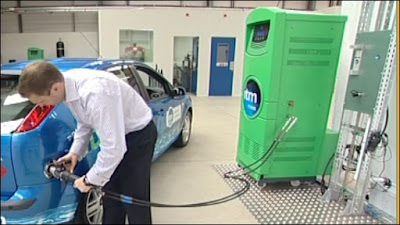
ITM Hydrogen Refueling Station
Hydrogen refuel station unveiled

By BBC News
7-9-08


A hydrogen refuelling station which could be installed in the home as an alternative to visiting a petrol station has been unveiled.

Users will need a hydrogen-powered car to go with it although the system can also be used for heating and cooking.

Hydrogen has long been touted as an alternative energy source to carbon-hungry fossil fuels.

One of the biggest obstacles to wider adoption of fuel-cell vehicles is the lack of hydrogen fuelling stations.

To be used as a fuel, hydrogen must first be produced using another energy source.

While some scientists are hopeful of the fuel uses of hydrogen, many others are sceptical because it is inefficient to produce, expensive to transport and to convert into electricity.

A home refuelling station could provide much needed infrastructure to kick-start a hydrogen-based economy, thinks Sheffield-based ITM Power, the firm behind the system.

Hydrogen fridge

The hydrogen home refuelling station works via an electrolyser which produces the gas from water and electricity.

An internal combustion generator converts the gas back into electricity to provide power for the home.

ITM Power has set up a showcase hydrogen home in Sheffield, where the gas is used for heating, cooking and to operate a fridge.

In terms of producing hydrogen to power a car, the unit can make enough gas overnight to provide fuel for 25 miles.

The hope is eventually to have higher-pressure refuelling units in public places which would be capable of offering enough hydrogen for cars to travel 100 miles.

Such units would be more expensive as they would require a hydrogen compressor which costs around £20,000.

But ITM thinks its system has the potential to revolutionise the move to more green energy.

"Given the pressing need to reduce our dependence on fossil fuels, especially oil, and to cut CO2 emissions, the future for hydrogen as an alternative means of storing and utilising energy cost-effectively has never been brighter," said Jim Heathcote, chief executive of ITM.

David Hart, a research fellow at Imperial College, London studying hydrogen energy, questioned the cost involved and how energy efficient it would be.

"The critical element of this is how much it would cost to put such a refuelling station in your home. The technology is very plausible but there are some issues about public acceptance," he said.

The fact that the refuelling station uses electricity meant it would not be a much-sought after zero emissions system unless the electricity itself is produced in a more green way, he added.

According to Mr Heathcote, the unit - which is currently only a prototype - could be commercially available as soon as the end of this year.

If they were mass produced he estimates they would initially cost around £2000.

He see the first market for the product as being large companies which use a lot of vehicles such as the Post Office.

But eventually it will become common in homes, he thinks. He said that the next stage of the firm's work would be to produce a liquid fuel.

Hydrogen cars

At the launch of the home refuel station, ITM also showed off a hybrid Ford Focus car converted to run on hydrogen.

The car needed three pieces of hardware to make it petrol-free - a hydrogen tank, which cost around £3000, four hydrogen injectors (about £100 each) and a chip to allow the conversion.

Last month, Japanese car manufacturer Honda began the first commercial production of a zero-emission, hydrogen fuel-cell powered vehicle.

Honda claims the vehicle offers three times better fuel efficiency than a traditional, petrol-powered car and plans to produce 200 of the cars over the next three years.

Prime minister Gordon Brown has said that he wants all new cars sold in Britain by 2020 to be electric or hybrid vehicles producing less than 100 grams of carbon dioxide per kilometre.

But Jon Gibbins, part of the hydrogen energy team at Imperial College, is not convinced that ITM's hybrid car will be the solution.

"Unless the hydrogen is used in a fuel cell then hydrogen vehicles are very inefficient. For a conventional engine, perhaps 20% of the energy in the electricity ends up driving the wheels versus maybe 75% for an electric vehicle."

"This seems unlikely to be a sustainable use of the limited supplies of renewable or low-carbon energy," he said.