Showing posts with label Paul Davies. Show all posts
Showing posts with label Paul Davies. Show all posts
Friday, July 25, 2014
Alien Artifacts On The Moon?


As nutty as it may seem to the uninitiated, the notion of looking for alien artifacts on our own Moon may finally be gaining mainstream scientific traction.
There are good reasons to seriously consider the possibility that at some point in the Earth-Moon system’s storied 4.5 billion year-old history, an alien intelligence may have passed through our solar system; leaving physical artifacts of their visits.
These artifacts would likely entail more than just alien space trash, and would arguably include evidence of alien scientific or industrial activity, such as extremely advanced lunar mining, energy generation; even technology related to lunar nearside Earth reconnaissance.
Or so says Paul Davies, a longtime SETI (Search for Extraterrestial Intelligence) researcher, physicist, and now Director of the Beyond Center at Arizona State University in Tempe. . . .

Thursday, December 29, 2011
Searching for Aliens On a Budget – Begin with The Moon
A peer reviewed paper/article (or the abstract thereof) is causing quite a stir in the electronic ether as of late. Theoretical physicist, cosmologist, astrobiologist and author (deep breath) as well as Director of the Beyond Center for Fundamental Concepts in Science at Arizona State University, Paul Davies, partnered with research technician in the Lunar Reconnaissance Orbiter Science Operations Center and undergraduate student (at ASU), Robert Wagner and they have offered up an argument to “widen the search for ET” all the while—keeping the economics of any such endeavor in mind.
Their paper will soon be published in the Acta Astronautica Journal, whose content is based on “original contributions in all fields of basic, engineering, life and social space sciences and of space technology . . ..”
Although the pair acknowledges the low probability of success for SETI’s (The Search for Extraterrestrial Intelligence) goals (and practices), at the same time they realize the “impact” it would have on the inhabitants of this planet; hence, they deem it prudent to “expand” the methodologies being employed and suggest we can start right here in our own backyard.
Although the reader might tend to expect a more complex proposition by these two scientists, their idea is quite simple—the goal: look for “alien technology” or footprint; the means: “search existing data bases.” In the Davies/Wagoner abstract they write:
For more on Paul Davies, see his web-site here.

Their paper will soon be published in the Acta Astronautica Journal, whose content is based on “original contributions in all fields of basic, engineering, life and social space sciences and of space technology . . ..”
Although the pair acknowledges the low probability of success for SETI’s (The Search for Extraterrestrial Intelligence) goals (and practices), at the same time they realize the “impact” it would have on the inhabitants of this planet; hence, they deem it prudent to “expand” the methodologies being employed and suggest we can start right here in our own backyard.
Although the reader might tend to expect a more complex proposition by these two scientists, their idea is quite simple—the goal: look for “alien technology” or footprint; the means: “search existing data bases.” In the Davies/Wagoner abstract they write:
“ . . . databases from astronomy, biology, earth and planetary sciences all offer low-cost opportunities to seek a footprint of extraterrestrial technology. In this paper we take as a case study one particular new and rapidly-expanding database: the photographic mapping of the Moon's surface by the Lunar Reconnaissance Orbiter (LRO) to 0.5 m resolution. Although there is only a tiny probability that alien technology would have left traces on the moon in the form of an artifact or surface modification of lunar features, this location has the virtue of being close, and of preserving traces for an immense duration.IF our alien cousins are like us in thought and spirit; that is to say, IF they have a yearn to explore the unknown, and expand their inner and outer horizons, then the moon becomes a very plausible site to search; as Davies and Wagner further point out, “the lunar environment could preserve artifacts for millions of years . . ..”
Systematic scrutiny of the LRO photographic images is being routinely conducted anyway for planetary science purposes, and this program could readily be expanded and outsourced at little extra cost to accommodate SETI goals, after the fashion of the SETI@home and Galaxy Zoo projects.”
For more on Paul Davies, see his web-site here.


Tuesday, January 26, 2010
The Search for Aliens Should Start On Earth Not Outer Space, Says Scientist
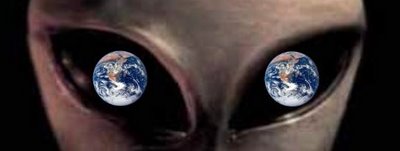
By www.telegraph.co.uk
1-25-10
The search for alien life forms should be conducted here on Earth rather than in outer space, scientists have claimed.
Prof Davies said: "We need to give up the notion that ET is sending us some sort of customised message and take a new approach."
Professor Paul Davies, a physicist at Arizona University will tell a meeting at the Royal Society that the best way of proving that extra-terrestrial life exists elsewhere in the universe is to use evidence from earth.1-25-10
The search for alien life forms should be conducted here on Earth rather than in outer space, scientists have claimed.
Prof Davies said: "We need to give up the notion that ET is sending us some sort of customised message and take a new approach."
The meeting at the Royal Society, which will include representatives from Nasa, the European Space Agency and the UN Office for Outer space Affairs marks the 5th anniversary of the Search for Extra-Terrestrial Intelligence (SETI) programme. Lord Rees, President of the Royal Society will also lead one of the sessions.
Prof Davies said: We need to give up the notion that ET is sending us some sort of customised message and take a new approach."
He suggested that the search could focus on deserts, volcanic vents, salt-saturated lakes and the dry valleys of Antarctica - places where ordinary life struggles to survive - to find "weird" microbes that belong to a "shadow biosphere".
Felissa Wolfe-Simon, from the US Geological Survey, is currently looking at the possibility that arsenic, found in contaminated places such as the Mono Lake in California, might support forms of life in the same way as other life forms use phosphorous.
However, Professor Colin Pillinger, who led the Beagle 2 Mars landing mission remains sceptical. He said: "I prefer to deal in scientific fact - this is wildly science fiction. You'd be off your trolley to go searching for arsenic-based life."
Prof Pillinger argues that Mars is the most likely place to find alien life.
The conference will also discuss how humans might respond to the discovery of extra-terrestrial intelligence.
Albert Harrison, the from University of California, said: "It is easy to imagine scenarios resulting in widespread psychological disintegration and social chaos. but historical prototypes, reactions to false alarms and survey results suggest that the predominant response to the discover of a microwave transmission from light years away is likely to be equanimity, perhaps even delight."

.png)